
Penny Dreadfuls, 1850 · page 166 of 394
The Mysteries of London; or, Lights and Shadows of London Life — page 166: what you’re looking at
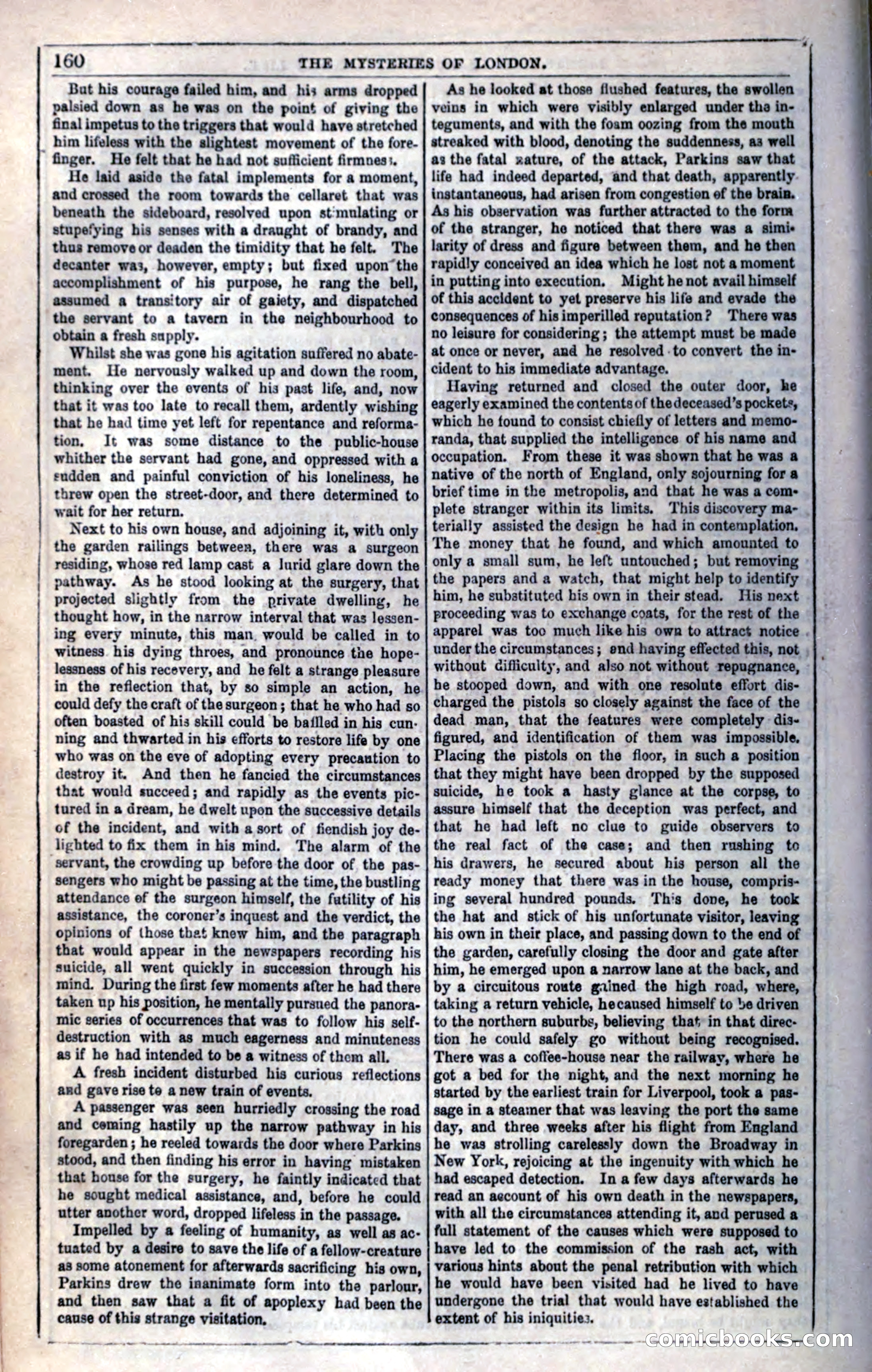
A restored page from Penny Dreadfuls, 1850. Page through the whole issue in the reader above.
📄 Transcribed text from this page (OCR, searchable)
Machine-transcribed from the original scan — historical spelling and the odd misread are preserved.
— oe - °° ° ° ° ° ° ° °° °°” — ~ finger. Bat his courage failed him, and his arms dropped palsied down as he was on the point of giving the final impetus to the triggers that would have stretched him lifeless with the slightest movement of the fore- He felt that he had not sufficient firmnes:. He laid aside the fatal implements for a moment, and crossed the room towards the cellaret that was beneath the sideboard, resolved upon st'mulating or stupefying his senses with a draught of brandy, and thus remove or deaden the timidity that he felt. The decanter wa3, however, empty; but fixed upon the accomplishment of his purpose, he rang the bell, assumed a transitory air of gaiety, and dispatched the servant to a tavern in the neighbourhood to obtain a fresh supply. Whilst she was gone his agitation suffered no abate- ment. He nervously walked up and down the room, thinking over the events of his past life, and, now that it was too late to recall them, ardently wishing that he had time yet left for repentance and reforma- tion. It was some distance to the public-house whither the servant had gone, and oppressed with a sudden and painful conviction of his loneliness, he threw open the street-door, and there determined to wait for her return. Next to his own house, and adjoining it, with only the garden railings between, there was a surgeon residing, whose red lamp cast a lurid glare down the pathway. As he stood looking at the surgery, that projected slightly from the private dwelling, he thought how, in the narrow interval that was lessen- ing every minute, this man. would be called in to witness his dying throes, and pronounce the hope- lessness of his recevery, and he felt a strange pleasure in the reflection that, by so simple an action, he could defy the craft of the surgeon; that he who had so often boasted of his skill could be bajflled in his cun- ning and thwarted in his efforts to restore life by one who was on the eve of adopting every precaution to destroy it. And then he fancied the circumstances that would succeed; and rapidly as the events pic- tured in a dream, he dwelt upon the successive details of the incident, and with a sort of fiendish joy de- lighted to fix them in his mind. The alarm of the servant, the crowding up before the door of the pas- sengers who might be passing at the time, the bustling attendance ef the surgeon himself, the futility of his assistance, the coroner’s inquest and the verdict, the opinions of those that knew him, and the paragraph that would appear in the newspapers recording his suicide, all went quickly in succession through his mind. During the first few moments after he had there taken up his position, he mentally pursued the panora- mic series of occurrences that was to follow his self- destruction with as much eagerness and minuteness as if he had intended to be a witness of them all. A fresh incident disturbed his curious reflections and gave rise te a new train of events. A passenger was seen hurriedly crossing the road and ceming hastily up the narrow pathway in his foregarden ; he reeled towards the door where Parkins stood, and then finding his error in having mistaken that house for the surgery, he faintly indicated that he sought medical assistance, and, before he could utter another word, dropped lifeless in the passage. Impelled by a feeling of humanity, as well as ac- tuated by a desire to save the life of a fellow-creature as some atonement for afterwards sacrificing his own, Parkins drew the inanimate form into the parlour, and then saw that a fit of apoplexy had been the cause of this strange visitation. am 4 + — a ee THE MYSTERIES OF LONDON, ee a ein As he looked at those flushed features, the swollen veins in which were visibly enlarged under the in- teguments, and with the foam oozing from the mouth streaked with blood, denoting the suddenness, as well as the fatal nature, of the attack, Parkins saw that life had indeed departed, and that death, apparently. instantaneous, had arisen from congestion of the brain. As his observation was further attracted to the form of the stranger, he noticed that there was a simi- larity of dress and figure between them, and he then rapidly conceived an idea which he lost not a moment in putting into execution. Might he not avail himself of this accident to yet preserve his life and evade the consequences of his imperilled reputation? There was no leisure for considering; the attempt must be made at once or never, and he resolved to convert the in- cident to his immediate advantage. Having returned and closed the outer door, he eagerly examined the contents of the deceased’s pockets, which he found to consist chiefly of letters and memo- randa, that supplied the intelligence of his name and occupation. From these it was shown that he was a native of the north of England, only sojourning for a brief time in the metropolis, and that he was a com- plete stranger within its limits. This discovery ma- _ terially assisted the design he had in contemplation, The money that he found, and which amounted to ; ” only a small sum, he left untouched; but removing — the papers and a watch, that might help to identify . him, he substituted his own in their stead. His next © proceeding was to exchange coats, for the rest of the apparel was too much like his own to attract notice under the circumstances; end having effected this, not without Gifliculty, and also not without repugnance, - he stooped down, and with one resolute effort dis- charged the pistols so closely against the face of the dead man, that the features were completely dis- figured, and identification of them was impossible, Placing the pistols on the floor, in such a position - that they might have been dropped by the supposed suicide, he took a hasty glance at the corpse, to assure himself that the deception was perfect, and that he had left no clue to guide observers to the real fact of the case; and then rushing to his drawers, he secured about his person all the ready money that there was in the house, compris- ing several hundred pounds. This done, he took the hat and stick of his unfortunate visitor, leaving his own in their place, and passing down to the end of the garden, carefully closing the door and gate after him, he emerged upon a narrow lane at the back, and by a circuitous route gained the high road, where, taking a return vehicle, hecaused himself to be driven to the northern suburbs, believing that in that direc- tion he could safely go without being recognised. There was a coffee-house near the railway, where he got a bed for the night, and the next morning he started by the earliest train for Liverpool, took a pas- sage in a steamer that was leaving the port the same day, and three weeks after his flight from England he was strolling carelessly down the Broadway in New York, rejoicing at the ingenuity with which he had escaped detection. Ina few days afterwards he read an aecount of his own death in the newspapers, with all the circumstances attending it, and perused a | full statement of the causes which were supposed to have led to the commission of the rash act, with various hints about the penal retribution with which he would have been visited had he lived to have undergone the trial that would have established the extent of his iniquities. ee oe . COMIC HOOKS.CO m ‘ * < « ; 4 —