
Penny Dreadfuls, 1850 · page 194 of 394
The Mysteries of London; or, Lights and Shadows of London Life — page 194: what you’re looking at
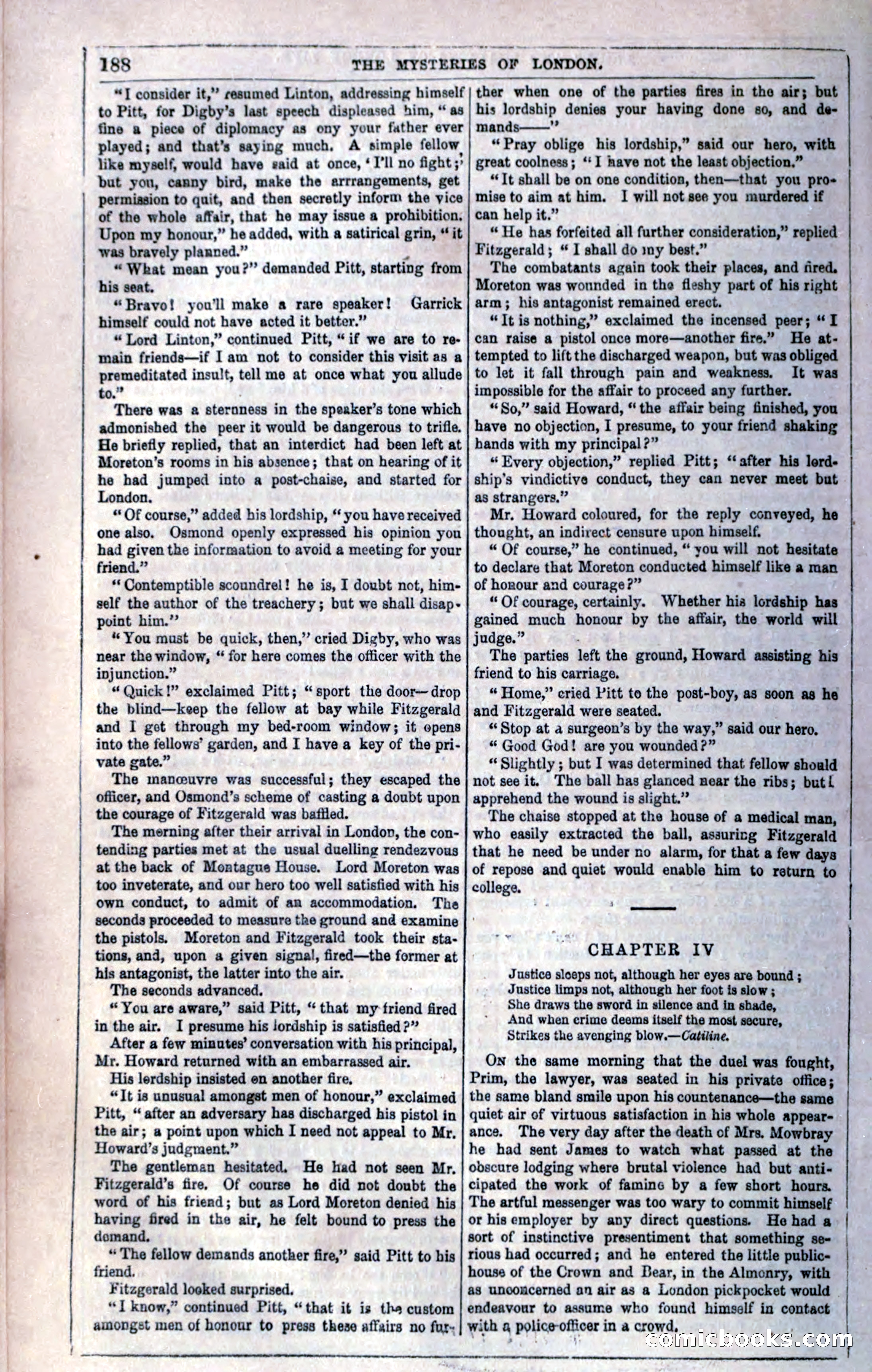
A restored page from Penny Dreadfuls, 1850. Page through the whole issue in the reader above.
📄 Transcribed text from this page (OCR, searchable)
Machine-transcribed from the original scan — historical spelling and the odd misread are preserved.
— —— ee ° oe ——_. oe ee eee i A ll A A yt CT i oa a 188 | MYSTE: ~ “J consider “” resumed Linton, addressing himself to Pitt, for Digby’s last speech displeased him, “ as fine a piece of diplomacy as ony your father ever played; and that’s saying much. A simple fellow like myself, would have said at once, ‘I'll no fight; } but you, canny bird, make the arrrangements, get permiasion to quit, and then secretly inform the yice of the whole affair, that he may issue a prohibition. Upon my honour,” he added, with a satirical grin, “ it was bravely planned.” “What mean you?” demanded Pitt, starting from his seat. “Bravo! you'll make a rare speaker! himself could not have acted it better.” “Lord Linton,” continued Pitt, “if we are to re- main friends—if I am not to consider this visit as a premeditated insult, tell me at once what you allude to. ” There was 2 steraness in the speaker’s tone which admonished the peer it would be dangerous to trifle. He briefly replied, that an interdict had been left at Moreton’s rooms in his absence; that on hearing of it he had jumped into a post-chaise, and started for London, “* Of course,” added his lordship, * you have received one also. Osmond openly expressed his opinion you had given the information to avoid a meeting for your friend.” **Contemptible scoundrel! he is, I doubt not, him- self the author of the treachery; but we shall disap-~ point him.” “You must be quick, then,’ cried Digby, who was near the window, “ for here comes the officer with the injunction.” “ Quick!” exclaimed Pitt; “sport the door— drop the blind—keep the fellow at bay while Fitzgerald and I get through my bed-room window; it opens into the fellows’ garden, and I havea key of the pri- vate gate.” The mancuvre was successful; they escaped the officer, and Osmond’s scheme of casting a doubt upon the courage of Fitzgerald was bafiled. The merning after their arrival in London, the con- tending parties met at the usual duelling rendezvous at the back of Montague House. Lord Moreton was too inveterate, and our hero too well satisfied with his own conduct, to admit of an accommodation. The seconds proceeded to measure the ground and examine the pistols. Moreton and Fitzgerald took their sta- tions, and, upon a given signal, fired—the former at his antagonist, the latter into the air. The seconds advanced. “You are aware,” said Pitt, “that my friend fired in the air. I presume his jordship is satisfied ?” After a few minutes’ conversation with his principal, Mr. Howard returned with an embarrassed air. His lerdship insisted en another fire, “It is unusual amongst men of honour,” exclaimed Pitt, “ after an adversary has discharged his pistol in the air; a point upon which I need not appeal to Mr, Howard’s judgment.” The gentleman hesitated. He had not seen Mr. Fitzgerald’s fire. Of course he did not doubt the word of his friend; but as Lord Moreton denied his having fired in the air, he felt bound to press the demand, “The fellow demands another fire,” said Pitt to his friend. Fitzgerald looked surprised. “I know,” continued Pitt, “that it is the custom amongst men of honour to press these affairs no fur- Garrick ee mee THE \YSTERIES or LONDON, ther when one of the parties fires in the air; but his lordship denies your having done so, and de- mands——”’ “Pray oblige his lordship,” said our hero, with great coolness; ‘‘I have not the least objection,” “It shall be on one condition, then—that you pro- mise to aim at him. I will not see you murdered if can help it.” “He has forfeited all further consideration,” replied Fitzgerald; “ I shall do my best.” The combatants again took their places, and fired, Moreton was wounded in the fleshy part of his right arm; his antagonist remained erect. “It is nothing,” exclaimed the incensed peer; “I can raise a pistol once more—another fire.” He at- tempted to lift the discharged weapon, but was obliged to let it fall through pain and weakness. It was impossible for the affair to proceed any further. “So,” said Howard, “the affair being finished, you have no objection, I presume, to your friend shaking hands with my principal?” “ Every objection,” replied Pitt; “after his lerd- ship’s vindictive conduct, they can never meet but as strangers.” Mr. Howard coloured, for the reply conveyed, he thought, an indirect censure upon himself. “Of course,” he continued, “ you will not hesitate to declare that Moreton conducted himself like a man of honour and courage?” “ Of courage, certainly. Whether hia lordship has gained much honour by the affair, the world will judge.” The parties left the ground, Howard assisting his friend to his carriage. “ Home,” cried Pitt to the post-boy, as soon as he and Fitzgerald were seated. “Stop at a surgeon’s by the way,” said our hero, “ Good God! are you wounded?” “Slightly ; but I was determined that fellow should not see it. The ball has glanced near the ribs; but apprehend the wound is slight.” The chaise stopped at the house of a medical man, — who easily extracted the ball, assuring Fitzgerald that he need be under no alarm, for that a few days of repose and quiet would enable him to return to college. i —_—_—_ CHAPTER IV Justice sleeps not, although her eyes are bound ; Justice limps not, although her foot is slow ; She draws the sword in silence and in shade, And when crime deems itself the most secure, Strikes the avenging blow.—Catiline, On the same morning that the duel was fought, Prim, the lawyer, was seated in his private office; the same bland smile upon his countenance—the same quiet air of virtuous satisfaction in his whole ance. The very day after the death of Mrs. M he had sent James to watch what passed at the obscure lodging where brutal violence had but anti- cipated the work of famine by a few short hours. The artful messenger was too wary to commit himself or his employer by any direct questions. He had a sort of instinctive presentiment that something se- rious had occurred; and he entered the little public- house of the Crown and Bear, in the Almonry, with as unconcerned an air as a London pickpocket would — endeavour to assume who found himself in contact with a police officer in a crowd, Jame Sn anne Gomicbooks:¢o