
Penny Dreadfuls, 1850 · page 195 of 394
The Mysteries of London; or, Lights and Shadows of London Life — page 195: what you’re looking at
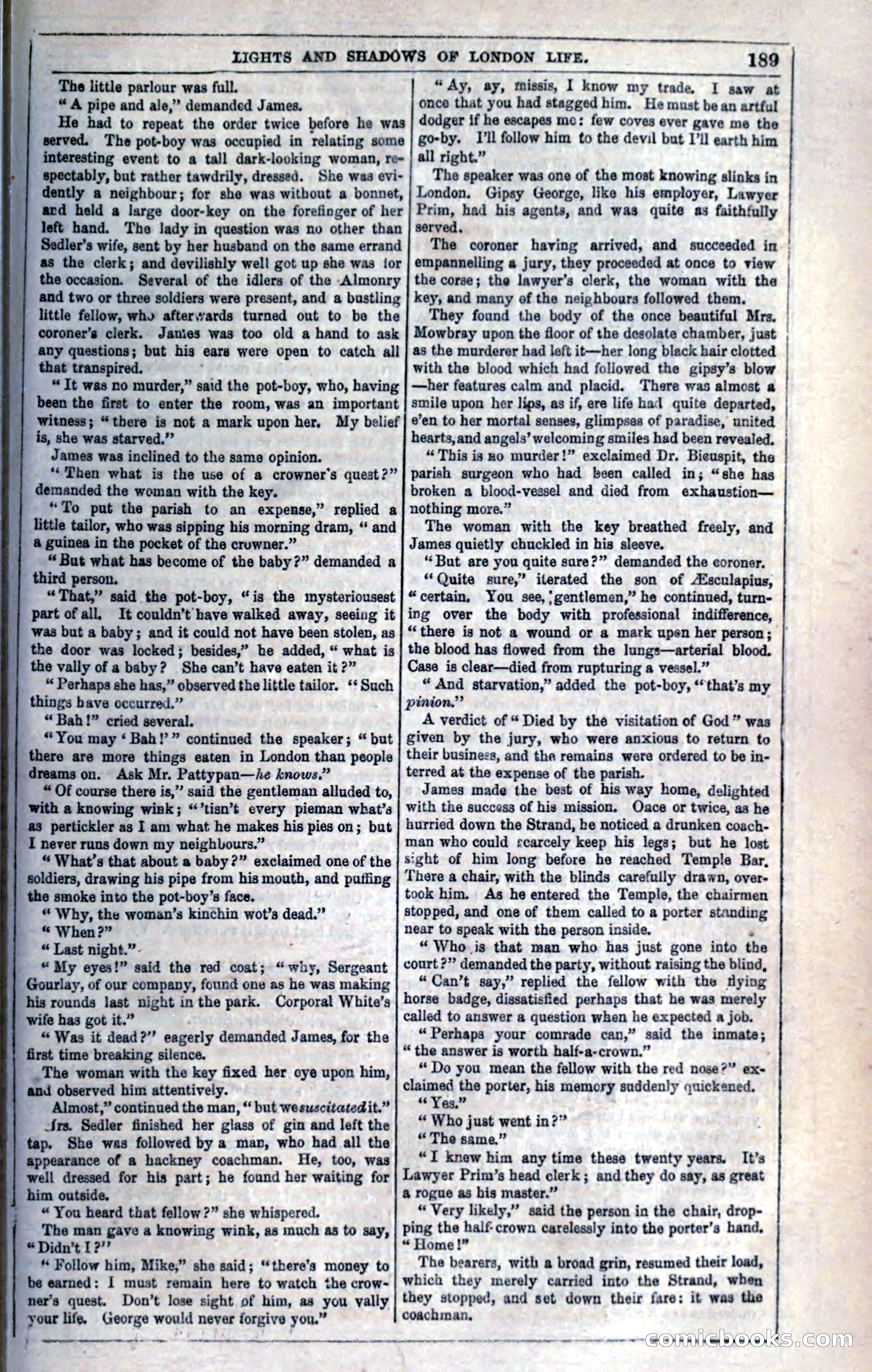
A restored page from Penny Dreadfuls, 1850. Page through the whole issue in the reader above.
📄 Transcribed text from this page (OCR, searchable)
Machine-transcribed from the original scan — historical spelling and the odd misread are preserved.
| | LIGHTS AND SHADOWS OF LONDON LIFE. 189 The little parlour was full. “A pipe and ale,” demanded James. He had to repeat the order twice before he was _ served. The pot-boy was occupied in relating some event to a tall dark-looking woman, re- spectably, but rather tawdrily, dressed. She was evi- dently a neighbour; for she was without a bonnet, ard held a large door-key on the forefinger of her left hand. The Jady in question was no other than _ Sedler’s wife, sent by her husband on the same errand as the clerk; and devilishly well got up she was {or the occasion. Several of the idlers of the -Almonry and two or three soldiers were present, and a bustling little fellow, who afterwards turned ont to be the coroner’s clerk. Janies was too old a hand to ask any questions ; but his eare were open to catch all once that you had stagged him. He must be an artful dodger if he escapes me: few coves ever gave me the go-by. I'll follow him to the devil but I’ll earth him all right.” The speaker was one of the most knowing slinks in London. Gipsy George, like his employer, Lawyer Prim, had his agents, and was quite as faithfully served. The coroner having arrived, and succeeded in empannelling a jury, they proceeded at once to view the corse; the lawyer’s clerk, the woman with the key, and many of the neighbours followed them. They found the body of the once beautiful Mrs, as the murderer had left it—her long black hair clotted with the blood which had followed the gipsy’s blow —her features calm and placid. There was almost a smile upon her lips, as if, ere life had quite departed, e’en to her mortal senses, glimpses of paradise, united hearts, and angels’ welcoming smiles had been revealed. “This is no murder!” exclaimed Dr. Bieuspit, the parish surgeon who had been called in; “she has broken a blood-vessel and died from exhaustion— nothing more.” The woman with the key breathed freely, and James quietly chuckled in his sleeve. “But are you quite sare?” demanded the coroner. “Quite sure,” iterated the son of A®sculapius, “certain, You see,’gentlemen,” he continued, turn- ing over the body with professional indifference, ‘ _ “It was no murder,” said the pot-boy, who, having _ been the first to enter the room, was an important _ Witness; “there is not a mark upon her, My belief is, she was starved,” James was inclined to the same opinion. “Then what is the use of a crowner's quest?” _ demanded the woman with the key. “To put the parish to an expense,” replied a _ little tailor, who was sipping his morning dram, “ and ‘& guinea in the pocket of the crowner.” _“ But what has become of the baby?” demanded a third person. “That,” said the pot-boy, “is the mysteriousest part ofall, It couldn’t have walked away, seeing it was but a baby; and it could not have been stolen, as the door was locked ; besides,” he added, “ what is the vally of a baby ? ‘She can’t have eaten it ?” __ “ Perhaps she has,” observed the little tailor. ‘‘ Such things bave occurred.” “Bah!” cried several. “You may ‘ Bah!’” continued the speaker; “ but ae are more things eaten in London than people dreams on. Ask Mr. Pattypan—he knows.” “ Of course there is,”’ said the gentleman alluded to, with a knowing wink; “’tisn’t every pieman what’s as pertickler as I am what he makes his pies on; but _I never runs down my neighbours.” _ “ What's that about a baby?” exclaimed one of the Soldiers, drawing his pipe from his mouth, and pufling the smoke into the pot-boy’s face. _ “Why, the woman’s kinchin wot’s dead.” “ When?” “ Last night.”- “ My eyes!” said the red coat; “why, Sergeant xourlay, of our company, found one as he was making his rounds last night in the park. Corporal White’s wife has got it.” “ Was it dead?” eagerly demanded James, for the first time breaking silence. The woman with the key fixed her cye upon him, and observed him attentively. Almost,” continued the man, “ but wesuscitatedit.” Irs. Sedler finished her glass of gin and left the tap. She was followed by a map, who had all the of a hackney coachman. He, too, was well dressed for his part; he found her waiting for “ You heard that fellow?” she whispered. The man gave a knowing wink, as much as to say, “Didn't Si | * Follow him, Mike,” she said; “there’s money to be earned: 1 must remain here to watch the crow- ‘ner’s quest. Don’t lose sight of him, as you yally } your life. George would never forgive you.” the blood has flowed from the lungs—arterial blood. Case is clear—died from rupturing a vessel.” “And starvation,” added the pot-boy, “that’s my pinion,” A verdict of “ Died by the visitation of God” was given by the jury, who were anxious to return to their business, and the remains were ordered to be in- terred at the expense of the parish. James made the best of his way home, delighted with the success of his mission. Oace or twice, as he hurried down the Strand, he noticed a drunken coach- man who could scarcely keep his legs; but he lost sight of him long before he reached Temple Bar, There a chair, with the blinds carefully drawn, over- took him. As he entered the Temple, the chairmen stopped, and one of them called to a porter standing near to speak with the person inside. “ Who.is that man who has just gone into the court ?” demanded the party, without raising the blind, “Can’t say,” replied the fellow with the fying horse badge, dissatisfied perhaps that he was merely called to answer a question when he expected a job. “Perhaps your comrade can,” said the inmate; “the answer is worth half-a-crown.” . “Do you mean the fellow with the red nose?” ex- claimed the porter, his memory suddenly quickened, “ Yes.” “ Who just went in?” “ The same,” “TI knew him any time these twenty years. It’s Lawyer Prim’s head clerk; and they do say, as great & rogue as his master.” “ Very likely,” said the person in the chair, drop- ping the half crown carelessly into the porter’s hand, “ Home !” The bearers, with a broad grin, resumed their load, which they merely carried into the Strand, when they stopped, and set down their fare; it was the coachiman, “Ay, ay, missis, I know my trade, I saw at Mowbray upon the floor of the desolate chamber, just , “there is not a wound or a mark upen her person; | — ——_— TT a OIE LOOLES (©) . ‘ iy