
Penny Dreadfuls, 1850 · page 228 of 394
The Mysteries of London; or, Lights and Shadows of London Life — page 228: what you’re looking at
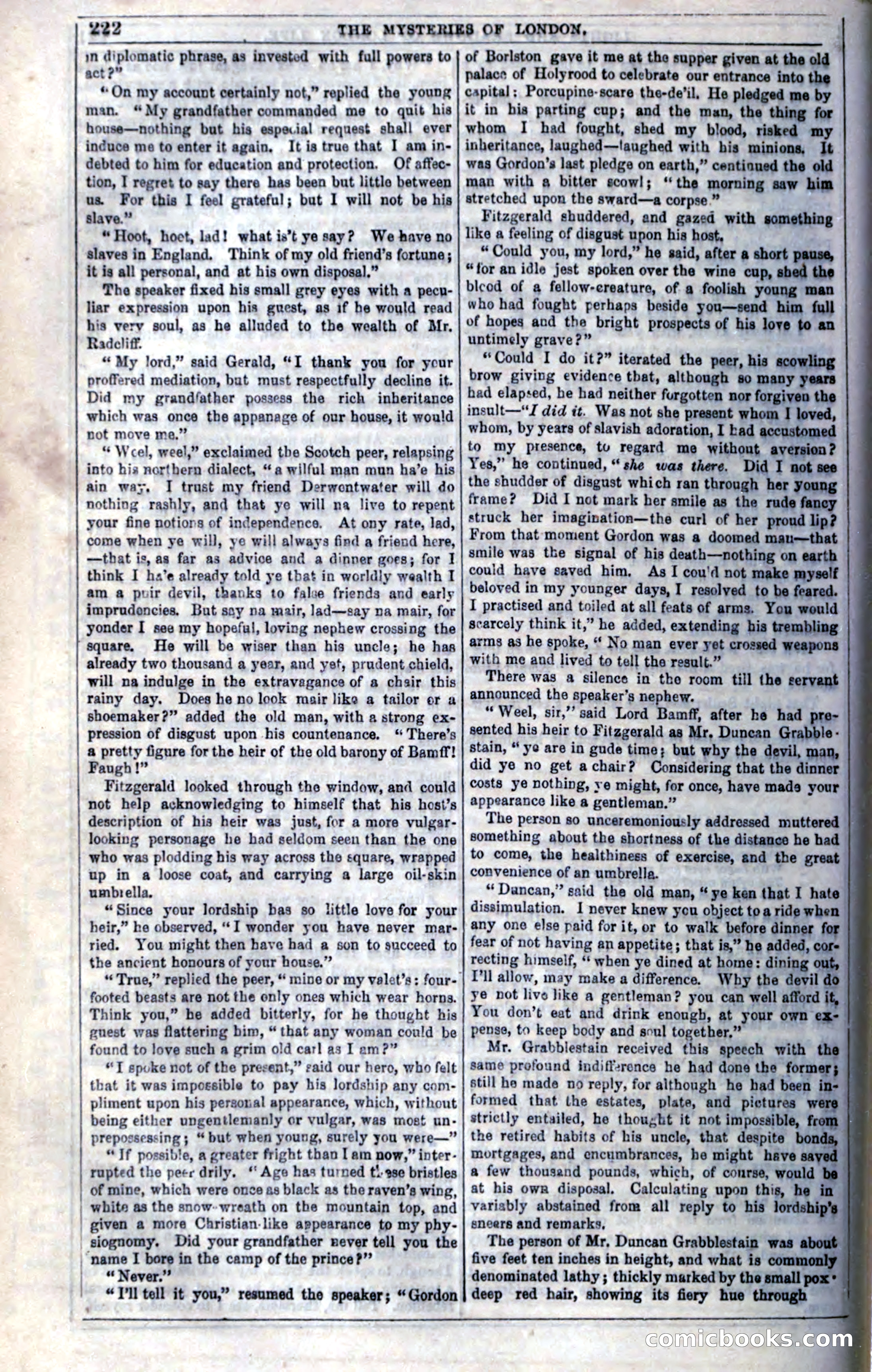
A restored page from Penny Dreadfuls, 1850. Page through the whole issue in the reader above.
📄 Transcribed text from this page (OCR, searchable)
Machine-transcribed from the original scan — historical spelling and the odd misread are preserved.
ee ee eee ee. - — ee eee ee at Ee yn diplomatic phrase, as invested with full powers to act?” “On my account certainly not,” replied the young man. “My grandfather commanded me to quit his house—nothing but his especial request shall ever induce me to enter it again, It is true that I am in- debted to him for education and protection. Of affec- tion, I regret to say there has been but little between us. For this I feel grateful; but I will not be his slave.” “Hoot, hoct, lad! what is’t yesay? We have no slaves in England. Think of my old friend’s fortune; it is all personal, and at his own disposal,” The speaker fixed his small grey eyes with a pecn- liar expression upon his guest, as if he would read his very soul, as he alluded to the wealth of Mr. Radcliff. “ My lord,” said Gerald, “I thank you for your proffered mediation, but must respectfully decline it. Did my grandfather possess the rich inheritance which was once the appanage of our house, it would not move me,” “ Weel, weel,” exclaimed the Scotch peer, relapsing into hia northern dialect, “a wilful man mun ha’e his ain way, I trast my friend Derwontwater will do nothing rashly, and that ye will na live to repent your fine notions of independence. At ony rate, lad, come when ye will, ye will always find a friend here, —that is, as far as advice and a dinner goes; for I think I ha’e already told ye that in worldly wealth I am a puir devil, thanks to false friends and early imprudoncies, But say na mair, lad—say na mair, for yonder I see my hopeful, loving nephew crossing the square. He will be wiser than his uncle; he has already two thousand a year, and yet, prudent chield, will na indulge in the extravagance of a chair this rainy day. Does he no look mair like a tailor or a shoemaker?” added the old man, with a strong ex- pression of disgust upon his countenance, ‘“ There’s a pretty figure for the heir of the old barony of Bamff! Faugh !” Fitzgerald looked through the window, and could not help acknowledging to himself that his host’s description of his heir was just, for a more vulgar- looking personage he had seldom seen than the one who was plodding his way across the square, wrapped up in a loose coat, and carrying a large oil-skin umbrella. “Since your lordship bas so little love for your heir,” he observed, “I wonder you have never mar- ried. You might then have had a son to succeed to the ancient honours of your house.” “True,” replied the peer, “ mine or my valet’s: four- footed beasts are not the only ones which wear horns. Think you,” he added bitterly, for he thought his gnest was flattering bim, “ that any woman could be found to love such a grim old carl as I am?” “T spvke not of the present,” said our hero, who felt that it was impossible to pay his lordship any com- pliment upon his personal appearance, which, without being either ungentlemanly or vulgar, was most un- prepossessing; “but when young, surely you were—” “If possible, a greater fright than I am now,” inter- rupted the peer drily. ‘Age has turned t!.9se bristles of mine, which were once as black as the raven’s wing, white as the snow-wreath on the mountain top, and given a more Christian-like appearance to my phy- siognomy. Did your grandfather never tell you the ‘name I bore in the camp of the prince?” | Never.” | “T'll tell it you,” resumed the speaker; “Gordon THE MYSTERIES OF LONDO (DON, {3 ——— A hh — iy LS LL A STL Ct et te atta, of Borlston gave it me at the ven at palace of Holyrood to Mattos te oes a se capital; Porcupine-scare the-de’il, He pledged me by it in his parting cup; and the man, the thing for whom I had fought, shed my blood, risked m inheritance, laughed—taughed with his minions, was Gordon’s last pledge on earth,” centioned the old man with a bitter scowl; “the morning saw him stretched upon the sward—a corpse.” Fitzgerald shuddered, and gazed with something like a feeling of disgust upon his host, . “Could you, my lord,” he said, after a short pause “for an idle jest spoken over the wine od t bleod of a fellow-creature, of a foolish young man who had fought perhaps beside you—send him full of hopes and the bright prospects of his love to an untimely grave?” * Could I do it?” iterated the scowling brow giving evidence that, abe mS years had elapsed, he had neither furgotten nor forgiven insult—“J did it. Was not she present whom I lov whom, by years of slavish adoration, I had accusto to my presence, tu regard me without aversion Yes,” he continued, “ she was there. T not see the shudder of disgust which ran ‘iva ee young frame? Did I not mark her smile as the rude fancy struck her imagination—the curl of her proud lip? From that moment Gordon was a doomed —th smile was the signal of his death—nothing on | could have saved him, As I cou'd not make myself beloved in my younger days, I resolyed to b PUTA MET - Nam =e snail I practised and toiled at all feats of arms, Yo would | scarcely think it,” he added, extending his trembling | arms as he spoke, “ No man ever yet crossed weapons | with me and lived to tell the result.” 7 There was a silence in the room till the servant | announced the speaker’s nephew. . a “‘ Weel, sir,’’ said Lord Bamff, after he had sented his heir to Fitzgerald as Mr, Dunean G stain, “ ye are in gude time; but why th I, mar did ye no get a chair? Considering oe See inner | costs ye nothing, ye might, for once, haye made your | appearance like a gentleman.” | The person so unceremoniously addressed muttered something about the shortness of the distance he had to come, the healthiness of exercise, and the great convenience of an umbrella. “Dancan,” said the old man, “ye ken that I hate dissimulation. I never knew you object toa ride when any one else paid for it, or to walk before dinner for fear of not having an appetite; that is,” he added, or recting himself, “ when ye dined at home: dining out I'll allow, may make a difference. Vbhy the devil d ye not live like a gentleman? you can well afford i You don’t eat and drink enough, at your own ex: pense, to keep body and soul together,” | Mr. Grabblestain received this speech with the same profound indifference he had done the former; still he made no reply, for although he had in- formed that the estates, plate, and pictures re strictly entailed, he thought it not impossible, fron the retired habits of his uncle, that despite bon is, mortgages, and encumbrances, he might have save a few thousand pounds, which, of conrse, would be at his owr disposal. Calculating upon this, he variably abstained from all reply to his lordship’s sneers and remarks, fie The person of Mr, Duncan Grabblestain was about five feet ten inches in height, and what is commonl denominated lathy ; thickly marked by the small pox deep red hair, showing its fiery hue through — | books.com (E@) AACE S