
Penny Dreadfuls, 1850 · page 229 of 394
The Mysteries of London; or, Lights and Shadows of London Life — page 229: what you’re looking at
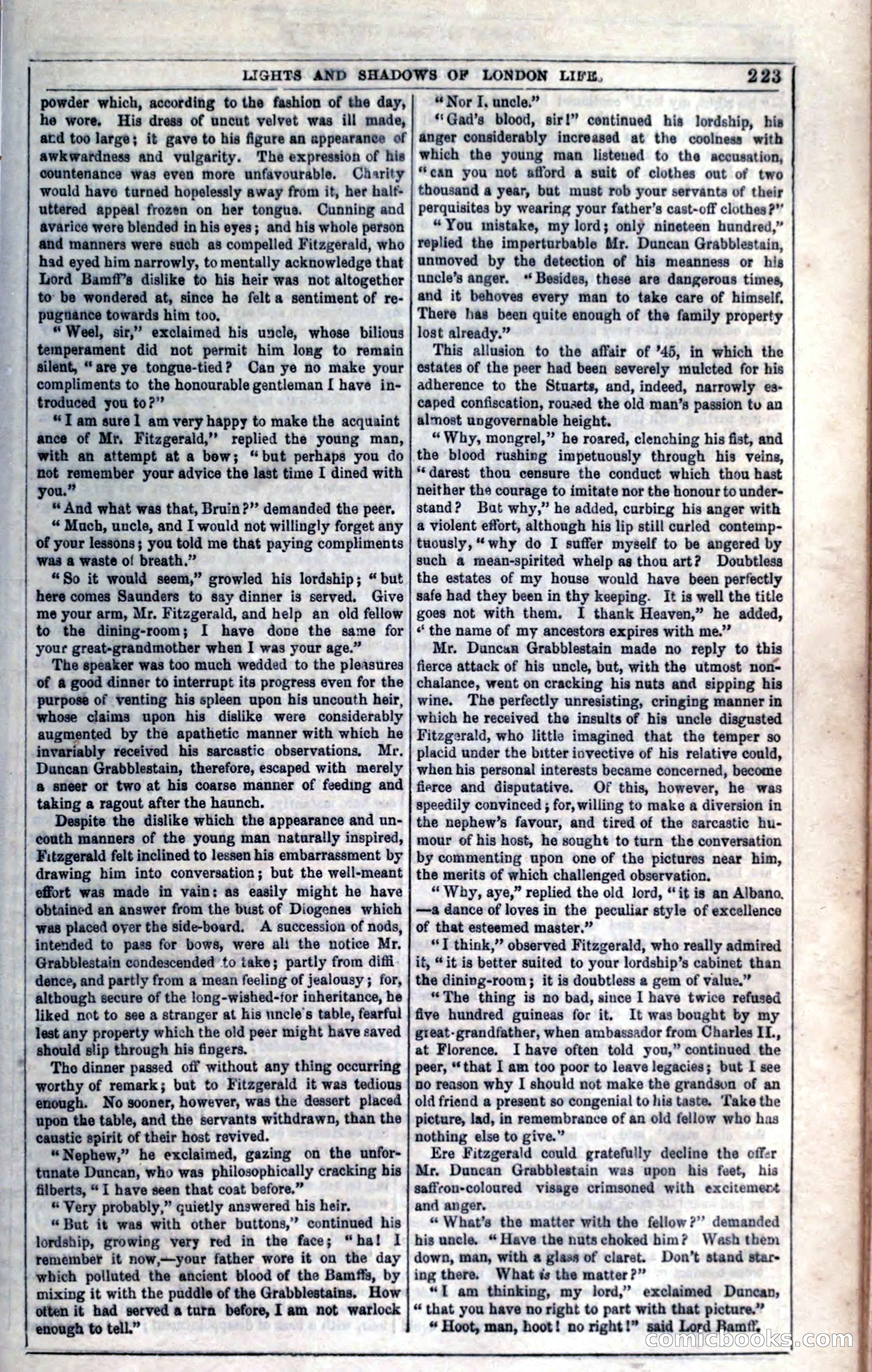
A restored page from Penny Dreadfuls, 1850. Page through the whole issue in the reader above.
📄 Transcribed text from this page (OCR, searchable)
Machine-transcribed from the original scan — historical spelling and the odd misread are preserved.
ee mn rw - = ae es powder which, according to the fashion of the day, he wore, His dress of uncut velvet was ill made, atd too large; it gave to his figure an appearance of awkwatdness and vulgarity. The expression of his countenance Was even more unfavourable. Charity would have turned hopelessly away from it, her halt- uttered appeal frozen on her tongues. Cunning and avarice were blended in his eyes; and his whole person and manners were such as compelled Fitzgerald, who had eyed him narrowly, to mentally acknowledge that Lord Bamff’s dislike to his heir was not altogether to be wondered at, since he felt a sentiment of re- e towards him too. * Weel, sir,” exclaimed his uncle, whose bilious temperament did not permit him long to remain silent, “are ye tongue-tied? Can ye no make your compliments to the honourable gentleman [ have in- troduced you to?” | *“T am sure 1 am very happy to make the acquaint ance of Mr, Fitzgerald,” replied the young man, with ah attempt at a bow; “but perhaps you do ‘not eociecabee your advice the last time I dined with “ And what was that, Bruin?’’ demanded the peer. “ Much, uncle, and I would not willingly forget any of your lessons; you told me that paying compliments was a waste o! breath.” “So it would seem,” growled his lordship; “ but here comes Saunders to say dinner is served. Give me your arm, Mr. Fitzgerald, and help an old fellow to the dining-room; I have done the same for your great-grandmother when I was your age.” The speaker was too much wedded to the pleasures of a good dinner to interrupt its progress even for the purpose of venting his spleen upon his uncouth heir, whose claims upon his dislike were considerably a by the apathetic manner with which he . received his sarcastic observations. Mr. Duncan Grabblestain, therefore, escaped with merely a sneer or two at his coarse manner of feeding and taking a ragout after the haunch. Despite the dislike which the appearance and un- eouth manners of the young man naturally inspired, Fitzgerald felt inclined to lessen his embarrassment by drawing him into conversation; but the well-meant effort was made in vain: as easily might he have obtained an answer from the bust of Diogenes which was placed oyer the side-board. A succession of nods, intended to pass for bows, were ali the notice Mr. Grabblestain condescended to take; partly from diffi dence, and partly from a mean feeling of jealousy ; for, although secure of the long-wished-for inheritance, he liked not to see a stranger at his uncle's table, fearful lest any property which the old peer might have saved should slip through his fingers. The dinner passed off without any thing occurring worthy of remark; but to Fitzgerald it was tedious enough. No sooner, however, was the dessert placed upon the table, and the servants withdrawn, than the caustic spirit of their host revived. “Nephew,” he exclaimed, gazing on the unfor- tunate Duncan, who was philosophically cracking his filberts, “I have seen that coat before.” “ Very probably,” Guietly answered his heir. “But it was with other buttons,” continued his lordship, growing very red in the face; “ha! I remember it now,—your father wore it on the day which polluted the ancient blood of the Bamfis, by mixing it with the puddle of the Grabblestains. How otten it had served a turn before, I am not warlock enough to tell.” LIGHTS AND SHADOWS OF LONDON LIFE, 223 “ Nor I, uncle.” *Gad’s blood, sirl” continued his lordship, his anger considerably increased at the coolness with which the young man listened to the accusation, “can you not afford a suit of clothes out of two thousand a year, but must rob your servants of their perquisites by wearing your father’s cast-off clothes?” “You mistake, my lord; only nineteen hundred,” replied the imperturbable Mr. Duncan Grabblestain, unmoved by the detection of his meanness or his uncle’s anger. “ Besides, these are dangerous times, and it behoves every man to take care of himself, There has been quite enough of the family property lost already.” This allusion to the affair of ’45, in which the estates of the peer had been severely mulcted for his adherence to the Stuarts, and, indeed, narrowly es- caped confiscation, roused the old man’s passion tu an almost ungovernable height. “Why, mongrel,” he roared, clenching his fist, and the blood rushing impetuously through his veins, *“‘darest thou censure the conduct which thou hast neither the courage to imitate nor the honour to under- stand? Bat why,” he added, curbirg his anger with a violent effort, although his lip still curled contemp- tuously, “why do I suffer myself to be angered by such a mean-spirited whelp as thou art? Doubtless the estates of my house would have been perfectly safe had they been in thy keeping. It is well the title goes not with them. I thank Heaven,” he added, “the name of my ancestors expires with me.” Mr. Duncan Grabblestain made no reply to this fierce attack of his uncle, but, with the utmost non- chalance, went on cracking his nuts and sipping his wine. The perfectly unresisting, cringing manner in which he received the insults of his uncle disgusted Fitzgerald, who little imagined that the temper so placid under the bitter invective of his relative could, when his personal interests became concerned, become | fierce and disputative. speedily convinced ; for, willing to make a diversion in the nephew’s favour, and tired of the sarcastic hu- mour of his host, he sought to turn the conversation by commenting upon one of the pictures near him, the merits of which challenged observation. “Why, aye,” replied the old lord, “it is an Albano. —a dance of loves in the peculiar style of excellence of that esteemed master.” “] think,” observed Fitzgerald, who really admired it, “it is better suited to your lordship’s cabinet than the dining-room; it is doubtless a gem of value.” “The thing is no bad, since I have twice refused five hundred guineas for it. It was bought by my giteat-grandfather, when ambassador from Charles IL, at Florence. I have often told you,” continued the peer, “that I am too poor to leave legacies; but I see no reason why I should not make the grandsun of an old friend a present so congenial to his taste. Take the picture, lad, in remembrance of an old fellow who has nothing else to give.” Ere Fitzgerald could gratefully decline the offer Mr. Duncan Grabblestain was upon his feet, his saffron-coloured visage crimsoned with excitement and anger. “ What’s the matter with the fellow ?’’ demanded his uncle, “ Have the nuts choked him? Wash them down, man, with a glass of claret. Don’t stand star- ing there. What és the matter?” “I am thinking, my lord,” exclaimed Duncan, “that you have no right to part with that picture.” “ Hoot, man, hoot! no right!” maid Lord Bamff. ANUCLOOOLE Of this, however, he was |