
Penny Dreadfuls, 1850 · page 255 of 394
The Mysteries of London; or, Lights and Shadows of London Life — page 255: what you’re looking at
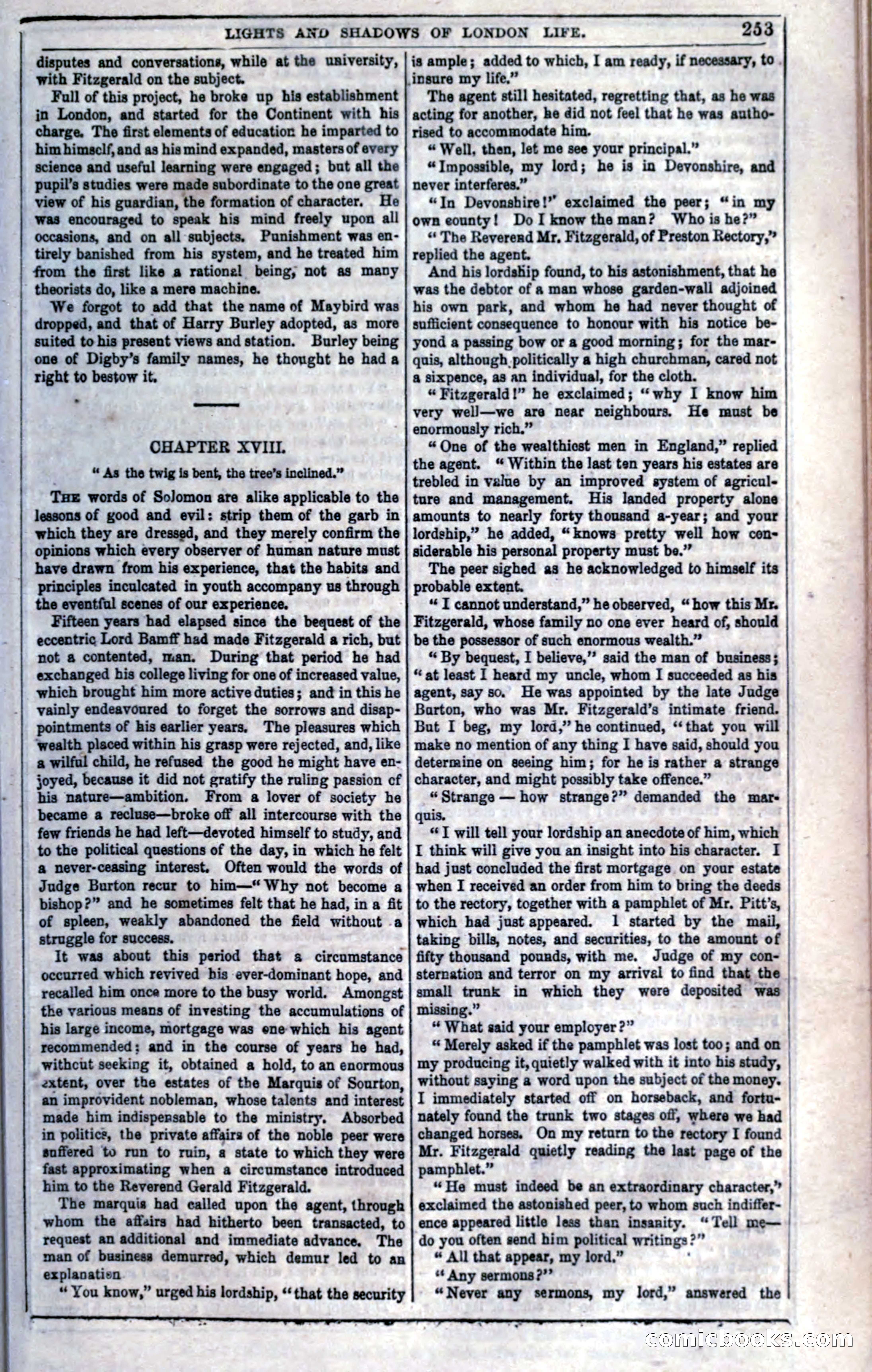
A restored page from Penny Dreadfuls, 1850. Page through the whole issue in the reader above.
📄 Transcribed text from this page (OCR, searchable)
Machine-transcribed from the original scan — historical spelling and the odd misread are preserved.
LIGHTS | AND SHADOWS OF LONDON LIFE. 253 disputes and conversations, while at while at the university, is ample; added to which, I am ready, if necessary, to with Fitzgerald on the subject. Full of this project, he broke up his establishment insure my life,” The agent still hesitated, regretting that, as he was in London, and started for the Continent with his | acting for another, he did not feel that he was autho- charge. The first elements of education he imparted to him himsclf, and as his mind expanded, masters of every science and useful learning were engaged; but all the _ pupil’s studies were made subordinate to the one great view of his guardian, the formation of character. He was encouraged to speak his mind freely upon all occasions, and on all subjects. Punishment was en- tirely banished from his system, and he treated him from the first like a rational being; not as many theorists do, like a mere machine. We forgot to add that the name of Maybird was dropped, and that of Harry Burley adopted, as more suited to his present views and station. Burley being one of Digby’s family names, he thought he hada right to bestow it. CHAPTER XVIIL “ As the twig is bent, the tree’s inclined.” Tae words of Solomon are alike applicable to the lessons of good and evil: strip them of the garb in which they are dressed, and they merely confirm the opinions which every observer of human nature must have drawn from his experience, that the habits and principles inculcated in youth accompany us through the eventful scenes of our experience. Fifteen years had elapsed since the bequest of the eccentric Lord Bamff had made Fitzgerald a rich, but not a contented, man. During that period he had exchanged his college living for one of increased value, which brought him more active duties; and in this he vainly endeavoured to forget the sorrows and disap- pointments of his earlier years. The pleasures which ‘wealth placed within his grasp were rejected, and, like ga wilful child, he refused the good he might have en- joyed, because it did not gratify the ruling passion cf his nature—ambition. From a lover of society he became a recluse—broke off all intercourse with the few friends he had left—devoted himself to study, and to the political questions of the day, in which he felt a never-ceasing interest, Often would the words of Judge Burton recur to him—“‘ Why not become a bishop?” and he sometimes felt that he had, in a fit of spleen, weakly abandoned the field without a struggle for success. It was about this period that a circumstance occurred which revived his ever-dominant hope, and recalled him once more to the busy world. Amongst the various means of investing the accumulations of his large income, mortgage was ene which his agent recommended; and in the course of years he had, withcut seeking it, obtained a hold, to an enormous extent, over the estates of the Marquis of Sourton, an improvident nobleman, whose talents and interest made him indispensable to the ministry. Absorbed in politics, the private affairs of the noble peer were suffered to run to ruin, a state to which they were fast approximating when a circumstance introduced him to the Reverend Gerald Fitzgerald. The marquis had called upon the agent, through whom the affairs had hitherto been transacted, to request an additional and immediate advance. The man of business demurred, which demur led to an explanatien “ You know,” urged his lordship, “that the security ° rised to accommodate him. “ Well, then, let me see your principal.” “Impossible, my lord; he is in Devonshire, and never interferes.” “In Devonshire!” exclaimed the peer; “in my own eounty! DolIknowtheman? Who is he?” “ The Reverend Mr, Fitzgerald, of Preston Rectory,” replied the agent. And his lordship found, to his astonishment, that he was the debtor of a man whose garden-wall adjoined his own park, and whom he had never thought of sufficient consequence to honour with his notice be- yond a passing bow or a good morning ; for the mar- quis, although politically a high churchman, cared not a sixpence, as an individual, for the cloth. “ Fitzgerald!” he exclaimed; “why I know him very well—we are near neighbours. He must be enormously rich,” “One of the wealthiest men in England,” replied the agent. “ Within the last ten years his estates are trebled in value by an improved system of agricul- ture and t. His landed property alone amounts to nearly forty thousand a-year; and your lordship,” he added, “knows pretty well how con- siderable his personal property must be.” The peer sighed as he acknowledged to himself its probable extent. “ T cannot understand,” he observed, “how this Mr. Fitzgerald, whose family no one ever heard of, should be the possessor of such enormous wealth.” “ By bequest, I believe,”’ said the man of business; “ at least I heard my uncle, whom I succeeded as his agent, say so. He was appointed by the late Judge Barton, who was Mr. Fitzgerald’s intimate friend. But I beg, my lord,” he continued, “that you will make no mention of any thing I have said, should you determine on seeing him; for he is rather a strange character, and might possibly take offence.” “Strange — how strange?” demanded the mars quis. “T will tell your lordship an anecdote of him, which I think will give you an insight into his character. I had just concluded the first mortgage on your estate when I received an order from him to bring the deeds to the rectory, together with a pamphlet of Mr. Pitt’s, which had just appeared. 1 started by the mail, taking bills, notes, and securities, to the amount of fifty thousand pounds, with me. Judge of my con- sternation and terror on my arrival to find that the small trunk in which they were deposited was | missing.” “ Merely asked if the pamphlet was lost too; and on my producing it, quietly walked with it into his study, without saying a word upon the subject of the money. I immediately started off on horseback, and fortu- nately found the trunk two stages off, where we had changed horses. On my return to the rectory I found | Mr. Fitzgerald quietly reading the last page of the | pamphlet.” “He must indeed be an extraordinary character,” | exclaimed the astonished peer, to whom such indiffer- ence appeared little less than insanity. “Tell me— | do you often send him political writings : y- | “ All that appear, my lord,” “ Any sermons ?”’ “Never any sermons, my lord,” answered the “ What said your employer?” | | CORMICOOOKS (CO) im