
Penny Dreadfuls, 1850 · page 256 of 394
The Mysteries of London; or, Lights and Shadows of London Life — page 256: what you’re looking at
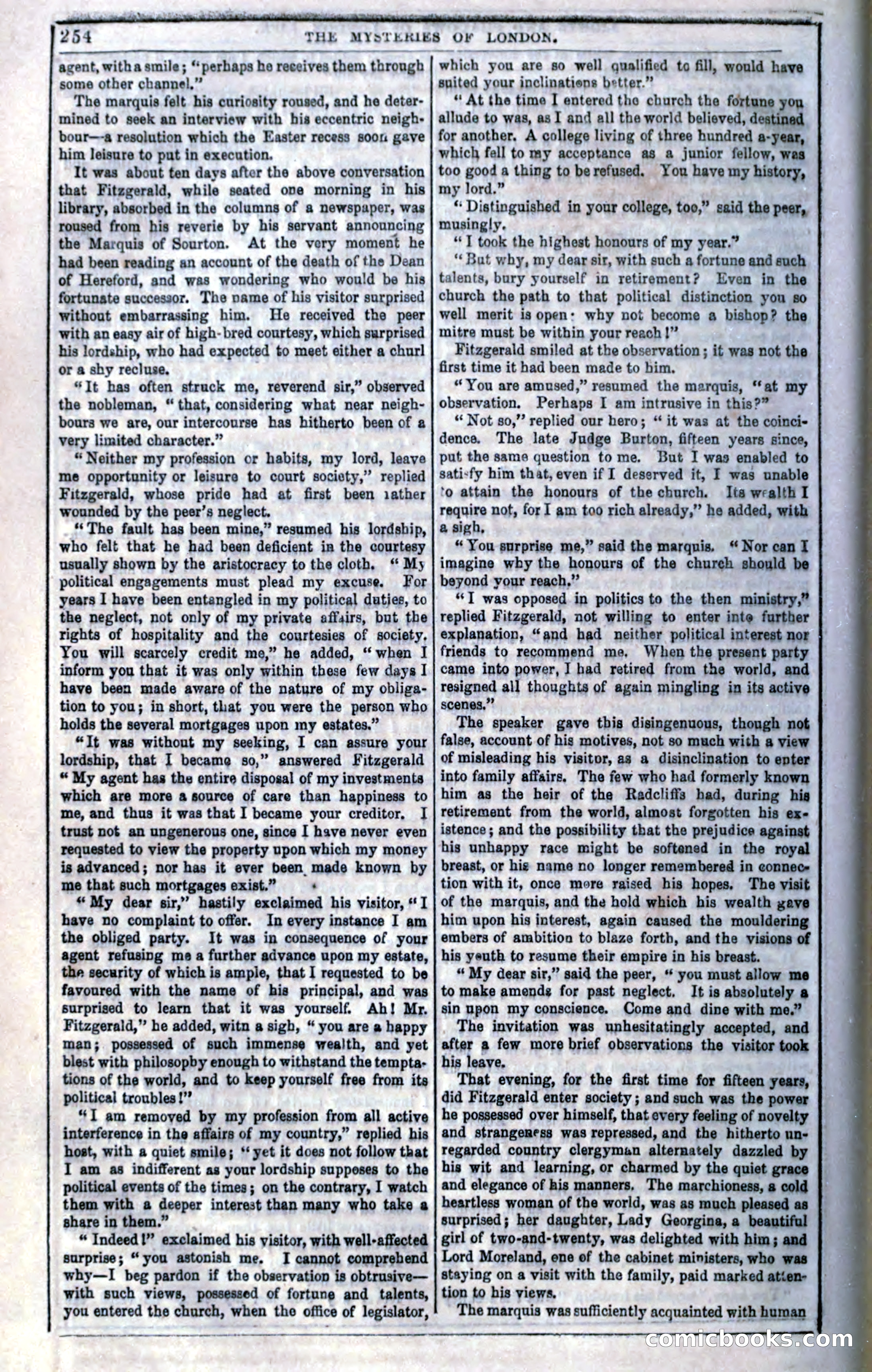
A restored page from Penny Dreadfuls, 1850. Page through the whole issue in the reader above.
📄 Transcribed text from this page (OCR, searchable)
Machine-transcribed from the original scan — historical spelling and the odd misread are preserved.
254 agent, witha smile; “perbaps he reeeives them through some other channel,” The marquis felt his curiosity roused, and he deter- mined to seek an interview with his eccentric neigh- bour—-a resolution which the Easter recess soon gave him leisure to put in execution. It was about ten days after the above conversation that Fitzgerald, while seated one morning in his library, absorbed in the columns of a newspaper, was roused from his reverie by his servant announcing the Marquis of Sourton. At the very moment he had been reading an account of the death of the Dean of Hereford, and was wondering who would be his fortunate successor. The name of his visitor surprised without embarrassing him. He received the peer with an easy air of high-bred courtesy, which surprised his lordship, who had expected to meet either a churl or a shy recluse, “Tt has often struck me, reverend sir,” observed the nobleman, “that, considering what near neigh- bours we are, our intercourse has hitherto been of a very limited character.” “ Neither my profession or habits, my lord, leave me opportunity or leisure to court society,” replied Fitzgerald, whose pride had at first been iather wounded by the peer’s neglect. **The fault has been mine,” resumed his lordship, who felt that he had been deficient in the courtesy usually shown by the aristocracy to the cloth, ‘ My political engagements must plead my excuse. For years I have been entangled in my political duties, to the neglect, not only of my private affairs, but the rights of hospitality and the courtesies of society, You will scarcely credit me,” he added, “ when I inform you that it was only within these few days I have been made aware of the nature of my obliga- tion to you; in short, that you were the person who holds the several mortgages upon my estates.” “It was without my seeking, I can assure your lordship, that I became so,” answered Fitzgerald “ My agent has the entire disposal of my investments which are more a source of care than happiness to me, and thus it was that I became your creditor, I trust not an ungenerous one, since I have never even requested to view the property upon which my money is advanced; nor has it ever been made known by me that such mortgages exist.” ‘ “ My dear sir,” hastily exclaimed his visitor, * I have no complaint to offer. In every instance I am the obliged party. It was in consequence of your agent refusing me a further advance upon my estate, the security of which is ample, that I requested to be favoured with the name of his principal, and was surprised to learn that it was yourself. Ah! Mr. Fitzgerald,” he added, witn a sigh, “ you are a happy man; possessed of such immense wealth, and yet blest with philosopby enough to withstand the tempta- tions of the world, and to keep yourself free from its political troubles !’’ “I am removed by my profession from all active interference in the affairs of my country,” replied his host, with a quiet smile; ** yet it does not follow that I am as indifferent as your lordship supposes to the political events of the times; on the contrary, I watch them with a deeper interest than many who take a share in them.” “ Indeed!” exclaimed his visitor, with well-affected surprise; “you astonish me. I cannot comprehend why—I beg pardon if the observation is obtrusive— with such views, possessed of fortune and talents, you entered the church, when the office of legislator, THE MYSTERIES OF LONDON, which you are so well qualified to fill, would have suited your inclinations better.” “ At the time I entered the church the fortune yon allude to was, as I and all the world believed, destin for another. A college living of three hundred a-year, which fell to my acceptance as a junior fellow, was too good a thing to berefused. You have my history, my lord.” “ Distinguished in your college, too,” said the peer, musingly. | “T took the highest honours of my year.” ‘“‘ Bat why, my dear sir, with such a fortune and such talents, bury yourself in retirement? Even in the church the path to that political distinction you so well merit is open: why not become a bishop? the mitre must be within your reach |” | Fitzgerald smiled at the observation ; it was not the first time it had been made to him, “You are amused,” resumed the marquis, “at my observation. Perhaps I am intrusive in this?” “ Not so,” replied our hero; “ it was at the coinci- dence. The late Judge Burton, fifteen years since, put the same question tome. But I was enabled to sati:fy him that, even if I deserved it, I was unable ‘o attain the honours of the church. Ita wealth I require not, for I am too rich already,” he added, with a sigh, “You surprise me,” said the marquis. “ Nor can I imagine why the honours of the chureh should be beyond your reach,” “‘T was opposed in politics to the then ministry,” replied Fitzgerald, not willing to enter inte further explanation, “and had neither political interest nor } friends to recommend me, When the present party came into power, J had retired from the world, and resigned all thoughts of again mingling in its active The speaker gave this disingenuous, though not false, account of his motives, not so much with a view of misleading his visitor, as a disinclination to epter into family affairs, The few who had formerly known him as the heir of the Radcliffs had, during hig retirement from the world, almost forgotten his ex- istence; and the possibility that the prejudice against his unhappy race might be softened in the royal breast, or hig name no longer remembered in connece tion with it, once more raised his hopes, The visit of the marquis, and the hold which his wealth gave him upon his interest, again caused the mouldering embers of ambition to blaze forth, and the visions of his yeuth to resume their empire in his breast. “* My dear sir,” said the peer, “ you must allow me to make amendg for past neglect, It is absolutely a sin upon my conscience. Come and dine with me.” The invitation was unhesitatingly accepted, and after a few more brief observations the visitor took his leave, That evening, for the first time for fifteen years, did Fitzgerald enter society ; and such was the power he possessed over himself, that every feeling of novelty and strangeness was repressed, and the hitherto un- | regarded country clergyman alternately dazzled by his wit and learning, or charmed by the quiet grace and elegance of his manners, The marchioness, a cold heartless woman of the world, was as much pleased as surprised; her daughter, Lady Georgina, a beautiful girl of two-and-twenty, was delighted with him; and Lord Moreland, ene of the cabinet ministers, who was staying on a visit with the family, paid marked atien- tion to his views. ‘-. The marquis was sufficiently acquainted with human OO! IOOKS*COIT