
Penny Dreadfuls, 1850 · page 317 of 394
The Mysteries of London; or, Lights and Shadows of London Life — page 317: what you’re looking at
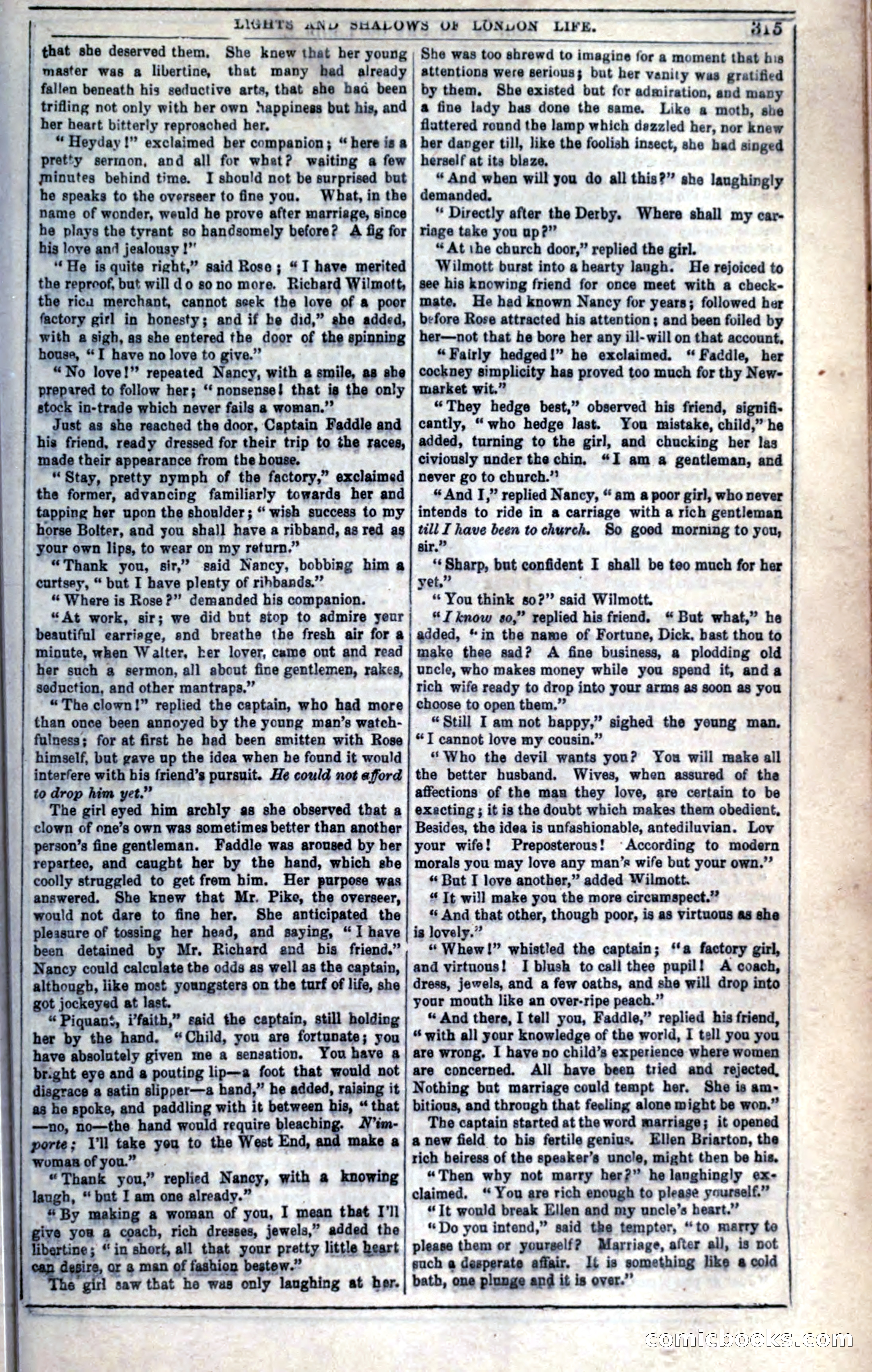
A restored page from Penny Dreadfuls, 1850. Page through the whole issue in the reader above.
📄 Transcribed text from this page (OCR, searchable)
Machine-transcribed from the original scan — historical spelling and the odd misread are preserved.
that she deserved them. She knew that her young master was a libertine, that many had already fallen beneath his seductive arts, that she bad been trifling not only with ber own happiness but his, and her heart bitterly reproached her, “ Heyday!” exclaimed ber companion; “ here is a pretty sermon, and all for what? waiting a few minutes behind time. I should not be surprised but he speaks to the overseer to fine you. What, in the name of wonder, weuld he prove after marriage, since his love and jealousy !”" “He is quite right,” said Rose; “1 have merited the reproof, but will do sono more. Richard Wilmott, pA hant, cannot seek the love of a poor bg he in honesty; and if he did,” she added, bose B99 she satored ‘he door of the spinning ve no love to give.” ete repeated Nancy, with a smile, as she fe iies © her; “‘ nonsense! that ig the only : in-trade which never fails a woman.” as she reached the door, Captain Faddle and his friend, ready dressed for their trip to the races, made their jematenee from the house. . Stay, pretty nymph of the factory,” exclaimed the former, advancing familiarly towards her and tappin upon the shoulder; “ wish success to my hives fol, and you shall havea ribband, as red as your owe own lips, to wear on my return,” Thank you, sir,” said Nancy, bobbing him a curtsey, “ but I have plenty of rihbands.” | “ Where is Rose?” demanded his companion. “At work, sir; we did but stop to admire yeur beautiful earriege, and breathe the fresh air for a minute, when Walter, ker lover, came out and read her such g sermon, all about fine gentlemen, rakes, seduction, and other mantraps.”’ “The clown!” replied the captain, who had more than once been annoyed by the young man’s watch- fulness; for at first he had been smitten with Rose . himself, but gave up the idea when he found it would interfere with his friend’s pursuit. He could not afford to drop him yet.” The girl eyed him archly as she observed that a clown of one’s own was sometimes better than another person’s fine gentleman. Faddle was aroused by her repartee, and caught her by the hand, which she ier has “ to get from him. Her purpose was answered. She knew that Mr. Pike, the overseer, anh pa not dare to fine her, She anticipated the pleasure ae of inating her head, and saying, “I have been detained by Mr. Richard and bis friend.” Nancy could 2 the odds as well as the captain, ; b, like most youngsters on the turf of life, she got j at last. “Piquan’, ifaith,” said the captain, still holding ere you are fortunate; you absolutely given me a sensation. You have a and @ pouting lip—a foot that would not »@ a satin slipper—a hand,” he added, it spoke, and paddling with it between ap Rothe hand would require bleachi, ey a ; I'll take you to the West End, a of ” you,” replied Nancy, with a knowing 5) mains rome y.” By a woman of you, I mean that I'll rich dresses, jewels,” added the ine 5 © in short, all that your prot little heart Wit 7 that he was only Tanghing at her. Fist fi or) ifs man of LIGHTS aNU SHALOWS UF LONUON LIFE. __—_—_—_—_— Ce nt lc a tae Ai EEA Net: oat Ne A le! es wa 2 Be Bae | She was too shrewd to imagine for a moment that his attentions were serious; but her vanity was gratified by them. She existed but for admiration, and many a fine lady has done the same. Like a moth, she flattered round the lamp which dezzled her, nor knew her danger till, like the foolish insect, she bad singed herself at its blaze, “ And when will you do all this?” she laughingly demanded. * Directly after the Derby. Where shall my car- riage take you up?” “At the church door,” replied the girl. Wilmott burst into a hearty langh. He rejoiced to see his knowing friend for once meet with a check- mate, He hed known Nancy for years; followed her before Rose attracted his attention; and been foiled by her—not that he bore her any ill-will on that account, “Fairly hedged!” he exclaimed. “ Faddle, her cockney simplicity has proved too much for thy New- market wit.” “They hedge best,” observed his friend, signifi- cantly, “who hedge last. You mistake, child,” he added, turning to the girl, and chucking her las civiously under the chin, “I am a gentleman, and never go to church.” “ And I,” replied Nancy, “ am a poor girl, who never intends to ride in a carriage with a rich gentleman till I have been to church. So good morning to you, sir.” ‘Sharp, but confident I shall be teo much for her yet, ” * You think so?” said Wilmott. * I know so,” replied his friend. “ But what,” he added, “in the name of Fortune, Dick, bast thou to make thee sad? A fine business, a plodding old uncle, who makes money while you spend it, anda rich wife ready to drop into your arms as soon as you choose to open them,” “Still I am not bappy,” sighed the young man. *T cannot love my cousin.” “Who the devil wants you? You will make all the better husband. Wives, when assured of the affections of the man they love, are certain to be exacting ; it is the doubt which makes them obedient, Besides, the idea is unfashionable, antediluvian. Loy your wife! Preposterous! ‘According to modern morals you may love any man’s wife but your own.”’ “ But I love another,” added Wilmott. “ It will make you the more circumspect.” And that other, though poor, is as virtuous as she is lovely.” “ Whew!” whistled the captain; ‘a factory girl, and virtuous! I blush to call thee pupil! A coach, dress, jewels, and a few oaths, and she will drop into your mouth like an over-ripe “ And there, I tell you, Faddle,” replied his friend, “with all your knowledge of the world, I tell you you are wrong, I have no child’s experience where women are concerned. All have been tried and rejected, Nothing but marriage could tempt her. She is am- bitious, and through that feoling alone might be won.” The captain started at the word marriage; it opened a new field to his fertile genius. Ellen Briarton, the rich heiress of the spesker’s uncle, might then be his. “Then why not marry her?” he langhingly ex- claimed. ‘“ You are rich enough to please yourself.” “It would break Ellen and my uncle’s heart.” | “Do you intend,” said the tempter, “to marry te please them or yourgelf? Marriage, after all, is not such @ desperate affair. It is something like @ cold bath, ¢ one plunge and it is over.” ECO NOOKS (CO) im