
Penny Dreadfuls, 1850 · page 318 of 394
The Mysteries of London; or, Lights and Shadows of London Life — page 318: what you’re looking at
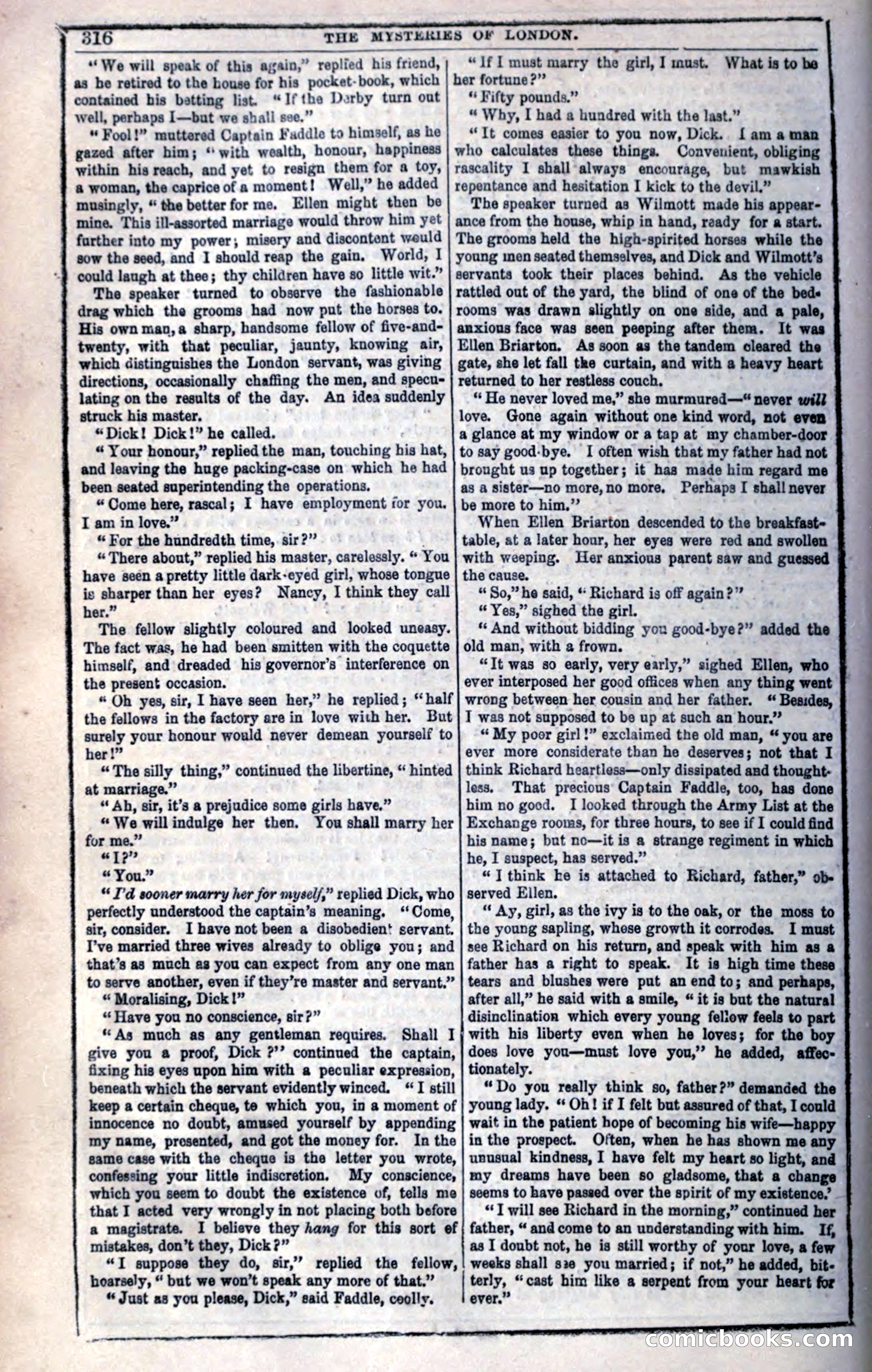
A restored page from Penny Dreadfuls, 1850. Page through the whole issue in the reader above.
📄 Transcribed text from this page (OCR, searchable)
Machine-transcribed from the original scan — historical spelling and the odd misread are preserved.
, 316 THE MYSTERIES OF LONDON. “We will speak of this again,” replied his friend, as he retired to the house for his pocket- book, which contained his betting list. “Ifthe Derby turn out well, perhaps I—but we shall see.” “ Fool!” muttered Captain Faddle to himself, as he gazed after him; “with wealth, honour, happiness within his reach, and yet to resign them for a toy, a woman, the caprice of a moment! Well,” he added musingly, “ the better for me. Ellen might then be mine. This ill-assorted marriage would throw him yet farther into my power; misery and discontent weuld sow the seed, and I should reap the gain. World, I could laugh at thee; thy children have so little wit.” The speaker turned to observe the fashionable drag which the grooms had now put the horses to. His own man,a sharp, handsome fellow of five-and- twenty, with that peculiar, jaunty, knowing air, which distinguishes the London servant, was giving directions, occasionally chaffing the men, and specu- lating on the results of the day. An idea suddenly “Dick! Dick!” he called. “ Your honour,” replied the man, touching his hat, and leaving the huge packing-case on which he had been seated superintending the operations. “ Come here, rascal; I have employment for you. I am in love.” “For the hundredth time, sir?” . “ There about,” replied his master, carelessly. * You have seen a pretty little dark-eyed girl, whose tongue is sharper than her eyes? Nancy, I think they call her.” 7 The fellow slightly coloured and looked uneasy. The fact was, he had been smitten with the coquette himself, and dreaded his governor’s interference on the present occasion. « Oh yes, sir, I have seen her,’ he replied; “half the fellows in the factory are in love with her. But surely your honour would never demean yourself to her!” “The silly thing,” continued the libertine, “ hinted . e”’ “ Ah, sir, it’s a prejudice some girls have.” “ We will indulge her then. You shall marry her for me.” “1?” “ You.” “ I'd sooner marry her for mysel/,” replied Dick, who perfectly understood the captain’s meaning, ‘Come, sir, consider. I have not been a disobedient servant, I’ve married three wives already to oblige you; and that’s as much as you can expect from any one man to serve another, even if they’re master and servant.” “ Moralising, Dick!” “ Have you no conscience, sir?” “As much as any gentleman requires. Shall I give you a proof, Dick ?’’ continued the captain, fixing his eyes upon him with a peculiar expression, beneath which the servant evidently winced. “TI still keep a certain cheque, te which you, in a moment of innocence no doubt, amused yourself by appending my name, presented, and got the money for. In the game case with the cheque is the letter you wrote, confessing your little indiscretion, My conscience, which you seem to doubt the existence of, tells me that I acted very wrongly in not placing both before a magistrate. I believe they hang for this sort of mistakes, don’t they, Dick?” “I suppose they do, sir,’ replied the fellow, hoarsely, “ but we won’t speak any more of that.” “ Just as you please, Dick,” said Faddle, coolly. at who calculates these things. rascality I shall always encourage, but mawkish repentance and hesitation I kick to the devil.” as I doubt not, he is still worthy of your love, afew terly, “cast him like a serpent from your ever.” “If I must marry the girl, I must. What is to be her fortune?” “ Fifty pounds.” “ Why, I had a hundred with the last.” “It comes easier to you now, Dick. [am aman Convenient, obliging The speaker turned as Wilmott made his appear- ance from the house, whip in hand, ready for a start. The grooms held the high-spirited horses while the young men seated themselves, and Dick and Wilmott’s servants took their places behind. As the vehicle rattled out of the yard, the blind of one of the bede rooms was drawn slightly on one side, and a pale, anxious face was seen peeping after them. It was Ellen Briarton. As soon as the tandem cleared the ~ gate, she let fall tke curtain, and with a heavy heart returned to her restless couch, . “ He never loved me,” she murmured—* never will love. Gone again without one kind word, not even a glance at my window or a tap at my chamber-door to say good-bye. I often wish that my father had not brought us up together; it has made him regard me as a sister—no more,no more, Perhaps I shall never be more to him,” When Ellen Briarton descended to the breakfast- table, at a later hour, her eyes were red and swollen with weeping. Her anxious parent saw and guessed § the cause. ,- “So,” he said, “ Richard is off again?” “ Yes,” sighed the girl. | “ And without bidding you good-bye?” added the old man, witha frown, “Tt was so early, very early,” sighed Ellen, who ever interposed her good offices when any thing went F wrong between her cousin and her father. “ Besides, § T was not supposed to be up at such an hour.’ “ My poor girl!” exclaimed the old man, “ you are ever more considerate than he deserves; not that I think Richard heartless—only dissipated and thought- less. That precious Captain Faddle, too, has done him no good. I looked through the Army List at the Exchange rooms, for three hours, to see if I could find his name; but no—it is a strange regiment in which he, I suspect, has served.” + “J think he is attached to Richard, father,” ob- §- served Ellen. , “ Ay, girl, as the ivy is to the oak, or the moss to the young sapling, whese growth it corrodes. I must J see Richard on his return, and speak with him as a father has a right to speak. It is high time these tears and blushes were put an end to; and perhaps, § after all,” he said with a smile, “ it is but the natural § disinclination which every young feliow feels to part — — with his liberty even when he loves; for the boy does love you—must love you,’? he added, affec- § tionately. “Do you really think so, father?” demanded the young lady. “ Oh! if I felt but assured of that, Icould 7 wait in the patient hope of becoming his wife—happy | in the prospect. Often, when he has shown me any } unusual kindness, I have felt my heart so light, and § my dreams have been s0 gladsome, that a change | seems to have passed over the spirit of my existence,’ } ‘“‘T will see Richard in the morning,” continued her | father, “ and come to an understanding with him. If, as weeks shall s2¢ you married; if not,” he added, bit- | —s COMMMKELOOVOLKS (Efe)