
Penny Dreadfuls, 1850 · page 320 of 394
The Mysteries of London; or, Lights and Shadows of London Life — page 320: what you’re looking at
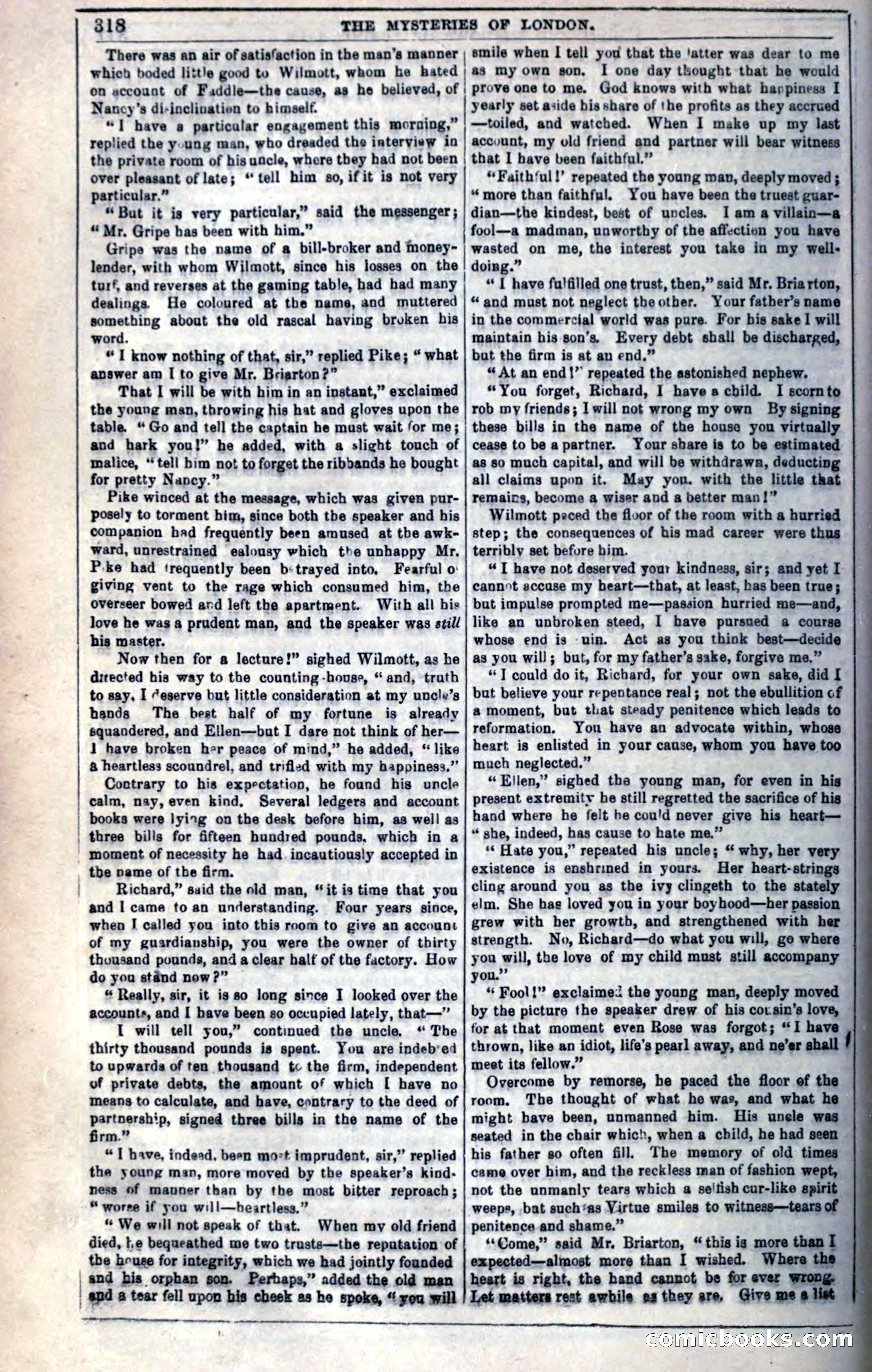
A restored page from Penny Dreadfuls, 1850. Page through the whole issue in the reader above.
📄 Transcribed text from this page (OCR, searchable)
Machine-transcribed from the original scan — historical spelling and the odd misread are preserved.
318 Nancy's di-inclination to bimeelf. “I have a particular engagement this morning,” | —toiled, and watched. When I make up my last | replied the young man, who dreaded the interview in | account, my vld friend and partner will bear witness | the private room of his uocle, whore they had not been | that | have been faithful.” over pleasant of late; “tell him so, ifit is not very particular.” “But it is very particular,” said the messenger; “ Mr. Gripe bas been with him.” Gripe was the name of a bill-broker and money- lender, with whom Wilmott, since his losses on the turf, and reverses at the gaming table, had had many dealings. He coloured at the name, and muttered something about the old rascal having broken his word. “ I know nothing of that, sir,” replied Pike; “ what answer am I to give Mr, Briarton?” That I will be with him in an instant,” exclaimed the young man, throwing his hat and gloves upon the table. “ Go and tell the captain he must wait for me; and hark you!” he added, with a slight touch of malice, “tell bim not to forget the ribbands he bought for pretty Nancy.” Pike winced at the message, which was given pur- posely to torment bim, since both tbe speaker and his companion had frequently been amused at the awk- ward, unrestrained ealousy which the unhappy Mr. P.ke had trequently been bstrayed into, Fearful o giving vent to the rage which consumed him, the overseer bowed and left the apartment. With all his love he was a prudent man, and the speaker was still his master. Now then for a lecture!” sighed Wilmott, as he ditected his way to the counting -house, “and, trath to say, I “eserve but little consideration at my uncle’s hands The best half of my fortune is already squandered, and Ellen—but I dare not think of her— 1 have broken her peace of mind,” he added, “ like & heartless scoundrel, and trifled with my happiness.” Contrary to his expectation, he found his uncle calm, nay, even kind, Several ledgers and account books were lying on the desk before him, as well as three bills for fifteen hundred pounds, which in a - moment of necessity he had. incautiously accepted in the pame of the firm. Richard,” said the old man, “it is time that you and | came to an understanding. Four years since, when I called you into this room to give an account of my guardianship, you were the owner of thirty thousand pounds, and a clear half of the factory. How do you stdnd now ?” “ Really, sir, it isso long since I looked over the accounts, and I have been so occupied lately, that—” I will tell you,” continued the uncle, “ The thirty thousand pounds is spent. You are indeb’ed to upwards of ten thousand tc the firm, independent vf private debts, the amount of which [ have no means to calculate, and have, contrary to the deed of partnership, signed three bills in the name of the firm.” “| have, indeed, been mort imprudent, sir,” replied the young man, more moved by the speaker’s kind- ness of mauner than by the most bitter reproach; “ woree if you will—beartless.” “ We will not speak of that. When my old friend died, t,e bequeathed me two trusts—the reputation of tbe beuse for integrity, which we had jointly founded snd bis orphan son. Perhaps,” added the old man | heert is right, the hand cannot be for ever ' | apd a tear fell upon his cheek as he spoke, “xou will | Let matters rest awbile ns they are, Give mee THE MYSTERIES OF LONDON, mE There was an air of satisfaction in the man’s manner | smile when I tell you that the ‘atter was dear to me | which boded little good to Wilmott, whom he hated | as my own son, I one day thought that he would | on account of Faddle—the cause, as he believed, of | prove one to me. God knows with what happiness I | an yearly set aside bis share of the profits as they accrued “Faithful!” repeated the young man, deeply moved; | “more than faithful. You have been the truest guar- dian—the kindest, best of uncles. I am a villain—a | fool—a madman, unworthy of the affection you have | wasted on me, the interest you take in my well- | doing.” “ I have fulfilled one trust, then,” said Mr. Bria rton, “and must not neglect the other. Your father’s name in the commercial world was pure. For bis sake! will maintain his son’s. Every debt shall be discharged, but the firm is at an end.” “At an end!” repeated the astonished nephew. “You forget, Richard, I havea child. I scornto rob my friends; I will not wrong my own By signing these bills in the name of the house you cease to be apartner. Your share is to be estimated as 80 much capital, and will be withdrawa, ‘tale the all claims upon it. May yon. with the little the remains, become a wiser and a better man!” Wilmott peced the floor of the room with a hurried step; the consequences of his mad career were thus terribly set before bim. “A “T have not deserved your kindness, sir; and yet I cannot accase my heart—that, at least, has been true; but impulse prompted me—passion hurried me—and, like an unbroken steed, | have pursned a course whose end is uin. Act as you think best—decide as you will; but, for my father’s sake, forgive me.” “JT could do it, Richard, for your own sake, did but believe your repentance real; not the ebullition « a moment, but that steady penitence which leads to reformation. You have an advocate within, whose heart is enlisted in your cause, whom you have too much neglected.” “Ellen,” sighed the young man, for even in hig present extremity he still regretted the sacrifice of his hand where he felt be cou'd never give his heart— “ she, indeed, has cause to hate me,” ‘‘ Hate you,” repeated his uncle; “ why, her very — existence is enshrined in yours. Her heart-stri cling around you as the ivy clingeth to the stately | elm. She bag loved you in your boyhood—her passion ~ grew with her growth, and strengthened with her strength. No, Richard—do what you will, go where you will, the love of my child must still accompany you.” “ Fool!” exclaimed the young man, deeply moved — by the picture the speaker drew of his corsin’s love, | for at that moment even Rose was forgot; “I have thrown, like an idiot, life’s pearl away, and ne’er shall ? meet its fellow.” ; ; Overcome by remorse, he paced the floor of the | room, The thought of what he was, and what he might bave been, unmanned him. His unele was | | seated in the chair which, when a child, he had seen” his father so often fill. The memory of old times | came over him, and the reckless man of fashion not the unmanly tears which a seltish cur-like weeps, bat such*as Virtue smiles to w - penitence and shame.” ‘*©ome,” said Mr. Briarton, “ this is more than i le SS ee ee ¥ wee me TR on a reer ee ooo — oa it~ os > eS » com boo (COMME XS