
Penny Dreadfuls, 1850 · page 321 of 394
The Mysteries of London; or, Lights and Shadows of London Life — page 321: what you’re looking at
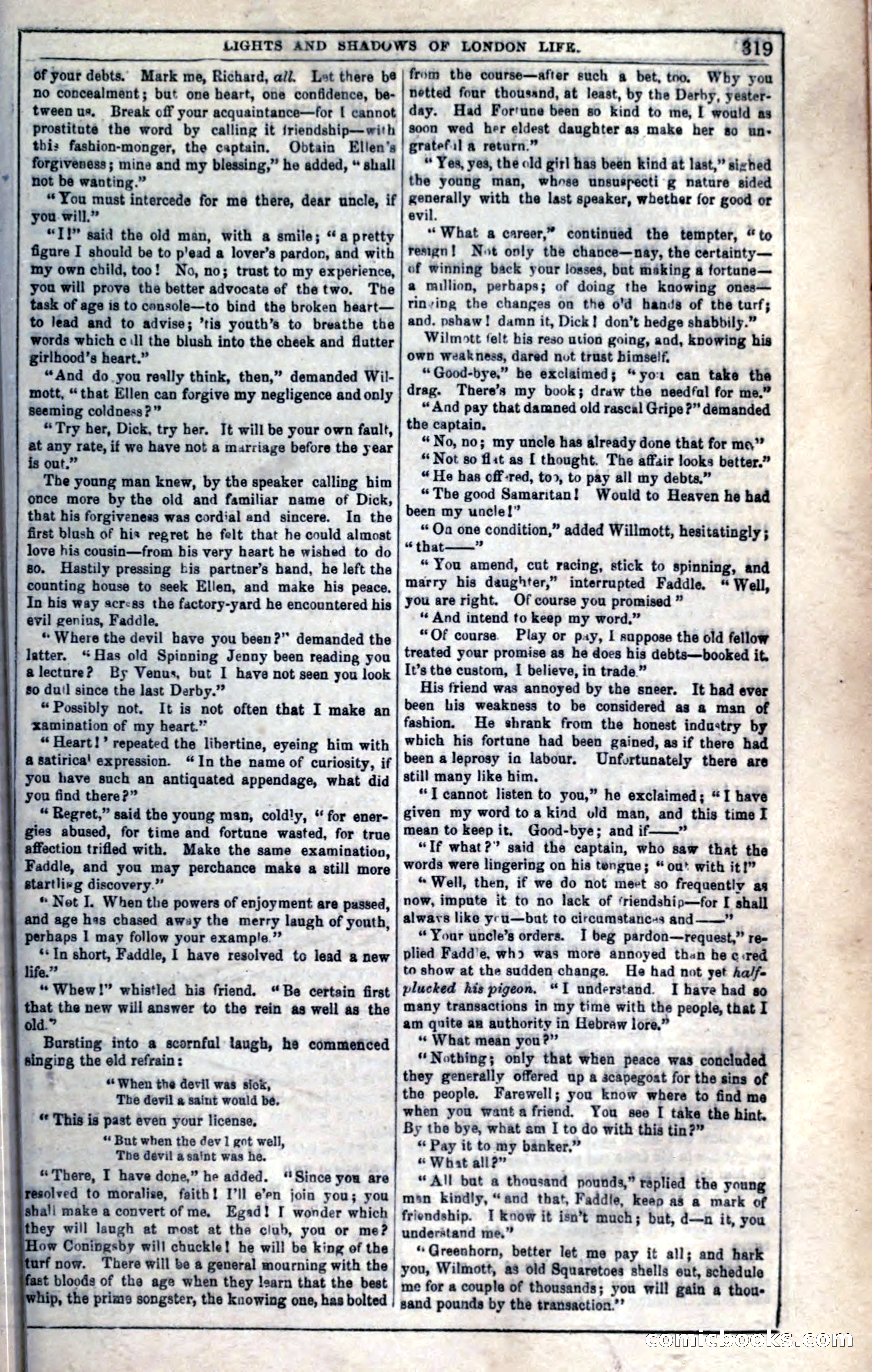
A restored page from Penny Dreadfuls, 1850. Page through the whole issue in the reader above.
📄 Transcribed text from this page (OCR, searchable)
Machine-transcribed from the original scan — historical spelling and the odd misread are preserved.
LIGHTS AND SHADUWS OF LONDON LIFE. Of your debts. Mark me, Richard, all. Let there be no concealmént; but one heart, one confidence, be- _tweenus, Break off your acquaintance—for | cannot prostitute the word by calling it iriendship—with this fashion-monger, the captain. Obtain Ellen's rg ; mine and my blessing,” he added, “ shall not be wanting.” “You must intercede for me there, dear uncle, if you. will.” “I!” said the old man, with a smile; “a pretty figure I should be to p’ead a lover’s pardon, and with my own child, too! No, no; trust to my experience, you will prove the better advocate of thetwo, The task of age is to console—to bind the broken heart— to lead and to advise; ’tis youth’s to breathe the words which cll the blush into the cheek and flutter girlhood’s heart.” “And do you really think, then,” demanded Wil- mott, “that Ellen can forgive my negligence and only seeming coldness?” “Try her, Dick, try her. It will be your own fault, . at any rate, if we have not a marriage before the year is out.” The young man knew, by the speaker calling him | once more by the old and familiar name of Dick, | that his forgiveness was cordial and sincere. In the | first blush of his regret he felt that he could almost | love his cousin—from bis very haart he wished to do 80. Hastily pressing bis partner’s hand, he left the counting house to seek Ellen, and make his peace, | In his way acress the factory-yard he encountered his oS — evil genius, Faddle, “ Where the devil have you been?” demanded the latter. “Has old Spinning Jenny been reading you alecture? By Venus, but I have not seen you look 80 du'l since the last Derby.” “Possibly not. It is not often that I make an xamination of my heart.” “ Heart!’ repeated the libertine, eyeing him with & satirica' expression. “In the name of curiosity, if you have such an antiquated appendage, what did you find there?” | _“ Regret,” said the young man, coldly, “ for ener- gies abused, for time and fortune wasted, for true affection trifled with. Make the same examination, _Faddle, and you may perchance make a still more startlieg discovery.” * Not I. When the powers of enjoyment are passed, and age has chased away the merry laugh of youth, perhaps | may follow your example.” **In short, Faddle, | have resolved to lead a new >] . “ Whew!” whistled his friend. “Be certain first ge eee eee to the rein as well as the Barsting into a scornful laugh, he commeficed singing the eld refrain: ” “ When the devil was sick, The devil a saint would be, © This is past even your license, “ But when the dev 1 got well, The devil a saint was he. “There, I have done,” he added. “Since you are shall make a convert of me. Egad! I wonder which hey will laugh Hos Coningsby will chuckle! he will be king of the fast bloods of the age when they learn that the best hip, the prime songster, the knowing one, has bolted sived to moralise, faith! I’ll e’en join you; you! man kindly, “and that, | friendship. T koow it isn’t mach; at most at the club, you or me? underatand me,” urf now. There will be a general mourning with the you, Wilmott, | __ $19 from the course—after such a bet, too. Why you netted four thousand, at least, by the Derby, yester- day. Had Fortune been so kind to me, I would as soon wed her eldest daughter as make her s0 un- grateful a return.” “ Yes, yes, the old girl has beén kind at last,” sighed the young man, whose unsuspecti g nature sided generally with the last speaker, whether for good or evil. “What a career,” continued the tempter, “to resign! Not only the chance—nay, the certainty— of winning back your losses, bat inéking a fortune— a million, perbaps; of doing the knowing ones— rinving the changes on the o'd hands of the turf; and. pshaw! damn it, Dick! don’t hedge shabbily.” Wilmott felt bis reso ution going, and, knowing his own weakness, dared not trust bimseif, “ Good-bye,” he exclaimed; “you can take the drag. There’s my book; draw the needfal for me.” “And pay that damned old rascal Gripe?” demanded the captain, “ No, no; my uncle has already done that for ma” “ Not so flat as [ thought. The affair looks better.” “ He has off-red, to, to pay all my debts.” “The good Samaritan! Would to Heaven he bad been my uncle!” “Oa one condition,” added Willmott, hesitatingly ; “ that——” “ You amend, cut racing, stick to spinning, and marry his daughter,” interrupted Faddle. “ Well, you are right. Of course you promised ” “* And intend to keep my word,” “Of course. Play or pay, I suppose the old fellow treated your promise as he does his debts—booked it, It’s the custom, I believe, in trade.” His friend was annoyed by the sneer. It had ever been his weakness to be considered as a man of fashion. He shrank from the honest industry by which his fortune had been gained, as if there had been a leprosy ia labour. Unfortunately there are still many like him. “T cannot listen to you,” he exclaimed; “I have given my word toa kind old man, and this time I mean to keep it. Good-bye; and if——” “If what?” said the captain, who saw that the words were lingering on his tongue; “out with it!” * Well, then, if we do not meet so frequently as now, impute it to no lack of ‘riendship—for [ shall alwavs like ycu—but to circumstanc+s and——” “Your uncle’s orders. I beg pardon—request,” re- plied Fadd'e, wh> was more annoyed than he c:red to show at the sudden change. He had not yet ha/f- plucked his pigeon, “I understand. I have had so many transactions in my time with the people, that I am quite am authority in Hebraw lore,” * What mean you?” “Nothing; only that when peace was concluded they generally offered up a scapegoat for the sins of the people. Farewell; you know where to find me when you wanta friend. You see I take the hint. By the bye, what am I to do with thia tin?” “ Pay it to my banker,” “ What all?” “All but a thousand poutds,” replied the young Faddle, keep a8 a mark of but, d—n it, you “Greenhorn, better let me pay it all; and hark as Old Squaretoes shells out, schedule me for a couple of thousands; you will gain a thou- sand pounds by the transaction.’’ OnniiGbooks CO