
Penny Dreadfuls, 1850 · page 366 of 394
The Mysteries of London; or, Lights and Shadows of London Life — page 366: what you’re looking at
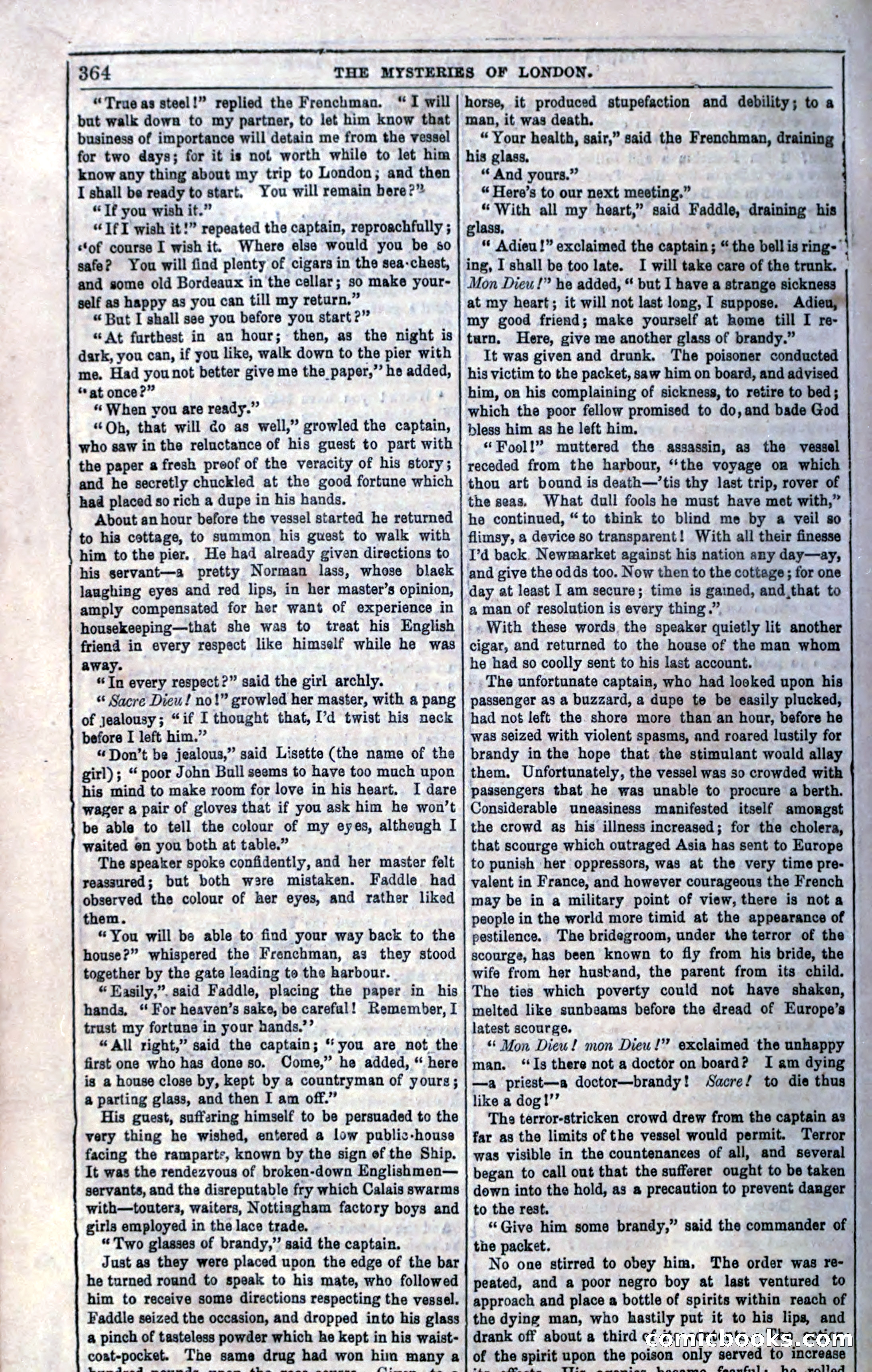
A restored page from Penny Dreadfuls, 1850. Page through the whole issue in the reader above.
📄 Transcribed text from this page (OCR, searchable)
Machine-transcribed from the original scan — historical spelling and the odd misread are preserved.
364 THE MYSTERIES OF LONDON. “True as steel!” replied the Frenchman. but walk down to my partner, to let him know that business of importance will detain me from the vessel for two days; for it is not worth while to let him know any thing about my trip to London; and then I shall be ready to start. You will remain bere?” “Tf you wish it.” “If I wish it!” repeated the captain, reproachfully ; «tof course I wish it. Where else would you be so safe? You will find plenty of cigars in the sea-chest, and some old Bordeaux in the cellar; so make your- self as happy as you can till my return.” “ But I shall see you before you start?” “At furthest in an hour; then, as the night is dark, you can, if you like, walk down to the pier with me. Had younot better give me the paper,” he added, “at once?” : “ When you are ready.” “Oh, that will do as well,” growled the captain, who saw in the reluctance of his guest to part with the paper afresh proof of the veracity of his story; and he secretly chuckled at the good fortune which had placed so rich a dupe in his hands. About an hour before the vessel started he returned to his cottage, to summon his guest to walk with him to the pier. He had already given directions to his servant—a pretty Norman lass, whose black laughing eyes and red lips, in her master’s opinion, amply compensated for her want of experience in housekeeping—that she was to treat his English friend in every respect like himself while he was away. “Tn every respect?” said the girl archly. ) ‘“‘ Sacre Dieu! no!” growled her master, with a pang of jealousy; “if I thought that, I’d twist his neck before I left him.” “Don’t be jealous,” said Lisette (the name of the girl); “ poor John Bull seems to have too much upon his mind to make room for love in his heart, I dare wager a pair of gloves that if you ask him he won’t be able to tell the colour of my eyes, although I waited en you both at table.” The speaker spoke confidently, and her master felt reassured; but both were mistaken. Faddle had observed the colour of her eyes, and rather liked them. “You will be able to find your way back to the house?” whispered the Frenchman, as they stood together by the gate leading to the harbour. “ Kasily,”. said Faddle, placing the paper in his hands, “ For heaven’s sake, be careful! Remember, I trust my fortune in your hands,’’ “All right,” said the captain; ‘you are not the first one who has done so. Come,” he added, “ here is a house close by, kept by a countryman of yours; @ parting glass, and then I am off.” His guest, suffering himself to be persuaded to the very thing he wished, entered a low public-house facing the ramparts, known by the sign of the Ship. It was the rendezvous of broken-down Englishmen— servants, and the disreputable fry which Calais swarms with—touters, waiters, Nottiagham factory boys and girls employed in the lace trade. “ Two glasses of brandy,’ said the captain. Just as they were placed upon the edge of the bar he turned round to speak to his mate, who followed him to receive some directions respecting the vessel. Faddle seized the occasion, and dropped into his glass a pinch of tasteless powder which he kept in his waist- coat-pocket. The same drug had won hii many a i i i in a aS y us oy “T will | horse, it produced stupefaction and debility; to a man, it was death. “ Your health, sair,” said the a re his glass, “ And yours.” “ Here’s to our next meeting.” “With all my heart,” said Faddle, draining his * Adieu!” exclaimed the captain; “the bell is ring-" ing, I shall be too late. I will take care of the trunk. Mon Dieu!” he added, * but I have a strange sickness at my heart; it will not last long, I suppose. my good friend; make yourself at home till I re- turn. Here, give me another glass of brandy.” It was given and drunk. The poisoner conducted his victim to the packet, saw him on board, and advised him, on his complaining of sickness, to retire to bed; which the poor fellow promised to do,and bade God bless him as he left him. ‘ Fool!” muttered the assassin, as the vessel receded from the harbour, “the voyage on which thou art bound is death—’tis thy last trip, rover of the seas. What dull fools he must have met with,” he continued, “to think to blind me by a veil so flimsy, a device so transparent! With all their finesse I’d back. Newmarket against his nation any day—ay, and give the odds too. Now then to the cottage; for one day at least I am secure; time is gained, and,that to a man of resolution is every thing.” With these words. the speaker quietly lit another cigar, and returned to the house of the man apace he had so coolly sent to his last account. The unfortunate captain, who had looked upon his passenger as a buzzard, a dupe te be easily plucked, had not left the shore more than an hour, before he was seized with violent spasms, and roared lustily for brandy in the hope that the stimulant would allay them. Unfortunately, the vessel was so crowded with passengers that he was unable to procure a berth. Considerable uneasiness manifested itself amongst the crowd as his illness increased; for the cholera, that scourge which outraged Asia has sent to Europe to punish her oppressors, was at the very time pre- valent in France, and however courageous the French may be in a military point of view, there is nota people in the world more timid at the appearance of pestilence. The bridegroom, under the terror of the scourge, has been known to fly from his bride, the wife from her husband, the parent from its child. The ties which poverty could not have shaken, melted like sunbeams before the dread of Europe’s latest scourge. - Mon Dieu! mon Dieu!” exclaimed the unhappy man. ‘Is there not a doctor on board? I am dying —a priest—a doctor—brandy! Sacre! to die thus like a dog!’’ The terror-stricken crowd drew from the captain as far as the limits of the vessel would permit. Terror was visible in the countenanees of all, and several began to call out that the sufferer ought to be taken down into the hold, as a precaution to prevent danger to the rest, ‘Give him some brandy,” said the commander of the packet. No one stirred to obey him, The order was re- peated, and a poor negro boy at last ventured to approach and place a bottle of spirits within reach of the dying man, who hastily put it to his lips end drank off about a third ¢7<‘r/4(Tai sfay (789 of the spirit upon the poison only served to inctease i