
Penny Dreadfuls, 1850 · page 367 of 394
The Mysteries of London; or, Lights and Shadows of London Life — page 367: what you’re looking at
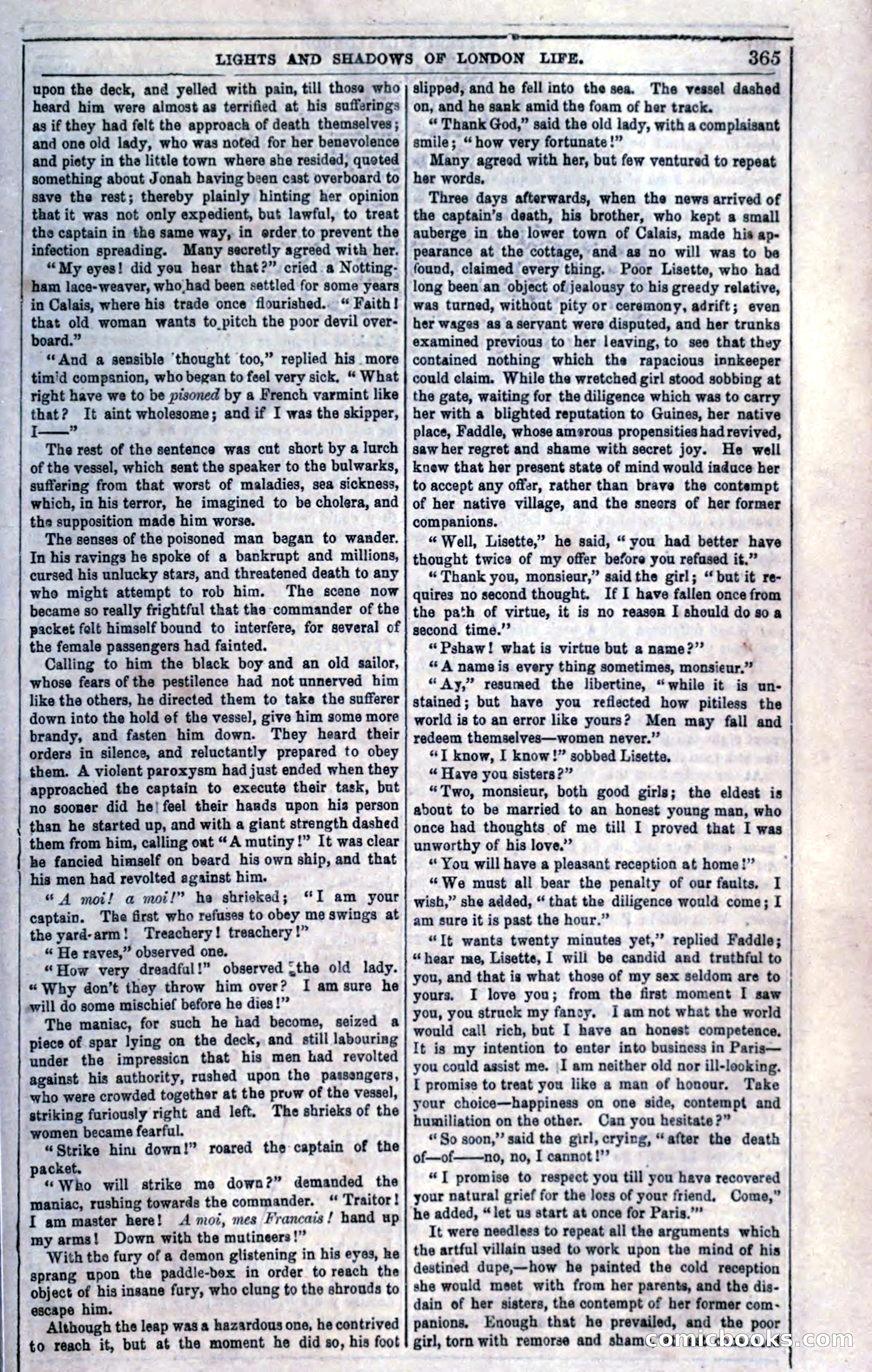
A restored page from Penny Dreadfuls, 1850. Page through the whole issue in the reader above.
📄 Transcribed text from this page (OCR, searchable)
Machine-transcribed from the original scan — historical spelling and the odd misread are preserved.
LIGHTS AND SHADOWS OF LONDON LIFE. "Qappnpumnatontinememaasenesntggremmeitinteinadh 365 upon the deck, and yelled with pain, till those who heard him were almost as terrified at his sufferings as if they had felt the approach of death themselves ; and one old lady, who was noted for her benevolence and piety in the little town where she resided, quoted something about Jonah baving been cast overboard to save the rest; thereby plainly hinting her opinion that it was not only expedient, but lawful, to treat the captain in the same way, in order to prevent the infection spreading. Many secretly agreed with her. “My eyes! did you hear that?” cried a Notting- ham lace-weaver, who had been settled for some years in Calais, where his trade once flourished.. “ Faith! that old woman wants to_pitch the poor devil over- board.” : “And a sensible ‘thought too,” replied his. more tim'd companion, who began to feel very sick, “ What right have we to be pisoned by a French varmint like that? It aint wholesome; and if I was the skipper, |——_”” The rest of the sentence was cut short by a lurch of the vessel, which sent the speaker to the bulwarks, suffering from that worst of maladies, sea sickness, which, in his terror, he imagined to be cholera, and the supposition made him worse. The senses of the poisoned man bagan to wander. In his ravings he spoke of a bankrupt and millions, cursed his unlucky stars, and threatened death to any who might attempt to rob him. The scene now became so really frightful that the commander of the packet felt himself bound to interfere, for several of the female passengers had fainted. Calling to him the black boy and an old sailor, whose fears of the pestilence had not unnerved him like the others, he directed them to take the sufferer down into the hold of the vessel], give him some more brandy, and fasten him down. They heard their orders in silence, and reluctantly prepared to obey them. A violent paroxysm had just ended when they approached the captain to execute their task, but no sooner did he! feel their hands upon his person than he started up, and with a giant strength dashed them from him, calling out “A mutiny!” It was clear he fancied himself on beard his own ship, and that his men had revolted against him. “4 moi! a moi!” he shrieked; “I am your captain. The first who refuses to obey me swings at the yard-arm! Treachery! treachery!” “ He raves,” observed one. “How very dreadful!” observed {the old lady. “ Why don’t they throw him over? I am sure he will do some mischief before he dies!” The maniac, for such he had become, seized a piece of spar lying on the deck, and still labouring under the impression that his men had revolted his authority, rushed upon the passengers, who were crowded together at the pruw of the vessel, striking furiously right and left. The shrieks of the women became fearful. “Strike hin. down!” roared the captain of the packet. “Who will strike me down?” demanded the maniac, rushing towards the commander. “ Traitor! I am master here! A moi, mes Francais! hand up my arms! Down with the mutineers!” With the fury of a demon glistening in his eyes, ke sprang upon the paddie-bex in order to reach the object of his insane fury, who clung to the shrouds to escape him. Although the leap was a hazardous one, he contrived to reach it, but at the moment he did so, his foot slipped, and he fell into the sea. The vessel dashed on, and he sank amid the foam of her track. “ Thank God,” said the old lady, with a complaisant smile; “how very fortunate!” Many agreed with her, but few ventured to repeat her words, Three days afterwards, when the news arrived of the captain’s death, his brother, who kept a small auberge in the lower town of Calais, made his ap- pearance at the cottage, and as no will was to be found, claimed every thing.» Poor Lisette, who had long been an object of jealousy to his greedy relative, was turned, without pity or ceremony, adrift; even her wages as aseryant were disputed, and her trunks examined previous to her leaving, to see that they contained nothing which the rapacious innkeeper could claim. While the wretched girl stood sobbing at the gate, waiting for the diligence which was to carry her with a blighted reputation to Guines, her native place, Faddle, whose amerous propensities had revived, saw her regret and shame with secret joy. He well knew that her present state of mind would induce her to accept any offer, rather than brave the contempt of her native village, and the snecrs of her former companions. “ Well, Lisette,” he said, “ you had better have thought twice of my offer before you refused it,” “ Thank you, monsieur,” said the girl; “ but it re- quires no second thought. If I have fallen once from the path of virtue, it is no reason I should do soa second time.” “Pshaw! what is virtue but a name?” ‘ “A nameis every thing sometimes, monsieur.” “Ay,” resumed the libertine, “while it is un- stained; but have you reflected how pitiless the world is to an error like yours? Men may fall and redeem themselves—women never.” “T know, I know!” sobbed Lisette, “ Have you sisters?” “Two, monsieur, both good girls; the eldest is about to be married to an honest young man, who once had thoughts of me till I proved that I was unworthy of his love.” “You will have a pleasant reception at home!” ‘We must all bear the penalty of our faults, I wish,” she added, “ that the diligence would come; I am sure it is past the hour.” “Tt wants twenty minutes yet,” replied Faddle; “hear me, Lisette, 1 will be candid and truthful to you, and that is what those of my sex seldom are to yours. I love you; from the first moment I saw you, you struck my fancy. Iam not what the world would call rich, but I have an honest competence, It is my intention to enter into business in Paris— you could assist me. I am neither old nor ill-looking. I promise to treat you like a man of honour. Take your choice—happiness on one side, contempt and humiliation on the other. Can you hesitate?” “So soon,” said the girl, crying, “after the death of—of——no, no, I cannot !’’ “T promise to respect you till you have recovered your natural grief for the loss of your friend, Come,” he added, “let us start at once for Paris.’” It were needless to repeat all the arguments which the artful villain used to work upon the mind of his destined dupe,—how he painted the cold reception she would meet with from her parents, and the dis- dain of her sisters, the contempt of her former com- panions. Enough that he prevailed, and the poor girl, torn with remorse and sham(c(e} /ai% 9X0\0),4 (C(O) im