
Penny Dreadfuls, 1850 · page 382 of 394
The Mysteries of London; or, Lights and Shadows of London Life — page 382: what you’re looking at
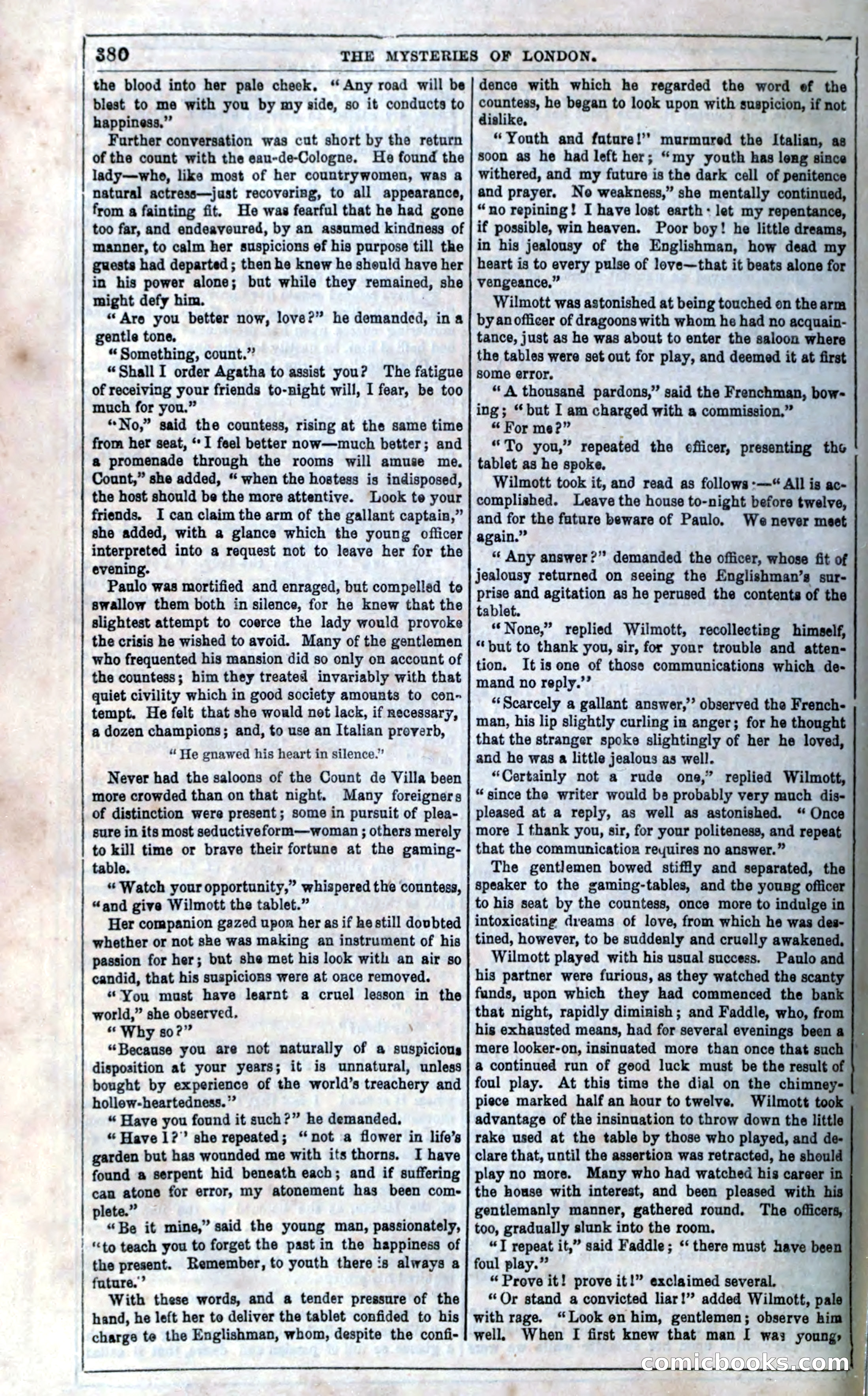
A restored page from Penny Dreadfuls, 1850. Page through the whole issue in the reader above.
📄 Transcribed text from this page (OCR, searchable)
Machine-transcribed from the original scan — historical spelling and the odd misread are preserved.
380 the blood into her pale cheek, | “ Any road. will be blest to me with you by my side, so it conducts to happiness,” Farther conversation was cut short by the return of the count with the eau-de-Cologne. He found the lady—whe, like most of her countrywomen, was a natural actress—just recovering, to all appearance, from a fainting fit. He was fearful that he had gone too far, and endeaveured, by an assumed kindness of manner, to calm her suspicions ef his purpose till the guests had departed ; then he knew he sheuld have her in his power alone; but while they remained, she might defy him. “Are you better now, love?” he demanded, ina gentle tone. “ Something, count.” “Shall I order Agatha to assist you? The fatigue of receiving your friends to-night will, I fear, be too much for you.” “No,” said the countess, rising at the same time from her seat, ‘* I feel better now—much better; and a promenade through the rooms will amuse me. Count,” she added, “ when the hostess is indisposed, the host should be the more attentive. Look te your friends. I can claim the arm of the gallant captain,” she added, with a glance which the young officer interpreted into a request not to leave her for the evening. Paulo was mortified and enraged, but compelled te swallow them both in silence, for he knew that the slightest attempt to coerce the lady would provoke the crisis he wished to avoid. Many of the gentlemen who frequented his mansion did so only on account of the countess; him they treated invariably with that quiet civility which in good society amounts to cen- tempt. He felt that she would not lack, if necessary, a dozen champions; and, to use an Italian proverb, “ He gnawed his heart in silence.” Never had the saloons of the Count de Villa been more crowded than on that night. Many foreigners of distinction were present; some in pursuit of plea- sure in its most seductiveform—woman ; others merely to kill time or brave their fortune at the gaming- table. “ Watch your opportunity,” whispered the countess, “and give Wilmott the tablet.” Her companion gazed upon her as if he still doubted whether or not she was making an instrument of his passion for her; but she met his look with an air so candid, that his suspicions were at once removed. “You must have learnt a cruel lesson in the world,” she observed. “ec Why 80 2” ‘ “Because you are not naturally of a suspicious disposition at your years; it is unnatural, unless bought by experience of the world’s treachery and hollew-heartedness.” “ Have you found it such?” he demanded. “ Have 1?” she repeated; “not a flower in life’s garden but has wounded me with its thorns. I have found a serpent hid beneath each; and if suffering can atone for error, my atonement has been com- plete.” “Be it mine,” said the young man, passionately, | “to teach you to forget the past in the happiness of | the present. Remember, to youth there is always a future.’ With these words, and a tender pressure of the hand, he left her to deliver the tablet confided to his charge te the Englishman, whom, despite the confi- —— THE MYSTERIES ‘8 OF LONDON, | dence with which he regarded the word ef the ag he began to look upon with suspicion, if not e. “Youth and fature!’’ murmured the Italian, as soon as he had left her; “my youth has long since withered, and my future is the dark cell of penitence and prayer. No weakness,” she mentally continued, “no repining! I have lost earth: let my repentance, if possible, win heaven. Poor boy! he little dreams, in his jealousy of the Englishman, how dead my heart is to every pulse of love—that it beats alone for vengeance,” Wilmott was astonished at being touched on the arm by an officer of dragoons with whom he had no acquain- tance, just as he was about to enter the saloon where the tables were set out for play, and deemed it at first some error. “A thousand pardons,” said the Frenchman, bow- ing; “but I am charged with a commission,” “ For me?” “To you,” repeated the eflicer, presenting the tablet as he spoke. | Wilmott took it, and read as follows -—* All is ac- complished. Leave the house to-night before twelve, and for the future beware of Paulo. We never meet | again.” 4 “ Any answer?” demanded the officer, whose fit of | jealousy returned on seeing the Englishman’s sur- | prise and agitation as he perused the contents of the | tablet. ** None,” replied Wilmott, recolleetiag himelt, | “but to thank you, sir, for your trouble and atten- tion. Itis one of those communications which de- mand no reply.’’ ( “‘Scarcely a gallant answer,’ observed the French- man, his lip slightly curling in anger; for he thought | that the stranger spoke slightingly of her he loved, - and he was a little jealous as well. | “Certainly not a rude one,” replied Wilmott, “since the writer would ba probably very much dis- | pleased at a reply, as well as astonished. “Once more I thank you, sir, for your politeness, and repeat that the communication reyuires no answer.” The gentlemen bowed stiffly and separated, the | speaker to the gaming-tables, and the young officer to his seat by the countess, once more to indulge in intoxicating dreams of love, from which he was des- tined, however, to be suddenly and cruelly owaheneaa Wilmott played with his usual success. Paulo a his partner were furious, as they watched the scanty funds, upon which they had commenced the k that night, rapidly diminish; and Faddle, who, re his exhausted means, had for ‘several evenings been : mere looker-on, insinuated more than once that such a continued run of geod luck must be the reault ol foul play. At this time the dial on the chim piece marked half an hour to twelve. Wilmott t advantage of the insinuation to throw down the litt rake used at the table by those who played, and d clare that, until the assertion was retracted, he s play no more. Many who had watched his cabo’ the house with interest, and been pleased bem gentlemanly manner, gathered round. The too, gradually slunk into the room. “T repeat it,” said Faddle; ‘‘ there must have kb foul play.” “ Prove it! prove it!” exclaimed several. “Or stand a convicted liar!” added Wilmott, pal with rage. “Look en him, gentlemen; observe hir well, When [I first knew that man I was yor eco ag el oo OK