
Penny Dreadfuls, 1850 · page 383 of 394
The Mysteries of London; or, Lights and Shadows of London Life — page 383: what you’re looking at
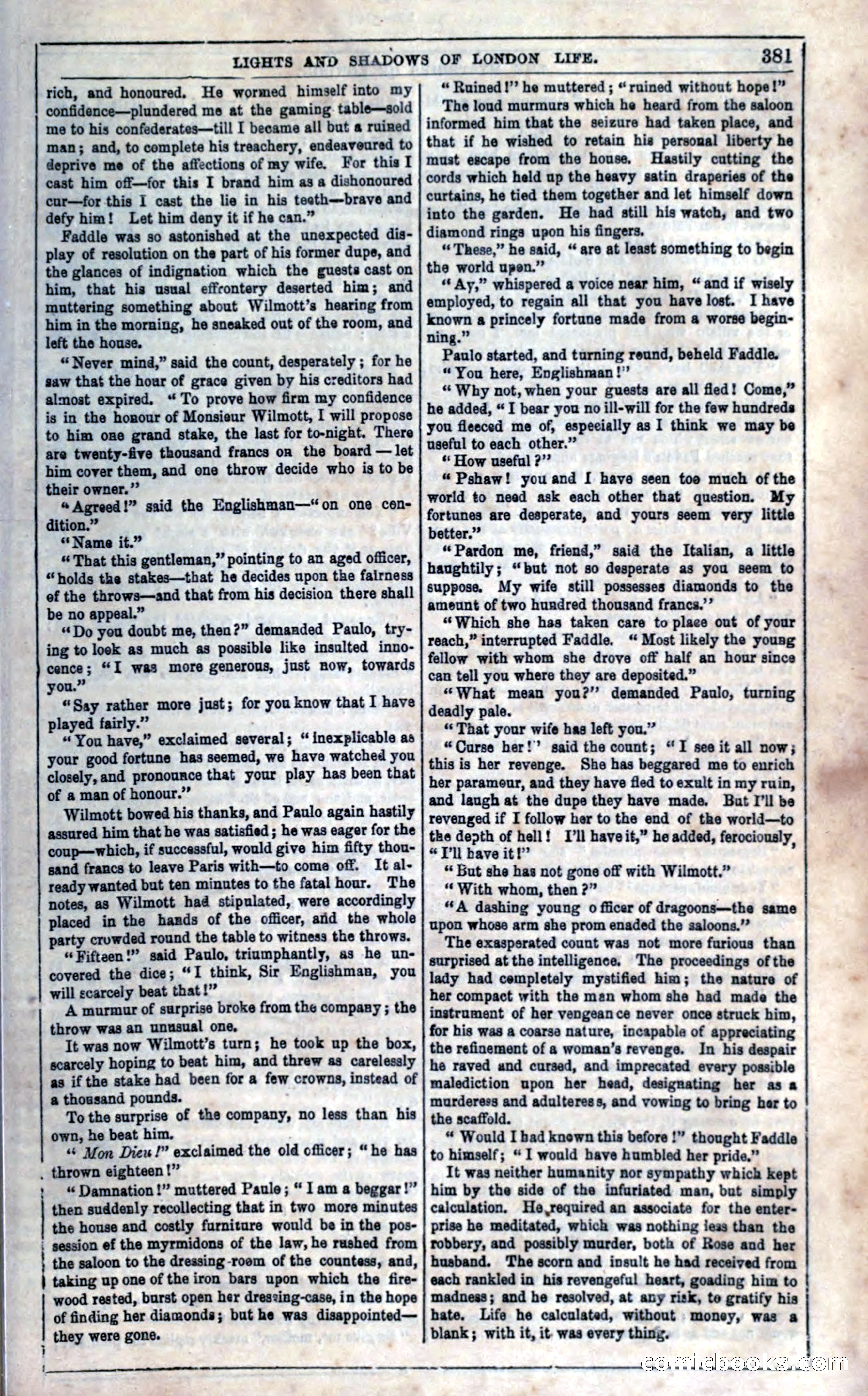
A restored page from Penny Dreadfuls, 1850. Page through the whole issue in the reader above.
📄 Transcribed text from this page (OCR, searchable)
Machine-transcribed from the original scan — historical spelling and the odd misread are preserved.
rich, and honoured. He wormed himself into my confidence—plundered me at the gaming table—sold me to his confederates—till I became all but a ruined man; and, to complete his treachery, endeaveured to deprive me of the affections of my wife. For this I cast him off—for this I brand him as a dishonoured cur—for this I cast the lie in his teeth—brave and defy him! Let him deny it if he can.” Faddle was so astonished at the unexpected dis- play of resolution on the part of his former dupe, and the glances of indignation which the guests cast on him, that his usual effrontery deserted him; and muttering something about Wilmott’s hearing from him in the morning, he sneaked out of the room, and left the house. “Never mind,” said the count, desperately ; for he saw that the hour of grace given by his creditors had almost expired. “To prove how firm my confidence is in the honour of Monsieur Wilmott, I will propose to him one grand stake, the last for to-night. There are twenty-five thousand francs on the board — let him cover them, and one throw decide who is to be their owner.” « Agreed!” said the Englishman—“on one cen- dition.” “Name it.” “That this gentleman,” pointing to an aged officer, “holds the stakes—that he decides upon the fairness ef the throws—and that from his decision there shall be no appeal.” “Do you doubt me, then?” demanded Paulo, try- ing to lock as much as possible like insulted inno- cence; “I was more generous, just now, towards you.” “Say rather more just; for you know that I have layed fairly.” Ton have,” exclaimed several; “inexplicable as your good fortune has seemed, we have watched you closely, and pronounce that your play has been that of a man of honour.” Wilmott bowed his thanks, and Paulo again hastily assured him that he was satisfied ; he was eager for the coup—which, if successful, would give him fifty thou- sand francs to leave Paris with—to come off. It al- ready wanted but ten minutes to the fatal hour. The notes, as Wilmott had stipulated, were accordingly placed in the hands of the officer, atid the whole cruwded round the table to witness the throws. “ Fifteen!” said Paulo, triumphantly, as he un- covered the dice; “I think, Sir Englishman, you will scarcely beat that!” A murmur of surprise broke from the company ; the throw was an unusual one, It was now Wilmott’s turn; he took up the box, scarcely hoping to beat him, and threw as carelessly as if the stake had been for a few crowns, instead of a thousand pounds. To the surprise of the company, no less than his own, he beat him. | “ Mon Dicu!”’ exclaimed the old officer; “he has . thrown eighteen!” “ Damnation!” muttered Paule; “ 1 am a beggar!” then suddenly recollecting that in two more minutes the house and costly furniture would be in the pos- : session ef the myrmidons of the law, he rushed from | the saloon to the dressing-room of the countess, and, taking up one of the iron bars upon which the fire- wood rested, burst open her dreszing-case, in the hope of finding her diamonds; but he was disappointed— they were gone. j i me ee —— es LIGHTS AND SHADOWS OF LONDON LIFE. 881 “ Ruined !’’ he muttered; “ruined without hope!” The loud murmurs which he heard from the saloon informed him that the seizure had taken place, and that if he wished to retain his personal liberty he must escape from the house, MHastily cutting the cords which held up the heavy satin draperies of the curtains, he tied them together and let himself down into the garden. He had still his watch, and two diamond rings upon his fingers. * These,” he said, “ are at least something to begin the world upon.” “ Ay,” whispered a voice near him, “and if wisely employed, to regain all that you have lost. I have known a princely fortune made from a worse begin- ning.” Paulo started, and turning reund, beheld Faddle. “You here, Englishman!’ “ Why not, when your guests are all fled! Come,” he added, “I bear you no ill-will for the few hundreds you fleeced me of, especially as I think we may be useful to each other.” * How useful ?” “ Pshaw! you and I have seen too much of the world to need ask each other that question. My fortunes are desperate, and yours seem very little better.” “Pardon me, friend,” said the Italian, a little haughtily; “but mot so desperate as you seem to suppose. My wife still possesses diamonds to the ameunt of two hundred thousand francs.’’ “‘Which she has taken care to place out of your reach,” interrupted Faddle. “ Most likely the young fellow with whom she drove off half an hour since can tell you where they are deposited.” “What mean you?” demanded Paulo, turning deadly pale. “That your wife has left you.” “Curse her!’ said the count; “I see it all now; this is her revenge. She has beggared me to enrich her paramour, and they have fled to exult in my ruin, and laugh at the dupe they have made. But I'll be revenged if I follow her to the end of the world—to tke depth of hell! I'll haveit,” he added, ferociously * Pll bave it!” : “ But she has not gone off with Wilmott.” “ With whom, then ?” “A dashing young o flicer of dragoons—the same upon whose arm she prom enaded the saloons.” The exasperated count was not more furious than surprised at the intelligence. The proceedings of the lady had cempletely mystified him; the nature of her compact with the man whom she had made the instrument of her vengeance never once struck him, for his was a coarse nature, incapable of appreciating the refinement of a woman’s revenge. In his despair he raved and cursed, and imprecated every possible malediction upon her head, designating her as a murderess and adulteress, and vowing to bring her to the scaffold. “ Would I bad known this before !” thought Faddle to himself; “I would have humbled her pride,” It was neither humanity nor sympathy which kept him by the side of the infuriated man, but simply calculation. He required an associate for the enter- prise he meditated, which was nothing jess than the robbery, and possibly murder, both of Rose and her husband. The scorn and insult he had received from each rankled in his revengeful heart, goading him to madness; and he resolved, at any risk, te gratify his hate. Life he calculated, without money, was a blank; with it, it. was every thing. LOAD coy Ol KSAGO)