
Penny Dreadfuls, 1850 · page 384 of 394
The Mysteries of London; or, Lights and Shadows of London Life — page 384: what you’re looking at
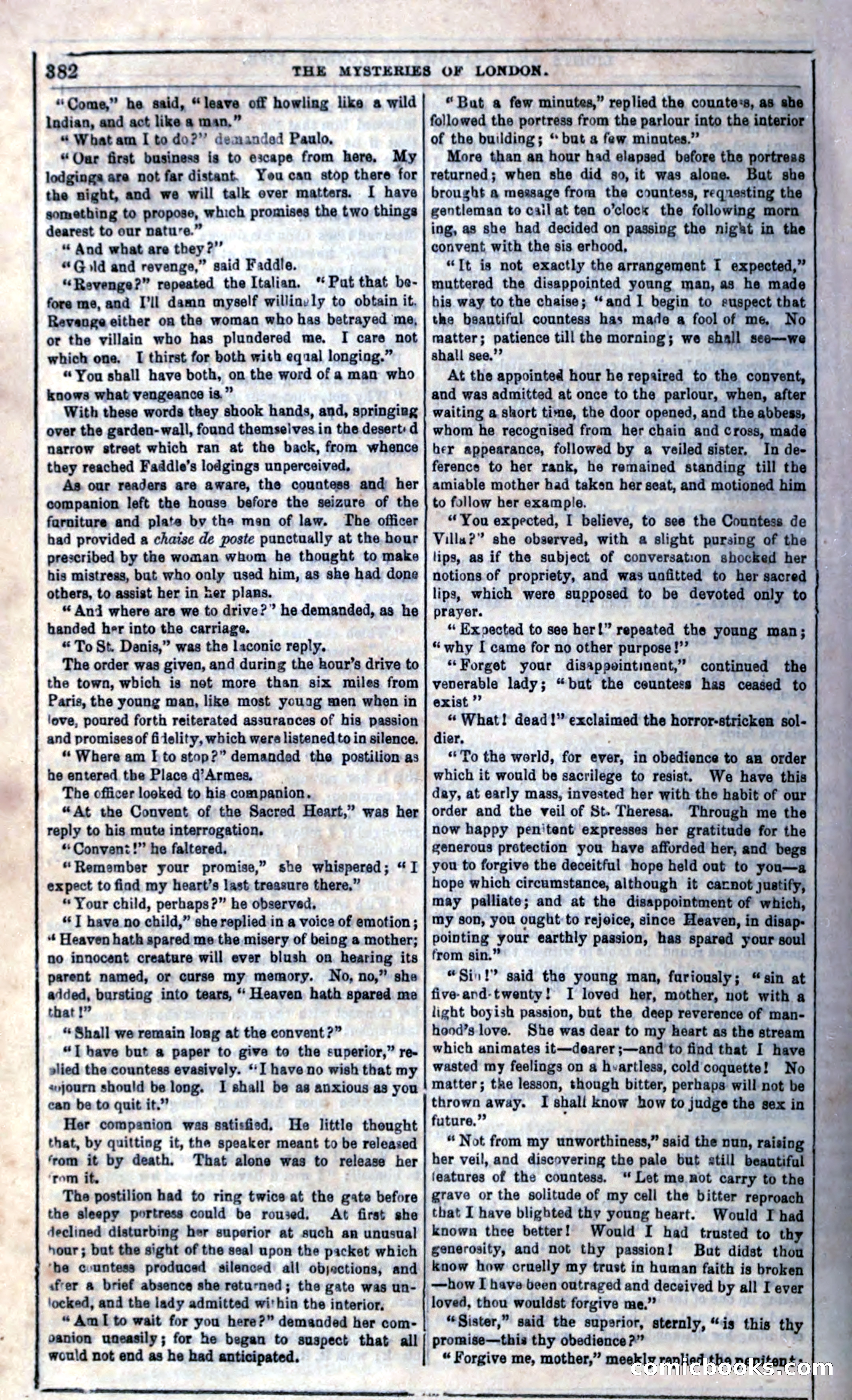
A restored page from Penny Dreadfuls, 1850. Page through the whole issue in the reader above.
📄 Transcribed text from this page (OCR, searchable)
Machine-transcribed from the original scan — historical spelling and the odd misread are preserved.
$82 HE M “ Come,” he said, “leave off howling like a a wild Indian, and act like a man,” “ What am I to do?”’ demanded Paulo, “Oar first business is to escape from here, My lodginga are not far distant. Youcan stop there for the night, and we will talk ever matters. I have something to propose, which promises the two things dearest to our nature.” “ And what are they 2” “Gld and revenge,” said Faddle. a ?” repeated the Italian. “Put that be- fore me, and I'll damn myself willinvly to obtain it, Revenge either on the woman who has betrayed ‘me, or the villain who has plundered me. I care not which one. I thirst for both with equal longing.” “You shall have both, on the word of a man who knows what vengeance is.” With these words they shook hands, and, springing over the garden- wall, found themselves in the desert: d narrow street which ran at the back, from whence they reached Faddle’s lodgings unperceived, As our readers are aware, the countess and her companion left the house before the seizure of the farniture and plate by the man of law. The officer had provided a chaise de poste punctually at the hour prescribed by the woman whom he thought to make his mistress, but who only used him, as she had done others, to assist her in her plans. “ Ani where are we to drive?” he demanded, as he handed her into the carriage. “ To St. Danis,” was the laconic reply. The order was given, and during the hour’s drive to the town, which is not more than six miles from Paris, the young man, like most youog men when in love, poured forth reiterated assurances of his passion and promisesof filelity, which were listened to in silence. “ Where am [ to stop?” demanded the postilion as he entered the Place d’Armes, __ The officer looked to his companion. “At the Convent of the Sacred Heart,” was her reply to his mute interrogation. **Convent!”’ he faltered, “Remember your promise,” she whispered; “I expect to find my heart’s last treasure there,” “Your child, perhaps?” he observed, “*] have no child,” she replied in a voice of emotion ; “ Heaven hath spared me the misery of being a mother; no innocent creature will ever blush on hearing its parent named, or curse my memory. No, no,” she aided, bursting into tears, ‘‘ Heaven hath spared me that !” “ Shall we remain long at the eonvent ?” “[ have but a paper to give to the superior,” re- slied the countess evasively. ‘‘I have no wish that my «journ should be long. I shall be as anxious as you can be to quit it.” Her companion was satisfied. He little thought that, by quitting it, the speaker meant to be released from it by death. That alone was to release her ‘rom it. The postilion had to ring twice at the gate before the sleepy portress could be roused. At first she declined disturbing her superior at such an unusual hour; bat the sight of the seal upon the packet which ‘he countess produced silenced all objections, and sfrer a brief absence she returned; the gate was un- locked, and the lady admitted wi'hin the interior, “Am | to wait for you here?” demanded her com- oanion uneasily; for he began to suspect that all { promise—this thy obedience?” would not end as he had anticipated. : ee +4" THE MYSTERIES OF LONDON. AAR REE ARAN a “But a few minutes,” replied the countess, as sh followed the portress from the parlour into the of the building; “ but a few minutes.” More than an hour had elapsed before the returned; when she did so, it was alone. brought a message from the countess, req) gentleman to cail at ten o’clock the tioone t she g the morn, ing, as she had decided on passing the night in the convent with the sis erhood, “It is not exactly the arrangement I ex muttered the disappointed young man, as he w his way to the chaise; “and 1 begin to « that the beantifal eonntens has made a fool of me, No matter; patience till the morning; we See—we shall see.’’ At the appointed hour he repaired to the convent, and was admitted at once to the parlour, when, after waiting a short time, the door opened, and thea whom he recognised from her chain and Cross, m her appearance, followed by a veiled sister, In de- ference to her rank, he remained stan till amiable mother had taken her seat, and motioned | to follow her example. “You expected, I believe, to see the Countess de Villa?” she observed, with a slight pursin of the lips, as if the subject of conversation s her notions of propriety, and was unfitted to her sacred lips, which were supposed to be devoted only to prayer. “ Expected to see her!” repeated the young man; “ why I came for no other purpose !’’ “Forget your disappointment,” continued the venerable lady; “but the countess has ceased to exist ”’ “ What! dead! exclaimed the horror-stricken sol- dier, “To the world, for ever, in obedience to an order which it would be sacrilege to resist. We have this day, at early mass, invested her with the habit of our order and the veil of St. Theresa. Through me the now happy penitent expresses her gratitude for the generous protection you have afforded her, and begs you to forgive the deceitful hope held out to you—a hope which circumstance, although it carnot justify, may palliate; and at the disappointment of which, | my son, you ought to rejoice, since Heaven, in pointing your earthly passion, has spared your soul from sin.” “Sin!” said the young man, fariously; “sin at five-and- twenty ! I loved her, mother, not with a light boyish passion, but the deep reverence of man- hood’s love. She was dear to my heart as the stream which animates it—dearer ;—and to find that I have wasted my feelings on a hvartless, cold coquette! No matter; the lesson, though bitter, perhaps will not be thrown away. I shall know how to judge the sex in future,” “ Not from my unworthiness,” said the nun, ri her veil, and discovering the pale but atill features of the countess. “ Let me mot carry to the grave or the solitude of my cell the bitter reproach | | that I have blighted thy young heart. Would Thad | — known thee better! Would I had trusted to thy | generosity, and not thy passion! But didst know how cruelly my trast in human faith is ona —how I have been outraged and deceived by all Iever loved, thou wouldst forgive me,” “Sister,” said the superior, sternly, “is this thy “ Forgive me, mother,” meek}7 rantied tha reniten ts.