
Penny Dreadfuls, 1850 · page 391 of 394
The Mysteries of London; or, Lights and Shadows of London Life — page 391: what you’re looking at
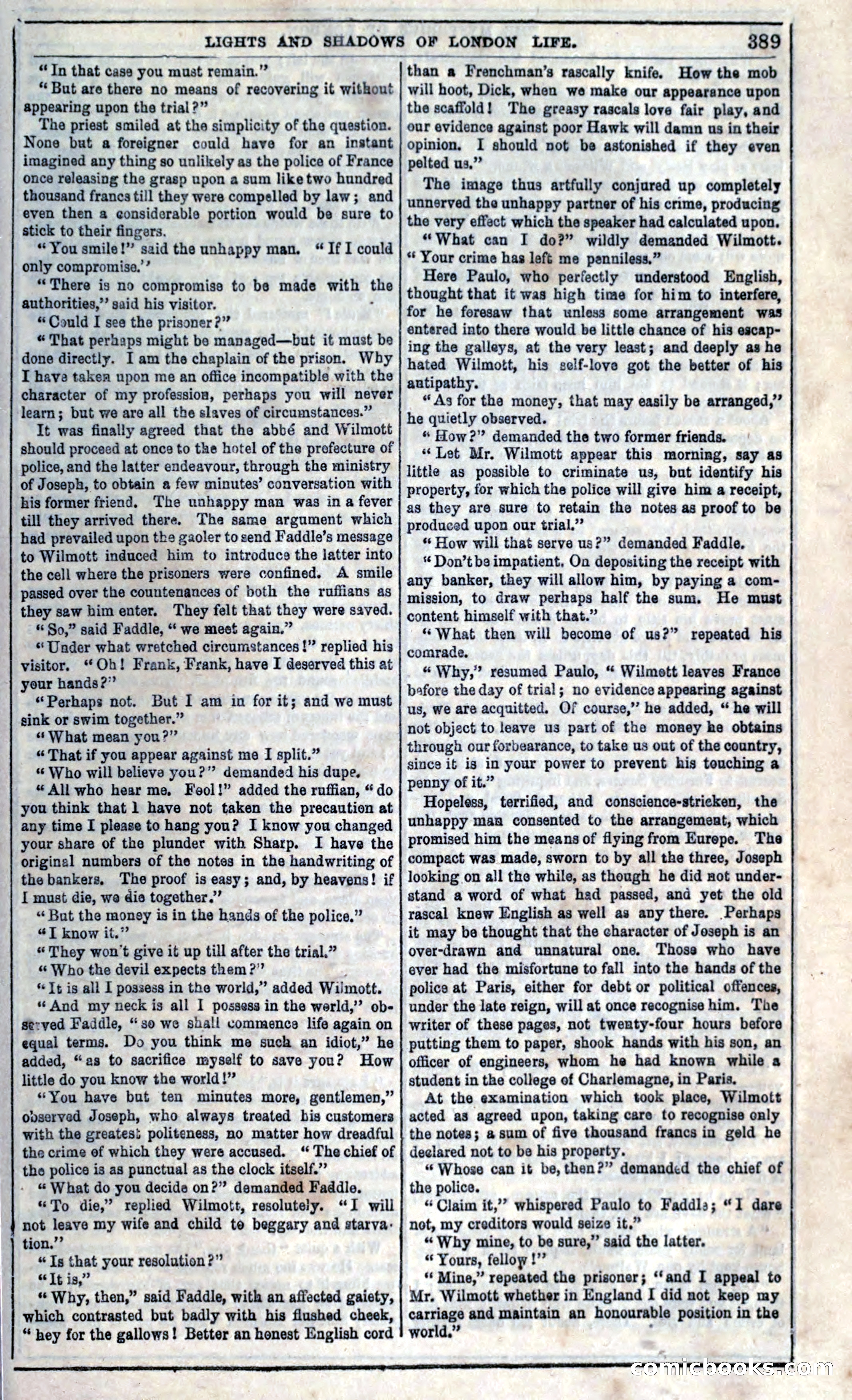
A restored page from Penny Dreadfuls, 1850. Page through the whole issue in the reader above.
📄 Transcribed text from this page (OCR, searchable)
Machine-transcribed from the original scan — historical spelling and the odd misread are preserved.
s LIGHTS AND SHADOWS OF LONDON LIFE. “Tn that case you must remain.” ** But are there no means of recovering it without appearing upon the trial?” The priest smiled at the simplicity of the question. None but a foreigner could have for an instant imagined any thing so unlikely as the police of France once releasing the grasp upon a sum liketwo hundred thousand francs till they were compelled by law; and even then a considerable portion would be sure to stick to their fingers. “You smile!” said the unhappy man. “If I could only compromise.’ . “There is no compromise to be made with the authorities,” said his visitor. “Could I see the prisoner?” “That perhaps might be managed—but it must be done directly. I am the chaplain of the prison. Why I have taken upon me an office incompatible with the character of my profession, perhaps you will never learn; but we are all the slaves of circumstances.” It was finally agreed that the abbé and Wilmott should proceed at once to the hotel of the profecture of police, and the latter endeavour, through the ministry of Joseph, to obtain a few minutes’ conversation with his former friend. The unhappy man was in a fever till they arrived there. The same argument which had prevailed upon the gaoler tosend Faddle’s message to Wilmott induced him to introduce the latter into the cell where the prisoners were confined. A smile passed over the countenances of both the ruflians as they saw him enter. They felt that they were saved. * So,” said Faddle, “ we meet again.” “ Under what wretched circumstances!” replied his visitor. “Oh! Frank, Frank, have I deserved this at your hands?” ‘Perhaps not. But I am in for it; and we must sink or swim together.” “ What mean you?” “ That if you appear against me I split.” “ Who will believa you?” demanded his dupe. “ All who hear me, Fool!” added the ruffian, “ do you think that 1 have not taken the precaution at any time I please to hang you? I know you changed your share of the plunder with Sharp. I have the original numbers of the notes in the handwriting of the bankers, The proof is easy; and, by heavens! if I must die, we die together.” “ But the money is in the hands of the police.” “T know it.” “They won't give it up till after the trial.” “ Who the devil expects them 2” “It is all I possess in the world,” added Wilmott. * And my neck is all I possess in the werld,’” ob- served Faddle, “so we shall commence life again on equal terms. Do you think me such an idiot,” he added, “as to sacrifice myself to save you? How little do you know the world!” “You have but ten minutes more, gentlemen,” ovserved Joseph, who always treated his customers with the greatesi politeness, no matter how dreadful the crime of which they were accused. ‘ The chief of the police is as punctual as the clock itself.” . What do you decide on?” demanded Faddle. “To die,’ replied Wilmott, resolutely. “I will not leave my wife and child to beggary and starva: tion.”’ “Ts that your resolution?” T3 It is,” ** Why, then,” said Paddle, with an affected gaiety, which contrasted but badly with his flushed cheek, “ hey for the gallows! Better an honest English cord 389 than a Frenchman’s rascally knife. How the mob will hoot, Dick, when we make our appearance upon the scaffold! The greasy rascals love fair play, and our evidence against poor Hawk will damn us in their opinion. I should not be astonished if they even pelted us,” The image thus artfully conjured up completely unnerved the unhappy partner of his crime, producing the very effect which the speaker had calculated upon. “What can I do?” wildly demanded Wilmott. ** Your crime has left me penniless,” Here Paulo, who perfectly understood English, thought that it was high time for him to interfere, for he foresaw that unless some arrangement was entered into there would be little chance of his escap- ing the galleys, at the very least; and deeply as he hated Wilmott, his self-love got the better of his antipathy. “As for the money, that may easily be arranged,’ he quietly observed. “ How?” demanded the two former friends. “Let Mr. Wilmott appear this morning, say as little as possible to criminate us, but identify his property, for which the police will give him a receipt, as they are sure to retain fhe notes as proof to be produced upon our trial,” *‘ How wiill that serve us?” demanded Faddle, “ Don’t be impatient, On depositing the receipt with any banker, they will allow him, by paying a com- mission, to draw perhaps half the sum. He must content himself with that.” “What then will become of us?” repeated his comrade. “ Why,” resumed Paulo, “ Wilmott leaves France bafore the day of trial; no evidence appearing against us, we are acquitted. Of course,” he added, “ he will not object to leave us part of the money he obtains through our forbearance, to take us out of the country, since it is in your power to prevent his touching a penny of it.” Hopeless, terrified, and conscience-stricken, the unhappy mas consented to the arrangement, which promised him the means of flying from Eurepe. The compact was made, sworn to by all the three, Joseph looking on all the while, as though he did not under- stand a word of what had passed, and yet the old rascal knew English as well as any there. Perhaps it may be thought that the character of Joseph is an over-drawn and unnatural one. Those who have ever had the misfortune to fall into the hands of the police at Paris, either for debt or political offences, under the late reign, will at once recognise him. The writer of these pages, not twenty-four hours before putting them to paper, shook hands with his son, an officer of engineers, whom he had known while a student in the college of Charlemagne, in Paris. At the examination which took place, Wilmott acted as agreed upon, taking care to recognise only the notes; a sum of five thousand francs in geld he declared not to be his property. “ Whose can it be, then?” demanded the chief of the police. “ Claim it,’’ whispered Paulo to Faddla; “1 dare not, my creditors would seize it,” “ Why mine, to be sure,” said the latter. “ Yours, fellow !” ‘‘ Mine,” repeated the prisoner; ‘‘and I appeal to Mr. Wilmott whether in England I did not keep my carriage and maintain an honourable position in the world,”