
Penny Dreadfuls, 1850 · page 392 of 394
The Mysteries of London; or, Lights and Shadows of London Life — page 392: what you’re looking at
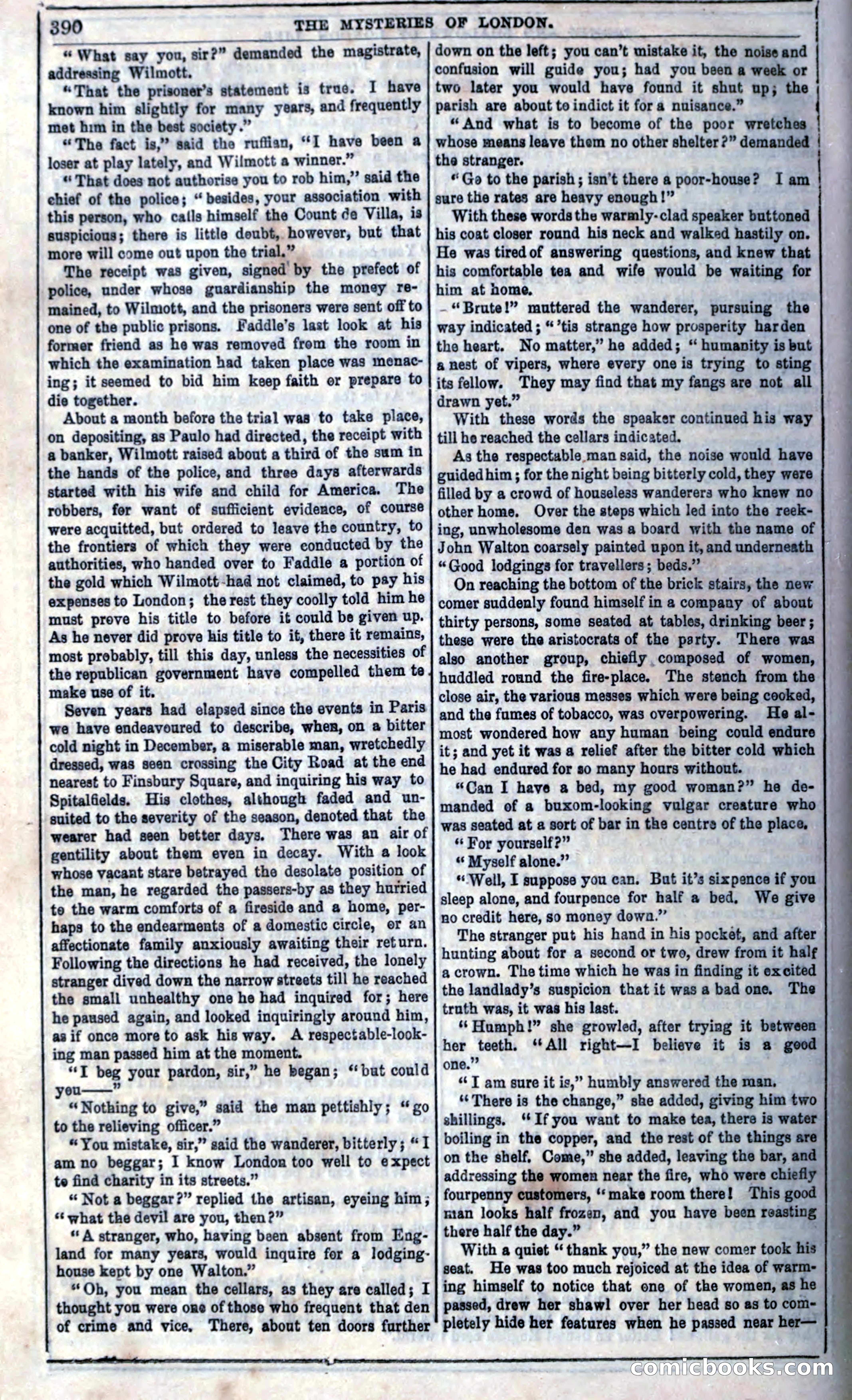
A restored page from Penny Dreadfuls, 1850. Page through the whole issue in the reader above.
📄 Transcribed text from this page (OCR, searchable)
Machine-transcribed from the original scan — historical spelling and the odd misread are preserved.
® et EE ee THE MYSTERIES OF LONDON. 390 “ What say you, sir?” demanded the magistrate, addressing Wilmott. “That the prisoner’s statement is true. I have known him slightly for many years, and frequently met him in the best society.” “The fact is,’ said the ruffian, “I have been a loser at play lately, and Wilmott a winner.” “ That does not authorise you to rob him,” said the ehief of the police; “besides, your association with this person, who calls himself the Count de Villa, is suspicious; there is little deubt, however, but that more will come out upon the trial.” The receipt was given, signed by the prefect of police, under whose guardianship the money re- mained, to Wilmott, and the prisoners were sent off to one of the public prisons. Faddle’s last look at his former friend as he was removed from the room in which the examination had taken place was menac- ing; it seemed to bid him keep faith er prepare to die together. About a month before the trial was to take place, on depositing, as Paulo had directed, the receipt with a banker, Wilmott raised about a third of the sum in the hands of the police, and three days afterwards started with his wife and child for America. The robbers, fer want of sufficient evidence, of course were acquitted, but ordered to leave the country, to the frontiers of which they were conducted by the authorities, who handed over to Faddle a portion of the gold which Wilmott-had not claimed, to pay his expenses to London; the rest they coolly told him he must prove his title to before it could be given up. As he never did prove his title to it, there it remains, most probably, till this day, unless the necessities of the republican government have compelled them te make use of it. Seven years had elapsed since the events in Paris we have endeavoured to describe, wher, on a bitter cold night in December, a miserable man, wretchedly dressed, was seen crossing the City Road at the end nearest to Finsbury Square, and inquiring his way to Spitalfields. His clothes, although faded and un- suited to the severity of the season, denoted that the wearer had seen better days. There was an air of gentility about them even in decay. With a look whose vacant stare betrayed the desolate position of the man, he regarded the passers-by as they hurried te the warm comforts of a fireside and a home, per- haps to the endearments of a domestic circle, er an affectionate family anxiously awaiting their return. Following the directions he had received, the lonely stranger dived down the narrow streets till he reached the small unhealthy one he had inquired for; here he paused again, and looked inquiringly around him, as if once more to ask his way. A respectable-look- ing man passed him at the moment. “T beg your pardon, sir,” he began; “but could you-—” “Nothing to give,” said the man pettishly; “ go to the relieving officer.” “You mistake, sir,” said the wanderer, bitterly; “1 am no beggar; I know London too well to expect te find charity in its streets.” “ Not a beggar?” replied the artisan, eyeing him; ‘* what the devil are you, then?” “A stranger, who, having been absent from Eng- land for many years, would inquire for a lodging- house kept by one Walton.” “Oh, you mean the cellars, as they are called; I thought you were one of those who frequent that den of crime and vice, There, about ten doors further a eit a ee aes down on the left; you can’t mistake it, the noise and confusion will guide you; had you been a week or two later you would have found it shut up; the parish are about to indict it fora nuisance.” “And what is to become of the poor wretches whose means leave them no other shelter?” demanded | the stranger. < “ Go to the parish; isn’t there a poor-house? I am sure the rates are heavy enough!” With these words the warmly-clad speaker buttoned his coat closer round his neck and walked hastily on. He was tiredof answering questions, and knew that his comfortable tea and wife would be waiting for him at home, .“Brute!” muttered the wanderer, pursuing the way indicated; “’tis strange how prosperity harden the heart. No matter,” he added; “ humanity is but a nest of vipers, where every one is trying to sting its fellow. They may find that my fangs are not all drawn yet.” | With these words the speaker continued his way till he reached the cellars indicated. As the respectable man said, the noise would have guided him ; for the night being bitterly cold, they were filled by a crowd of houseless wanderers who knew no other home, Over the steps which led into the reek- ing, unwholesome den was a board with the name of John Walton coarsely painted upon it, and underneath “Good lodgings for travellers; beds.” as : On reaching the bottom of the brick stairs, the new | — comer suddenly found himself in a company of about | thirty persons, some seated at tables, drinking beer; | — these were the aristocrats of the party. There was also another group, chiefly composed of women, huddled round the fire-place. The stench from the | — close air, the various messes which were being cooked, | — and the fumes of tobacco, was overpowering. He al- | most wondered how any human being could endure | it; and yet it was a relief after the bitter cold which | | he had endured for so many hours without. “Can I have a bed, my good woman?” he de- manded of a buxom-looking vulgar creature who was seated at a sort of bar in the centre of the place, “For yourself?” 7 “‘ Myself alone.” 1 *‘ Well, I suppose you can. But it’s sixpence if you | sleep alone, and fourpence for half a bed, We give | no credit here, so money down.” rf The stranger put his hand in his pocket, and after | hunting about for a second or two, drew from it halg | a crown. The time which he was in finding it excited the landlady’s suspicion that it wasa badone. The truth was, it was his last. ‘‘ Homph!” she growled, after trying it between | her teeth. ‘+All right—I believe it is a good} one.” | ay “T am sure it is,” humbly answered the man, Bi ‘There is the change,” she added, giving him two | shillings. ‘If you want to make tea, there is water | boiling in the copper, and the rest of the things are on the shelf, Come,” she added, leaving the bar, and addressing the women near the fire, who were chiefly fourpenny customers, ‘make room there! This good nian looks half frozen, and you have been reasting | there half the day.” 4 With a quiet “thank you,” the new comer took his | seat. He was too much rejoiced at the idea of warm- ing himself to notice that one of the women, as he | passed, drew her shawl over her head so as to com- pletely hide her features when he passed near her— (GO/A El DOOKS) com