
Penny Dreadfuls, 1850 · page 69 of 394
The Mysteries of London; or, Lights and Shadows of London Life — page 69: what you’re looking at
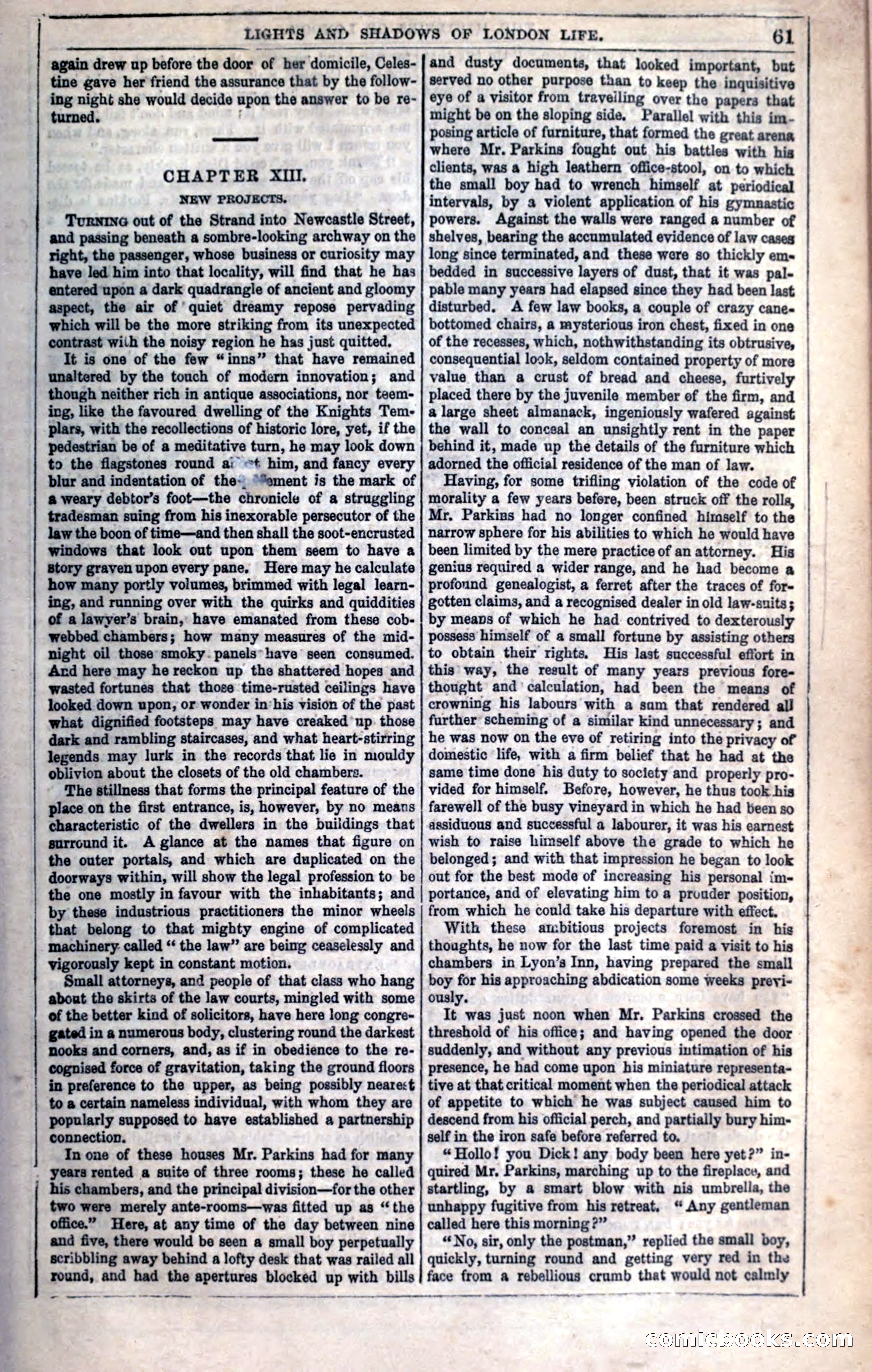
A restored page from Penny Dreadfuls, 1850. Page through the whole issue in the reader above.
📄 Transcribed text from this page (OCR, searchable)
Machine-transcribed from the original scan — historical spelling and the odd misread are preserved.
aE sel . LIGHTS AND SHADOWS OF LONDON LIFE. again drew up before the door of her domicile, Celes- tine gave her friend the assurance that by the follow- ing night she would decide upon the answer to be re- CHAPTER XI, NEW PROJECTS. TURNING out of the Strand into Newcastle Street, and passing beneath a sombre-looking archway on the right, the , whose business or curiosity may have led him into that locality, will find that he has entered upon a dark quadrangle of ancient and gloomy aspect, the air of ‘quiet dreamy repose pervading which will be the more striking from its unexpected contrast with the noisy region he has just quitted. It is one of the few “inns” that have remained unaltered by the touch of modern innovation; and though neither rich in antique associations, nor teem- ing, like the favoured dwelling of the Knights Tem- plars, with the recollections of historic lore, yet, if the pedestrian be of a meditative turn, he may look down to the round ai «t him, and fancy every blur and indentation of the. “ement is the mark of & weary debtor’s foot—the chronicle of a struggling tradesman suing from his inexorable persecutor of the law the boon of time—and then shall the soot-encrusted windows that look out upon them seem to have a story graven upon every pane. Here may he calculate how many portly volumes, brimmed with legal learn- ing, and running over with the quirks and quiddities of a lawyer’s brain, have emanated from these cob- webbed chambers; how many measures of the mid- night oil those smoky. panels" have seen consumed. Ard here may he reckon up the shattered hopes and wasted fortunes that those time-rusted ceilings have looked down upon, or wonder in’his vision of the past what dignified footsteps may have creaked up those dark and rambling staircases, and what heart-stirring legends may lurk in the records that lie in mouldy oblivion about the closets of the old chambers. The stillness that forms the principal feature of the place on the first entrance, is, however, by no means characteristic of the dwellers in the buildings that surround it. A glance at the names that figure on the outer portals, and which are duplicated on the doorways within, will show the legal profession to be the one mostly in favour with the inhabitants; and by these industrious practitioners the minor wheels that belong to that mighty engine of complicated machinery. called ‘‘ the law’’ are being ceaselessly and vigorously kept in constant motion. Small attorneys, and people of that class who hang about the skirts of the law courts, mingled with some of the better kind of solicitors, have here long congre- gated in a numerous body, clustering round the darkest nooks and corners, and, as if in obedience to the re- cognised force of gravitation, taking the ground floors in preference to the upper, as being possibly nearect to a certain nameless individual, with whom they are popularly supposed to have established a partnership connection In one of these houses Mr. Parkins had for many . years rented a suite of three rooms; these he called his chambers, and the principal division—for the other two were merely ante-rooms—was fitted up as “the office.” Here, at any time of the day between nine and five, there would be seen a small boy perpetually scribbling away behind a lofty desk that was railed all round, and had the apertures blocked up with bills ———_— © wees eee - ne -—-- - weeoor- -—---- = 61 and dusty documents, that looked important, but served no other purpose than to keep the inquisitive eye of a visitor from traveiling over the papers that might be on the sloping side. Parallel with this im- posing article of furniture, that formed the great arena where Mr. Parkins fought out his battles with his clients, was a high leathern office-stool, on to which the smal! boy had to wrench himself at periodical intervals, by a violent application of his gymnastic powers. Against the walls were ranged a number of shelves, bearing the accumulated evidence of law cases long since terminated, and these were so thickly em- bedded in successive layers of dust, that it was pal- pable many years had elapsed since they had been last disturbed. A few law books, a couple of crazy cane- bottomed chairs, a mysterious iron chest, fixed in one of the recesses, which, nothwithstanding its obtrusive, consequential look, seldom contained property of more value than a crust of bread and cheese, furtively placed there by the juvenile member of the firm, and a large sheet almanack, ingeniously wafered against the wall to conceal an unsightly rent in the paper behind it, made up the details of the furniture which adorned the official residence of the man of law. Having, for some trifling violation of the code of morality a few years befere, been struck off the rolls, Mr. Parkins had no longer confined himself to the narrow sphere for his abilities to which he would have been limited by the mere practice of an attorney. His genius required a wider range, and he had become a profound genealogist, a ferret after the traces of for- gotten claims, and a recognised dealer in old law-suits; by means of which he had contrived to dexterously possess himself of a small fortune by assisting others to obtain their rights. His last successful effort in this way, the result of many years previous fore- thought and calculation, had been the means of crowning his labours with a sam that rendered all further’ scheming of a similar kind unnecessary; and he was now on the eve of retiring into the privacy of domestic life, with a firm belief that he had at the same time done his duty to society and properly pro- vided for himself. Before, however, he thus took his farewell of the busy vineyard in which he had been so assiduous and successful a labourer, it was his earnest wish to raise himself above the grade to which he belonged; and with that impression he began to look out for the best mode of increasing his personal im- | portance, and of elevating him to a prouder position, from which he could take his departure with effect, With these ambitious projects foremost in his thoughts, he now for the last time paid a visit to his chambers in Lyon’s Inn, having prepared the small boy for his approaching abdication some weeks preyi- ously. It was just noon when Mr. Parkins crossed the threshold of his office; and having opened the door suddenly, and without any previous intimation of his presence, he had come upon his miniature representa- tive at that critical moment when the periodical attack of appetite to which he was subject caused him to descend from his official perch, and partially bury him- self in the iron safe before referred to. “ Hollo! you Dick! any body been here yet?” in- quired Mr, Parkins, marching up to the fireplace, and startling, by a smart blow with nis umbrella, the unhappy fugitive from his retreat, “ Any gentleman called here this morning ?” ‘No, sir, only the postman,” replied the small boy, quickly, turning round and getting very red in the face from a rebellious crumb that would not calmly ow eee ew CS —— ee, Oe ET LTT stent thn ste nuns smth sts ==> = CORMCMOOOKS (E() m