
Penny Dreadfuls, 1850 · page 70 of 394
The Mysteries of London; or, Lights and Shadows of London Life — page 70: what you’re looking at
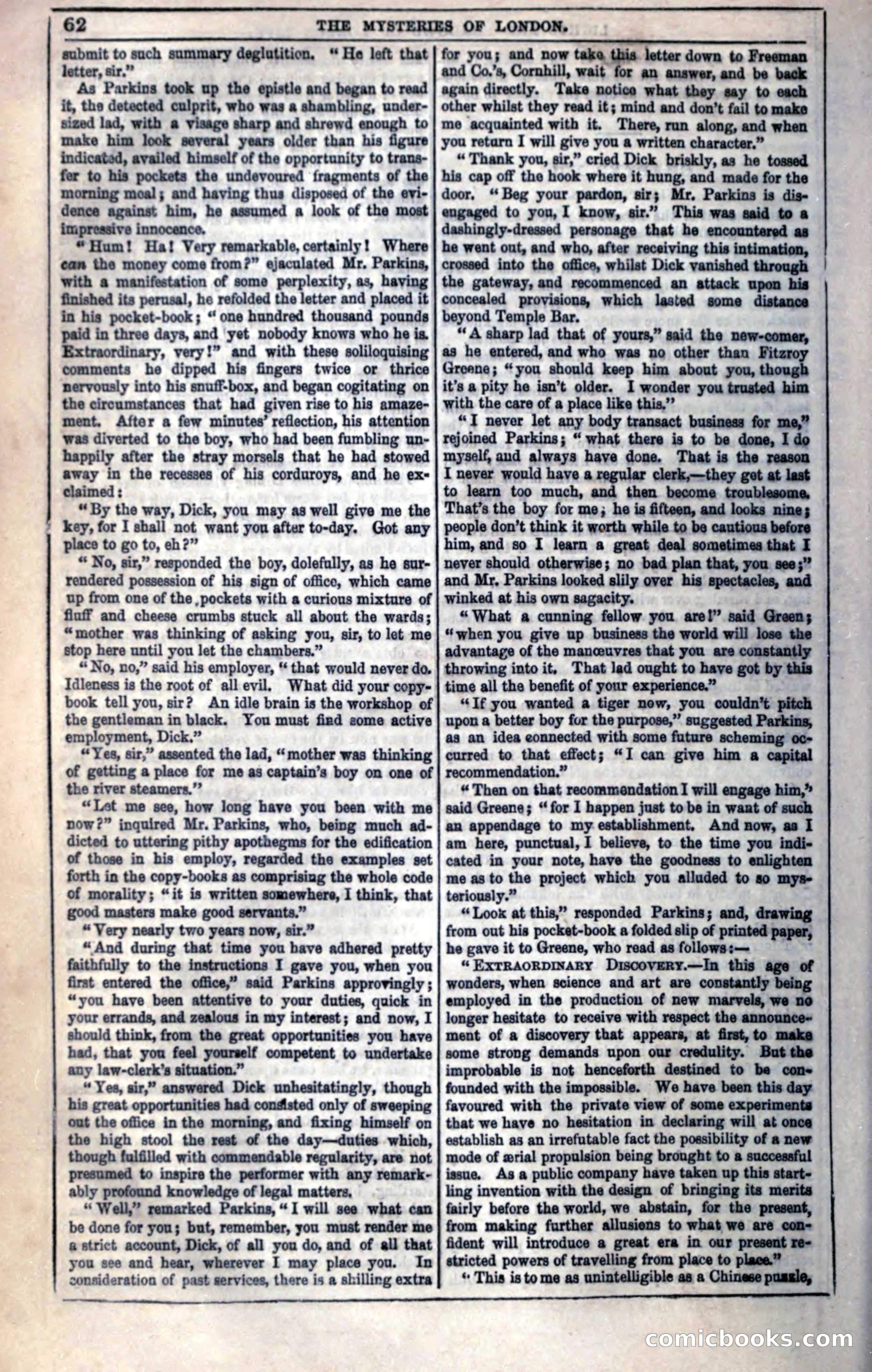
A restored page from Penny Dreadfuls, 1850. Page through the whole issue in the reader above.
📄 Transcribed text from this page (OCR, searchable)
Machine-transcribed from the original scan — historical spelling and the odd misread are preserved.
62 THE MYSTERIES OF LONDON, submit to such summary deglutition. “ He left that| for you; and now ae letter down to Freeman or letter, sir.” As Parkins took up the epistle and began to read it, the detected culprit, who was a shambling, under- sized lad, with a visage sharp and shrewd enough to make him look several years older than his figure indicated, availed himself of the opportunity to trans- fer to his pockets the undevoured fragments of the morning moal; and having thus disposed of the eyi- dence against him, he assumed a look of the most impressive innocence. “Hum! Ha! Very remarkable, certainly! Where can the money come from?” ejaculated Mr. Parkins, with a manifestation of some perplexity, as, having finished its perusal, he refolded the letter and placed it in his pocket-book; “one hundred thousand pounds paid in three days, and yet nobody knows who he is. Extraordinary, very!” and with these soliloquising comments he dipped his fingers twice or thrice nervously into his snuff-box, and began cogitating on the circumstances that had given rise to his amaze- ment. After a few minutes’ reflection, his attention was diverted to the boy, who had been fumbling un- happily after the stray morsels that he had stowed away in the recesses of his corduroys, and he ex- claimed ;: “ By the way, Dick, you may as well give me the * key, for I shall not want you after to-day. Got any place to go to, eh?” “ No, sir,” responded the boy, dolefully, as he sur- rendered possession of his sign of office, which came up from one of the ,pockets with a curious mixture of fluff and cheese crumbs stuck all about the wards; “mother was thinking of asking you, sir, to let me stop here until you let the chambers.” “ No, no,” said his employer, “ that would never do. Idleness is the root of all evil. What did your copy- book tell you, sir? An idle brain is the workshop of the gentleman in black. You must find some active employment, Dick.” “Yes, sir,” assented the lad, “mother was thinking of getting a place for me as captain’s boy on one of the river steamers.”’ “Let me see, how long have you been with me now?” inquired Mr. Parkins, who, being much ad- dicted to uttering pithy apothegms for the edification of those in his employ, regarded the examples set forth in the copy-books as comprising the whole code of morality; “it is written somewhere, I think, that good masters make good servants.” “Very nearly two years now, sir.” “And during that time you have adhered pretty faithfully to the instructions I gave you, when you firat entered the office,” said Parkins approvingly ; “you have been attentive to your duties, quick in your errands, and zealous in my interest; and now, I should think, from the great opportunities you have had, that you feel yourself competent to undertake any law-clerk’s situation.” “ Yes, sir,” answered Dick unhesitatingly, though his great opportunities had condisted only of sweeping out the office in the morning, and fixing himself on the high stool the rest of the day—duties which, though fulfilled with commendable regularity, are not presumed to inspire the performer with any remark- ably profound knowledge of legal matters, “ Well,” remarked Parkins, “I will see what can be done for you; but, remember, you must render me a strict account, Dick, of all you do, and of all that you see and hear, wherever I may place you. In consideration of past services, there is a shilling extra and Co,’s, Cornhill, wait for an answer, and be back again directly. Take notice what they say to each other whilst they read it; mind and don’t fail to make me acquainted with it. There, run along, and when you retarn I will give you a written character.” “ Thank you, sir,” cried Dick briskly, as he tossed his cap off the hook where it hung, and made for the door, “ Beg your pardon, sir; Mr, Parkins is dis- engaged to you, I know, sir.” This was said to a dashingly-dressed personage that he encountered as he went out, and who, after receiving this intimation, crossed into the office, whilst Dick vanished through the gateway, and recommenced an attack upon his concealed provisions, which lasted some distance beyond Temple Bar. “A sharp lad that of yours,” said the new-comer, as he entered, and who was no other than Fitzro Greene; “you should keep him about you, though it’s a pity he isn’t older. I wonder you trusted him with the care of a place like this,” “T never let any body transact business for me,” rejoined Parkins; “ what there is to be done, I do myself, aud always have done. That is the reason I never would have a regular clerk,—they get at last to learn too much, and then become troublesome, That’s the boy for me; he is fifteen, and looks nines people don’t think it worth while to be cautious before him, and so I learn a great deal sometimes that I never should otherwise; no bad plan that, you see;” and Mr, Parkins looked slily over his spectacles, and winked at his own sagacity. “What a cunning fellow you are!” said Green; “when you give up business the world will lose the advantage of the manceuvres that you are constantly throwing into it, That lad ought to have got by this time all the benefit of your experience.” “If you wanted a tiger now, you couldn’t pitch upon a better boy for the purpose,” suggested Parkins, as an idea eonnected with some future scheming oc- curred to that effect; “I can give him a capital recommendation.” “ Then on that recommendation I will engage him,” said Greene; “for 1 happen just to be in want of such an appendage to my establishment, And now, as I am here, punctual, I believe, to the time you indi- cated in your note, have the goodness to enlighten me as to the project which you alluded to so mys- teriously.” : “Look at this,” responded Parkins; and, drawing from out his pocket-book a folded slip of printed paper, he gave it to Greene, who read as follows:— | “ EXTRAORDINARY Discovery.—In this age of wonders, when science and art are constantly being employed in the production of new marvels, we no longer hesitate to receive with respect the announce+ ment of a discovery that appears, at first,to make some strong demands upon our credulity. But the improbable is not henceforth destined to be con- founded with the impossible. We have been this day favoured with the private view of some experiments that we have no hesitation in declaring will at once establish as an irrefutable fact the possibility of a new mode of wrial propulsion being bronght to a successful issue. As a public company have taken up this start- ling invention with the design of bringing its merits fairly before the world, we abstain, for the present, from making further allusions to what we are con- fident will introduce a great era in our present re- stricted powers of travelling from place to place.” « This isto me as unintelligible as a Chinese pussle, rep Te Gomicbooks.co li oe ——— .