
Penny Dreadfuls, 1853 · page 105 of 151
The Seamstress; or, The White Slave of England — page 105: what you’re looking at
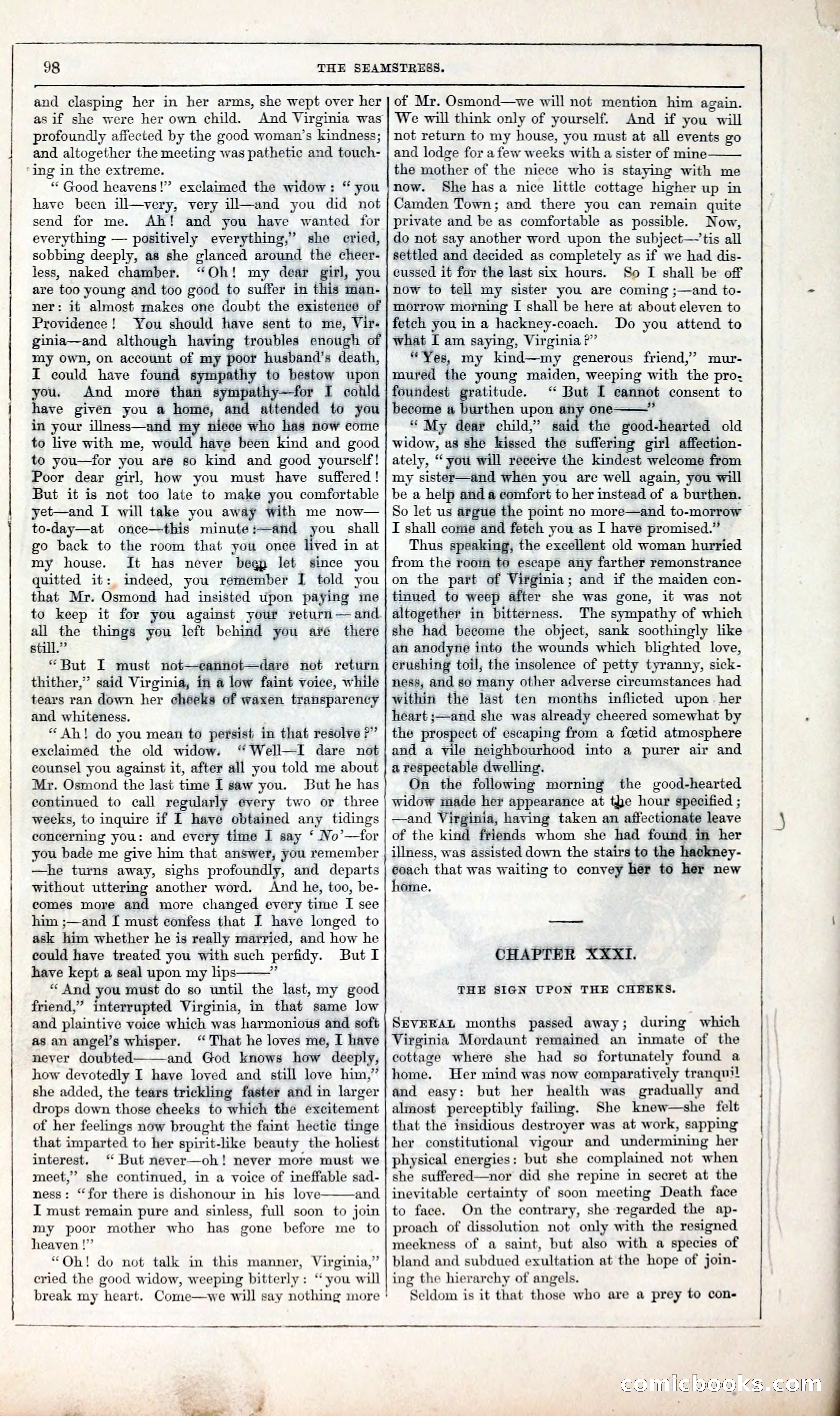
A restored page from Penny Dreadfuls, 1853. Page through the whole issue in the reader above.
📄 Transcribed text from this page (OCR, searchable)
Machine-transcribed from the original scan — historical spelling and the odd misread are preserved.
OO es LLL! LLL LL LL EL LCC ————————— eee oe ee ee 98 THE SEAMSTRESS. and clasping her in her arms, she wept over her as if she were her own child. And Virginia was profoundly affected by the good woman’s kindness; and altogether the meeting was pathetic and touch- ‘ing in the extreme. “ Good heavens!” exclaimed the widow: “ you have been ill—very, very il—and you did not send for me. Ah! and you have wanted for everything — positively everything,” she cried, sobbing deeply, as she glanced around the cheer- less, naked chamber. “Oh! my dear girl, you are too young and too good to suffer in this man- ner: it almost makes one doubt the existence of Providence! You should have sent to mie, Vir- ginia—and although having troubles enough of my own, on account of my poor husband’s death, I could have found sympathy to bestow upon you. And more than sympathy—for I cotdd have given you a home, and attended to you in your illness—and my niece who has now come to live with me, would have been kind and good to you—for you are so kind and good yourself! Poor dear girl, how you must have suffered! But it is not too late to make you comfortable yet—and I will take you away with me now— to-day—at once—this minute:—and you shall go back to the room that you once lived in at my house. It has never beep let since you quitted it: indeed, you remember I told you that Mr. Osmond had insisted upon paying me to keep it for you against your return — and. all the things you left behind you are there still.” “But I must not—cannot—dare not return thither,” said Virginia, in a low faint voice, while tears ran down her cheeks of waxen transparency and whiteness. “ Ah! do you mean to persist in that resolve ?” exclaimed the old widow. ‘“ Well—I dare not counsel you against it, after all you told me about Mr. Osmond the last time I saw you. But he has continued to call regularly every two or three weeks, to inquire if I have obtained any tidings concerning you: and every time I say ‘ No’—for you bade me give him that answer, you remember —he turns away, sighs profoundly, and departs without uttering another word. And he, too, be- comes more and more changed every time I see him ;—and I must confess that I have longed to ask him whether he is really married, and how he could haye treated you with such perfidy. But I have kept a seal upon my lips “ And you must do so until the last, my good friend,” interrupted Virginia, in that same low and plaintive voice which was harmonious and soft as an angel’s whisper. “That he loves me, I have never doubted and God knows how deeply, how devotedly I have loyed and still love him,” she added, the tears trickling faster and in larger drops down those cheeks to which the excitement of her feelings now brought the faint hectie tinge that imparted to her spirit-like beauty the holiest interest. “ But never—oh! never more must we meet,’ she continued, in a voice of ineffable sad- ness: “for there is dishonour in his love and I must remain pure and sinless, full soon to join my poor mother who has gone before me to heaven !”’ “Oh! do not talk in this manner, cried the good widow, weeping bitterly : break my heart. Virginia,” “you will —= ee Come—we will say nothing more ' of Mr. Osmond—we will not mention him again. We will think only of yourself. And if you “will not return to my house, you must at all events go and lodge for afew weeks with a sister of mine the mother of the niece who is staying with me now. She has a nice little cottage higher up in Camden Town; and there you can remain quite private and be as comfortable as possible. Now, do not say another word upon the subject—’tis all settled and decided as completely as if we had dis- cussed it for the last six hours. So I shall be off now to tell my sister you are coming ;—and to- morrow morning [ shall be here at about eleven to fetch you in a hackney-coach. Do you attend to what I am saying, Virginia?” “Yes, my kind—my generous friend,” mur- mured the young maiden, weeping with the pro- foundest gratitude. “ But I earhet consent to become a burthen upon one “ My dear child,” said the weed hearted old widow, as she kissed the suffering girl affection- ately, “you will receive the kindest welcome from my sister—and when you are well again, you will be a help and a comfort to her instead of a burthen. So let us argue the point no more—and to-morrow I shall come and fetch you as I have promised.” Thus speaking, the excellent old woman hurried from the room to escape any farther remonstrance on the part of Virginia; and if the maiden con- tinued to weep after she was gone, it was not altogether in bitterness. The sympathy of which she had become the object, sank soothingly like an anodyne into the wounds which blighted love, crushing toil, the insolence of petty tyranny, sick- ness, and so many other adverse circumstances had within the last ten months inflicted upon her heart ;—and she was already cheered somewhat by the prospect of escaping from a fcetid atmosphere and a vile neighbourhood into a purer air and a respectable dwelling. On the following morning the good-hearted widow made her appearance at te hour specified ; —and Virginia, having taken an affectionate leave of the kind friends whom she had found in her illness, was assisted down the stairs to the hackney- eoach that was waiting to convey her to her new home. CHAPTER XXXI. THE SIGN UPON THE CHEEKS. SEVERAL months passed away; during which Virginia Mordaunt remained an inmate of the cottage where she had so fortunately found a home. Her mind was now comparatively tranqui! and easy: but her health was gradually and almost perceptibly failmg. She knew—she felt that the msidious destroyer was at work, sapping her constitutional vigour and undermining her physical energies: but she complained not when she suffered—nor did she repine in secret at the inevitable certainty of soon meeting Death face to face. On the contrary, she regarded the ap- proach of dissolution not only with the resigned meekness of a saint, but also with a species of bland and subdued exultation at the hope of join- ing the hierarchy of angels. Seldom is it that those who are a prey to con- _—_——_- --——— —- — — -————_ = - - ——_ + Gomicbdoo