
Penny Dreadfuls, 1853 · page 106 of 151
The Seamstress; or, The White Slave of England — page 106: what you’re looking at
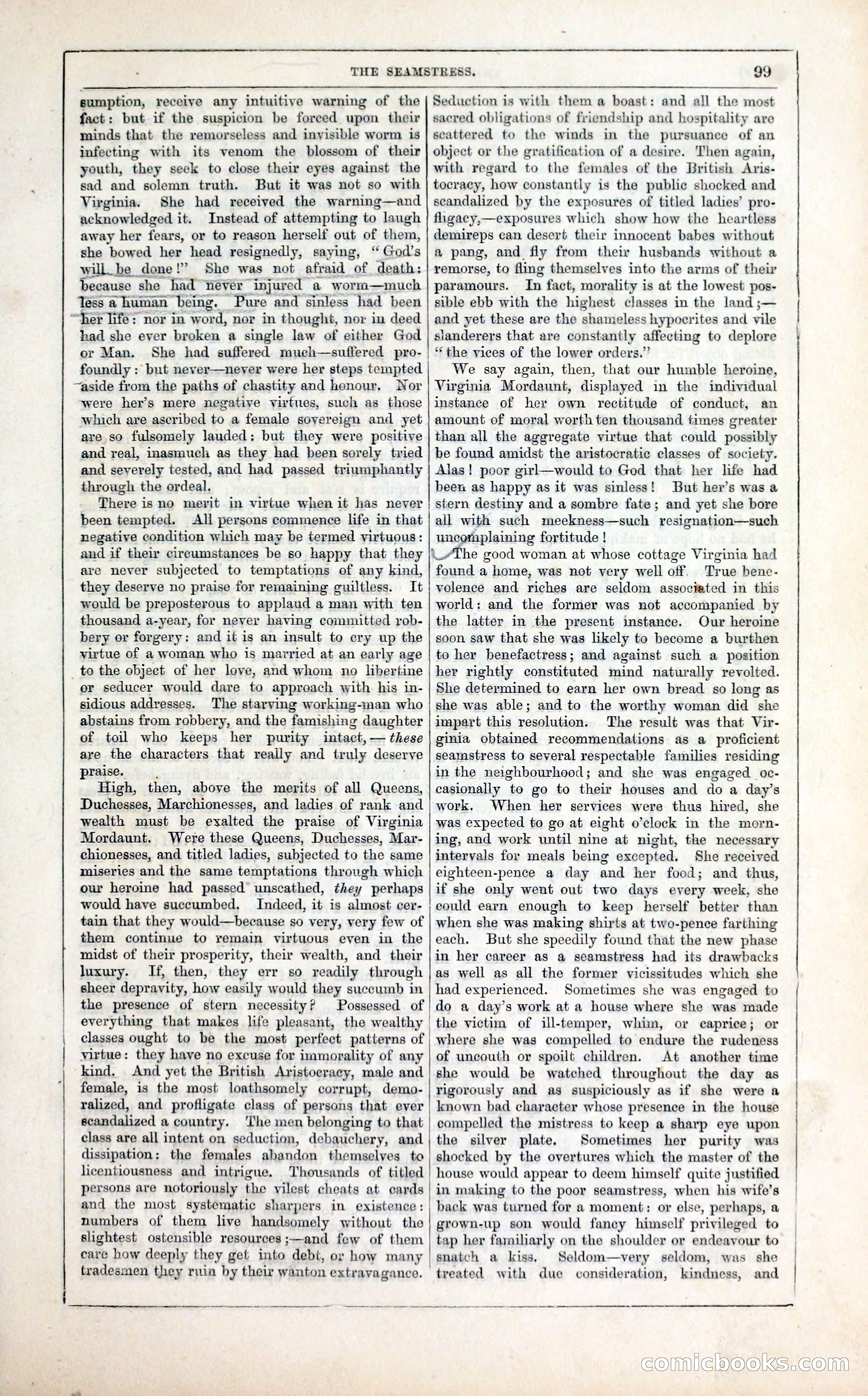
A restored page from Penny Dreadfuls, 1853. Page through the whole issue in the reader above.
📄 Transcribed text from this page (OCR, searchable)
Machine-transcribed from the original scan — historical spelling and the odd misread are preserved.
| | _to the object of her love, and whom no libertine THE SEAMSTRESS. 99 sumption, receiye any intuitive warning of the | Seduction is with them a boast: and all the most fact: but if the suspicion be forced upon their | sacred obligations of friendship and hospitality are minds that the remorseless and invisible worm is | scattered to the winds in the pursuance of an infecting with its venom the blossom of their | object or the gratification of a desire. Then again, youth, they seek to close their eyes against the} with regard to the females of the British Aris- sad and solemn truth. But it was not so with | tocracy, how constantly is the public shocked and Virginia. She had received the warning—and | seandalized by the exposures of titled ladies’ pro- acknowledged it. Instead of attempting to laugh | fligacy,—exposures which show how the heartless away her fears, or to reason herself out of them, | demireps can desert their innocent babes without she bowed her head resignedly, saying, “God’s|a pang, and fly from their husbands without a will_be done!’ ‘She was not afraid of death: | remorse, to fling themselves into the arms of their because she had never injured a worm—much | paramours. In fact, morality is at the lowest pos- Tess a human being. Pure and sinless had been} sible ebb with the highest classes in the land ;— “her life: nor in word, nor in thought, nor in deed | and yet these are the shameless hypocrites and vile had she ever broken a single law of either God | slanderers that are constantly affecting to deplore or Man. She had suffered much—suffered pro- | “ the vices of the lower ordeyrs.” foundly : but never—never were her steps tempted We say again, then, that our humble heroine, ~aside from the paths of chastity and honour. Nor | Virginia Mordaunt, displayed in the individual were her’s mere negative virtues, such as those | instance of her own rectitude of conduct, an which are ascribed to a female soyereign and yet | amount of moral worth ten thousand times greater are so fulsomely lauded: but they were positive | than all the aggregate virtue that could possibly and real, inasmuch as they had been sorely tiied | be found amidst the aristocratic classes of society. and severely tested, and had passed triumphantly | Alas! poor girl—would to God that her life had through the ordeal. been as happy as it was sinless! But her’s was a There is no merit in virtue when it has never | stern destiny and a sombre fate; and yet she bore been tempted. All persons commence life in that | all with such meekness—such resignation—such negative condition which may be termed yirtuous: | uncoraplaining fortitude ! and if their circumstances be so happy that they |\_/The good woman at whose cottage Virginia had are never subjected to temptations of any kind, | found a home, was not very well off, True bene- they deserve no praise for remaining cuiltless. It|volence and riches are seldom associated in this would be preposterous to applaud a man with ten | world: and the former was not accompanied by thousand a-year, for never having committed rob-| the latter in the present instance. Our heroine bery or forgery: and it is an insult to cry up the | soon saw that she was likely to become a burthen yirtue of a woman who is married at an early age | to her benefactress; and against such a position her rightly constituted mind naturally revolted. She determined to earn her own bread so long as she was able; and to the worthy woman did she impart this resolution. The result was that Vir- ginia obtained recommendations as a _ proficient seamstress to several respectable families residing in the neighbourhood; and she was engaged oc- casionally to go to their houses and do a day’s work. When her services were thus hired, she was expected to go at eight o’clock in the morn- ing, and work until nine at night, the necessary intervals for meals being excepted. She received eighteen-pence a day and her food; and thus, if she only went out two days every week, she could earn enough to keep herself better than when she was making shirts at two-pence farthing each. But she speedily found that the new phase in her career as a seamstress had its drawbacks as well as all the former vicissitudes which she had experienced. Sometimes she was engaged to do a day’s work at a house where she was made the victim of ill-temper, whim, or ecaprice; or where she was compelled to endure the rudeness of uncouth or spoilt children. At another time she would be watched throughout the day as rigorously and as suspiciously as if she were a known bad charaeter whose presence in the house compelled the mistress to keep a sharp eye upon er seducer would dare to approach with his in- sidious addresses. The starving working-man who abstains from robbery, and the famishing daughter of toil who keeps her purity intact, — these are the characters that really and truly deserve praise. ; High, then, aboye the merits of all Queens, Duchesses, Marchionesses, and ladies of rank and wealth must be exalted the praise of Virginia Mordaunt. Were these Queens, Duchesses, Mar- chionesses, and titled ladies, subjected to the same miseries and the same temptations through which our heroine had passed unscathed, they perhaps would have succumbed, Indeed, it is almost cer- tain that they would—because so very, very few of them continue to remain virtuous even in the midst of their prosperity, their wealth, and their luxury. If, then, they err so readily through sheer depravity, how easily would they succumb in the presence of stern necessity? Possessed of everything that makes life pleasant, the wealthy classes ought to be the most perfect patterns of virtue: they have no excuse for immorality of any kind, And yet the British Aristocracy, male and female, is the most loathsomely corrupt, demo- ralized, and profligate class of persons that ever scandalized a country. ‘The men belonging to that class are all intent on seduction, debauchery, andj the silver plate. Sometimes her purity was dissipation: the females abandon themselves to | shocked by the overtures which the master of the licentiousness and intrigue. Thousands of titled | house would appear to deem himself quite justified persons are notoriously the yilest cheats at cards | in making to the poor seamstress, when his wife’s and the most systematic sharpers in existence: | back was turned for a moment: or else, perhaps, a numbers of them live handsomely without the | grown-up son would faney himself privileged to slightest ostensible resources ;—and few of them | tap her familiarly on the shoulder or endeavour to care how deeply they get into debt, or how many | snatch a kiss. Seldom—very seldom, was she tradesmen they ruin by their wanton extravagance. treated with due consideration, kindness, and a a ii ee ee en Se ee CONNIE KOOKS (SO)