
Penny Dreadfuls, 1853 · page 129 of 151
The Seamstress; or, The White Slave of England — page 129: what you’re looking at
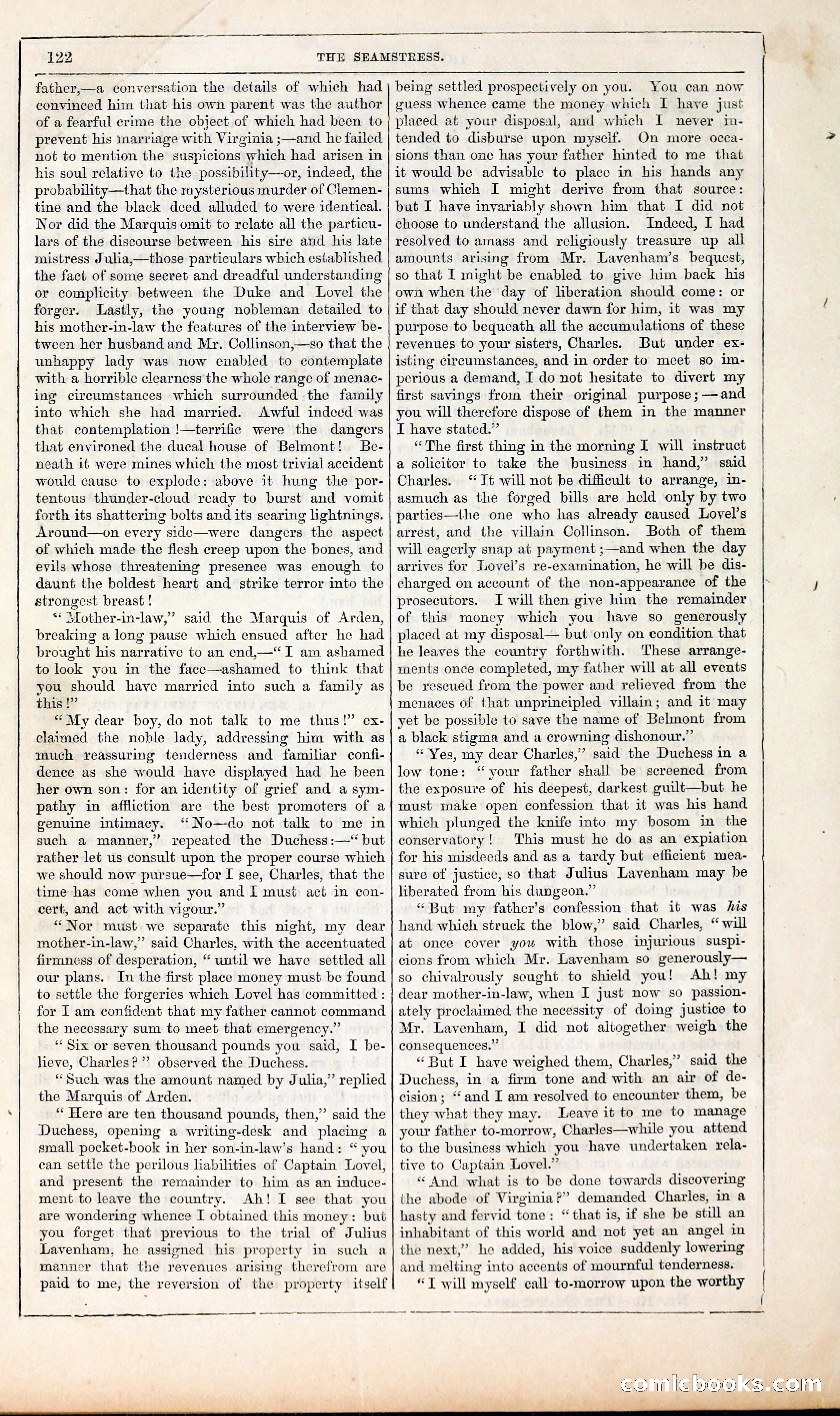
A restored page from Penny Dreadfuls, 1853. Page through the whole issue in the reader above.
📄 Transcribed text from this page (OCR, searchable)
Machine-transcribed from the original scan — historical spelling and the odd misread are preserved.
122 father,—a conversation the details of which had convinced him that his own parent was the author of a fearful crime the object of which had been to prevent his marriage with Virginia ;—and he failed not to mention the suspicions which had arisen in his soul relative to the possibility—or, indeed, the probability—that the mysterious murder of Clemen- tine and the black deed alluded to were identical. Nor did the Marquis omit to relate all the particu- lars of the discourse between his sire and his late mistress Julia,—those particulars which established the fact of some secret and dreadful understanding or complicity between the Duke and Lovel the forger. Lastly, the young nobleman detailed to his mother-in-law the features of the interview be- tween her husband and Mr. Collinson,—so that the unhappy lady was now enabled to contemplate with a horrible clearness the whole range of menac- ing circumstances which surrounded the family into which she had married. Awful indeed was that contemplation !—terrifie were the dangers that environed the ducal house of Belmont! Be- neath it were mines which the most trivial accident would cause to explode: above it hung the por- tentous thunder-cloud ready to burst and vomit forth its shattering bolts and its searing lightnings. Around—on every side—were dangers the aspect of which made the flesh creep upon the bones, and evils whose threatening presence was enough to daunt the boldest heart and strike terror into the strongest breast ! ** Mother-in-law,” said the Marquis of Arden, breaking a long pause which ensued after he had brought his narrative to an end,—* I am ashamed to look you in the face—ashamed to think that you should have married into such a family as this !” * My dear boy, do not talk to me thus!” ex- claimed the noble lady, addressing him with as much reassuring tenderness and familiar confi- dence as she would have displayed had he been her own son: for an identity of grief and a sym- pathy in affliction are the best promoters of a genuine intimacy. ‘‘No—do not talk to me in such a manner,’ repeated the Duchess :—“ but rather let us consult upon the proper course which we should now pursue—for I see, Charles, that the time has come when you and I must act in con- cert, and act with vigour.” “Nor must we separate this night, my dear mother-in-law,” said Charles, with the accentuated firmness of desperation, “ until we have settled all our plans. In the first place money must be found to settle the forgeries which Lovel has committed : for I am confident that my father cannot command. the necessary sum to meet that emergency.” “Six or seven thousand pounds you said, I be- lieve, Charles? ”? observed the Duchess. “Such was the amount named by Julia,” replied the Marquis of Arden. “ Here are ten thousand pounds, then,” said the Duchess, opening a writing-desk and placing a small pocket-book in her son-in-law’s hand: “ you can settle the perilous liabilities of Captain Lovel, and present the remainder to him as an induce- ment to leave the country. Ah! I see that you are wondering whence I obtained this money: but you forget that previous to the trial of Julius Lavenham, he assigned his property im such a manner that the revenues arising therefrom are paid to me, the reversion of the property itself ee rr THE SEAMSTRESS. being settled prospectively on you. You can now guess whence came the money which I have just placed at your disposal, and which I never in- tended to disburse upon myself. On more occa- sions than one has your father hinted to me that it would be advisable to place in his hands any sums which I might derive from that source: but I have invariably shown him that I did not choose to understand the allusion. Indeed, I had resolved to amass and religiously treasure up all amounts arismg from Mr. Lavenham’s bequest, so that I might be enabled to give him back his own when the day of liberation should come: or if that day should never dawn for him, it was my purpose to bequeath all the accumulations of these revenues to your sisters, Charles. But under ex- isting circumstances, and in order to meet so im- perious a demand, I do not hesitate to divert my first savings from their original purpose ;— and. you will therefore dispose of them in the manner I have stated.” “The first thing in the morning I will instruct a solicitor to take the business in hand,” said Charles. “It will not be difficult to arrange, in- asmuch as the forged bills are held only by two parties—the one who has already caused Lovel’s arrest, and the villain Collinson. Both of them will eagerly snap at payment ;—and when the day arrives for Lovel’s re-examination, he will be dis- charged on account of the non-appearance of the prosecutors. I will then give him the remainder of this money which you have so generously placed at my disposal— but only on condition that he leaves the country forthwith. These arrange- ments once completed, my father will at all events be rescued from the power and relieved from the menaces of that unprincipled villain; and it may yet be possible to save the name of Belmont from a black stigma and a crowning dishonour.”’ “Yes, my dear Charles,” said the Duchess in a low tone: “your father shall be screened from the exposure of his deepest, darkest guilt—but he must make open confession that it was his hand which plunged the knife into my bosom in the conservatory! This must he do as an expiation for his misdeeds and as a tardy but efficient mea- sure of justice, so that Julius Lavenham may be liberated from his dungeon.” “But my father’s confession that it was his hand which struck the blow,” said Charles, “ will at once cover you with those injurious suspi- cions from which Mr. Lavenham so generously— so chivalrously scught to shield you! Ah! my dear mother-in-law, when I just now so passion- ately proclaimed the necessity of doing justice to Mr. Lavenham, I did not altogether weigh the consequences.” “But I have weighed them, Charles,” said the Duchess, in a firm tone and with an air of de- cision; “and I am resolved to encounter them, be they what they may. Leave it to me to manage your father to-morrow, Charles—while you attend to the business which you have undertaken rela- tive to Captain Lovel.” “ And what is to be done towards discovering the abode of Virginia?” demanded Charles, in a hasty and fervid tone: “that is, if she be still an inhabitant of this world and not yet an angel in the next,” he added, his voice suddenly lowering and melting into accents of mournful tenderness. “TJ will myself call to-morrow upon the worthy ae -_—— me ee + eee —_—_