
Penny Dreadfuls, 1853 · page 130 of 151
The Seamstress; or, The White Slave of England — page 130: what you’re looking at
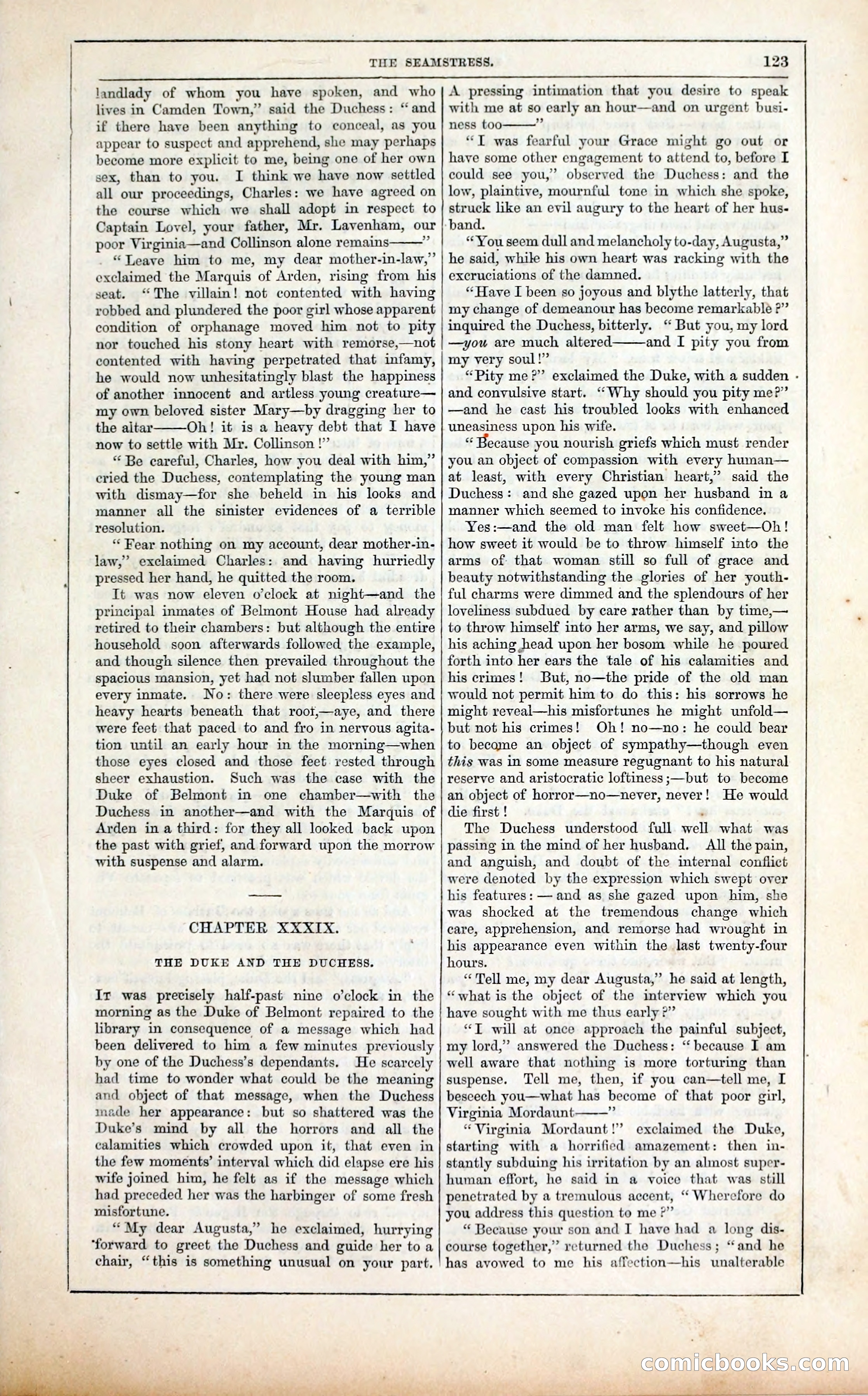
A restored page from Penny Dreadfuls, 1853. Page through the whole issue in the reader above.
📄 Transcribed text from this page (OCR, searchable)
Machine-transcribed from the original scan — historical spelling and the odd misread are preserved.
THE SEAMSTRESS. 123 landlady of whom you have spoken, and who lives in Camden Town,” said the Duchess: “and if there have been anything to conceal, as you appear to suspect and apprehend, she may perhaps become more explicit to me, being one of her own sex, than to you. I think we have now settled all our proceedings, Charles: we have agreed on the course which we shall adopt in respect to Captain Lovel, your father, Mr. Lavenham, our poor Virginia—and Collinson alone remains ¥ “Teave him to me, my dear mother-in-law,’ exclaimed the Marquis of Arden, rising from his seat. “The villain! not contented with having robbed and plundered the poor girl whose apparent condition of orphanage moved him not to pity nor touched his stony heart with remorse,—not contented with having perpetrated that infamy, he would now unhesitatingly blast the happiness of another innocent and artless young creature— my own beloved sister Mary—by dragging her to the altar Oh! it is a heavy debt that 1 have now to settle with Mr. Collinson !” “ Be careful, Charles, how you deal with him,” cried the Duchess, contemplating the young man with dismay—for she beheld in his looks and manner all the sinister evidences of a terrible resolution. “ Fear nothing on my account, dear mother-in- law,” exclaimed Charles: and having hurriedly pressed her hand, he quitted the room. It was now eleven o’clock at night—and the principal inmates of Belmont House had already retired to their chambers: but although the entire household soon afterwards followed the example, and though silence then prevailed throughout the spacious mansion, yet had not slumber fallen upon every inmate. No: there were sleepless eyes and heavy hearts beneath that root,—aye, and there were feet that paced to and fro in nervous agita- tion until an early hour in the morning—when those eyes closed and those feet rested through sheer exhaustion. Such was the case with the Duke of Belmont in one chamber—with the Duchess in another—and with the Marguis of Arden in a third: for they all looked back upon the past with grief, and forward upon the morrow with suspense and alarm. — + CHAPTER XXXIX. THE DUKE AND THE DUCHESS. Ir was precisely half-past nine o’clock in the morning as the Duke of Belmont repaired to the library in consequence of a message which had been delivered to him a few minutes previously by one of the Duchess’s dependants. He scarcely had time to wonder what could be the meaning and object of that message, when the Duchess meade her appearance: but so shattered was the Duke’s mind by all the horrors and all the calamities which crowded upon it, that even in the few moments’ interval which did elapse ere his wife joined him, he felt as if the message which had preceded her was the harbinger of some fresh misfortune. “My dear Augusta,’ > he exclaimed, hurrying ‘forward to greet the Duchess and guide her to a chair, “this is something unusual on your part. A pressing intimation that you desire to speak with me at so early an hour—and on urgent busi- ness too ra “T was fearful your Grace might go out or have some other engagement to attend to, before IL could see you,’ observed the Duchess: and the low, plaintive, mournful tone in which she spoke, struck like an evil augury to the heart of her hus- ‘band. “You seem dull and melancholy to-day, Augusta,” he said, while his own heart was racking with the excruciations of the damned. “Have I been so joyous and blythe latterly, that my change of demeanour has become remarkable ?” inquired the Duchess, bitterly. “ But you, my lord —you are much altered and I pity you from my very soul!” “Pity me?” exclaimed the Duke, with a sudden - and convulsive start. “‘Why should you pity me?” —and he cast his troubled looks with enhanced uneasiness upon his wife. “ Because you nourish griefs which must render you an object of compassion with every human— at least, with every Christian heart,” said the Duchess: and she gazed upon her husband in a manner which seemed to invoke his confidence. Yes:—and the old man felt how sweet—Oh! how sweet it would be to throw himself into the arms of that woman still so full of grace and beauty notwithstanding the glories of her youth- ful charms were dimmed and the splendours of her loveliness subdued by care rather than by time,— to throw himself into her arms, we say, and pillow his aching head upon her bosom while he poured forth into her ears the tale of his calamities and his crimes! But, no—the pride of the old man would not permit him to do this: his sorrows he might reveal—his misfortunes he might unfold— but not his crimes! Oh! no—no: he could bear to become an object of sympathy—though even this was in some measure regugnant to his natural reserve and aristocratic loftiness;—but to become an object of horror—no—never, never! He would cie first ! : The Duchess understood full well what was passing in the mind of her husband. All the pain, and anguish, and doubt of the internal conflict were denoted by the expression which swept over his features: — and as she gazed upon him, she was shocked at the tremendous change which care, apprehension, and remorse had wrought in his appearance even within the last twenty-four hours. “Tell me, my dear Augusta,” he said at length, “what is the object of the interview which you have sought with me thus early?” “T will at once approach the painful subject, my lord,’ answered the Duchess: ‘“ because I am well aware that nothing is more torturing than suspense. Tell me, then, if you can—tell me, I bescech you—what has become of that poor girl, Virginia Mordaunt 4 “Virginia Mordaunt!” exclaimed the Duke, starting with a horrified amazement: then in- stantly subduing his irritation by an almost super- human effort, he said in a voice that was still penetrated by a tremulous accent, “ Wherefore do you address this question to me ?” “ Because your son and I have had a long dis- course together,” returned the Duchess; “and he has avowed to me his affection—his unalterable (CO) Eomicboo