
Penny Dreadfuls, 1853 · page 97 of 151
The Seamstress; or, The White Slave of England — page 97: what you’re looking at
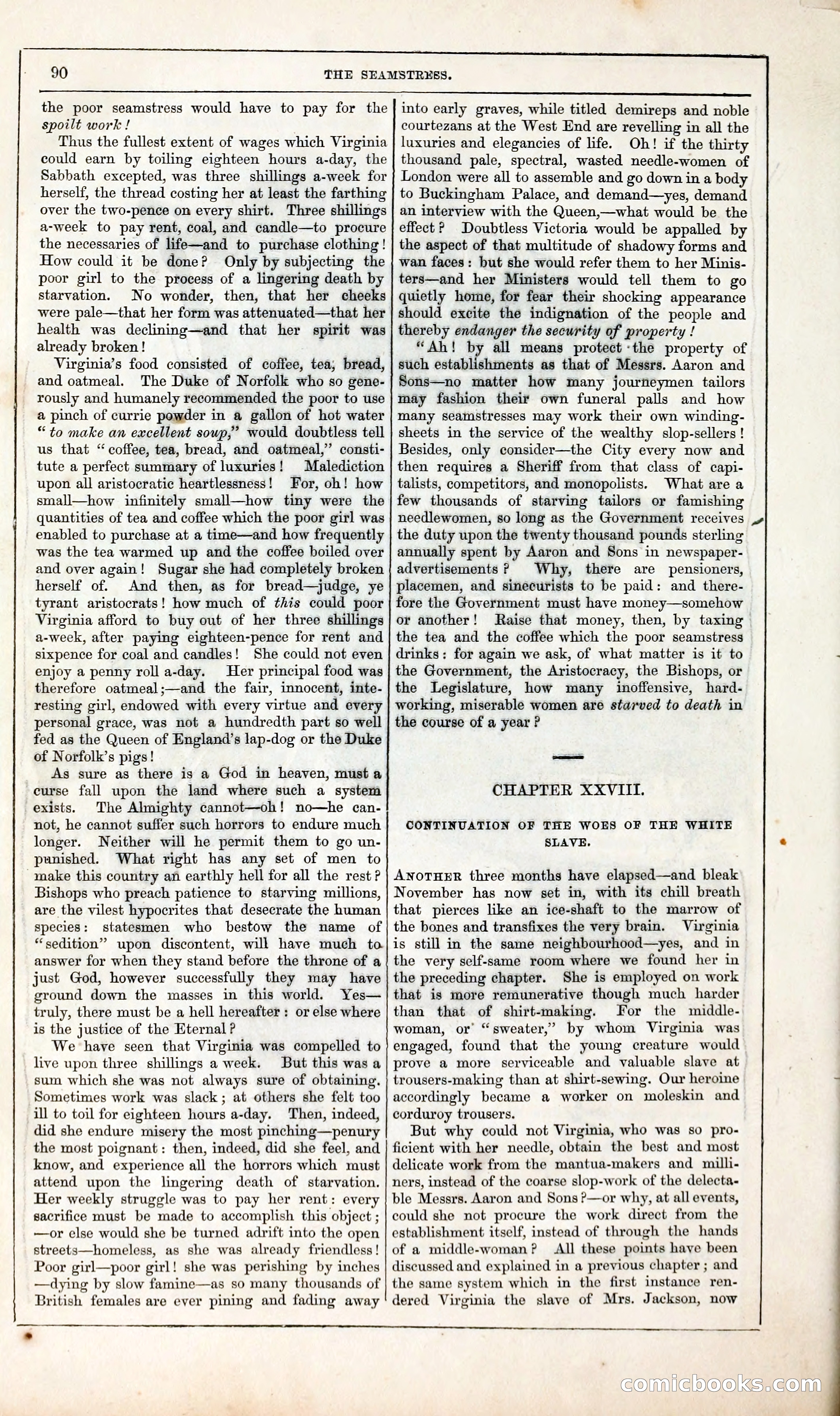
A restored page from Penny Dreadfuls, 1853. Page through the whole issue in the reader above.
📄 Transcribed text from this page (OCR, searchable)
Machine-transcribed from the original scan — historical spelling and the odd misread are preserved.
90 THE SEAMSTRYEES. LL SSS SSS the poor seamstress would have to pay for the spoilt work ! Thus the fullest extent of wages which Virginia could earn by toiling eighteen hours a-day, the Sabbath excepted, was three shillings a-week for herself, the thread costing her at least the farthing over the two-pence on every shirt. Three shillings a-week to pay rent, coal, and candle—to procure the necessaries of life—and to purchase clothing ! How could it be done? Only by subjecting the poor girl to the process of a lingering death by starvation. No wonder, then, that her cheeks were pale—that her form was attenuated—that her health was declining—and that her spirit was already broken! Virginia’s food consisted of coffee, tea, bread, and oatmeal. The Duke of Norfolk who so gene- rously and humanely recommended the poor to use a pinch of currie powder in a gallon of hot water “to make an excellent sowp,’ would doubtless tell us that “ coffee, tea, bread, and oatmeal,” consti- tute a perfect summary of luxuries! Malediction upon all aristocratic heartlessness! For, oh! how small—how infinitely small—how tiny were the quantities of tea and coffee which the poor girl was enabled to purchase at a time—and how frequently was the tea warmed up and the coffee boiled over and over again! Sugar she had completely broken herself of. And then, as for bread—judge, ye tyrant aristocrats! how much of this could poor Virginia afford to buy out of her three shillings a-week, after paying eighteen-pence for rent and sixpence for coal and candles! She could not even enjoy a penny roll a-day. Her principal food was therefore oatmeal ;—and the fair, innocent, inte- resting girl, endowed with every virtue and every personal grace, was not a hundredth part so well fed as the Queen of England’s lap-dog or the Duke of Norfolk’s pigs! As sure as there is a God in heaven, must a curse fall upon the land where such a system exists. The Almighty cannot—oh! no—he can- not, he cannot suffer such horrors to endure much longer. Neither will he permit them to go un- punished. What right has any set of men to make this country an earthly hell for all the rest? Bishops who preach patience to starving millions, are the vilest hypocrites that desecrate the human species: statesmen who bestow the name of “sedition” upon discontent, will have much to answer for when they stand before the throne of a just God, however successfully they may have ground down the masses in this world. Yes— truly, there must be a hell hereafter: or else where is the justice of the Eternal P We have seen that Virginia was compelled to live upon three shillings a week. But this was a sum which she was not always sure of obtaining. Sometimes work was slack; at others she felt too ill to toil for eighteen hours a-day. Then, indeed, did she endure misery the most pinching—penury the most poignant: then, indeed, did she feel, and know, and experience all the horrors which must attend upon the lingering death of starvation. Her weekly struggle was to pay her rent: every sacrifice must be made to accomplish this object ; —or else would she be turned adrift into the open streets—homeless, as she was already friendless! Poor girl—poor girl! she was perishing by inches —dying by slow famine—as so many thousands of British females are ever pining and fading away LLL LLL EE tet ec EE into early graves, while titled demireps and noble courtezans at the West End are revelling in all the luxuries and elegancies of life. Oh! if the thirty thousand pale, spectral, wasted needle-women of London were all to assemble and go down in a body to Buckingham Palace, and demand—yes, demand an interview with the Queen,—what would be the effect ? Doubtless Victoria would be appalled by the aspect of that multitude of shadowy forms and wan faces: but she would refer them to her Minis- ters—and her Ministers would tell them to go quietly home, for fear their shocking appearance should excite the indignation of the people and thereby endanger the security of property ! “Ah! by all means protect the property of such establishments as that of Messrs. Aaron and Sons—no matter how many journeymen tailors may fashion their own funeral palls and how many seamstresses may work their own winding- sheets in the service of the wealthy slop-sellers! Besides, only consider—the City every now and then requires a Sheriff from that class of capi- talists, competitors, and monopolists. What are a few thousands of starving tailors or famishing needlewomen, so long as the Government receives the duty upon the twenty thousand pounds sterling annually spent by Aaron and Sons in newspaper- advertisements P Why, there are pensioners, placemen, and sinecurists to be paid: and there- fore the Government must have money—somehow or another! Raise that money, then, by taxing the tea and the coffee which the poor seamstress drinks: for again we ask, of what matter is it to the Government, the Aristocracy, the Bishops, or the Legislature, how many inoffensive, hard- working, miserable women are starved to death in the course of a year ? CHAPTER XXVIII. CONTINUATION OF THE WOES OF THE WHITE SLAVE. ANOTHER three months have elapsed—and bleak November has now set in, with its chill breath that pierces like an ice-shaft to the marrow of the bones and transfixes the very brain. Virginia is still in the same neighbourhood—yes, and in the very self-same room where we found her in the preceding chapter. She is employed on work that is more remunerative though much harder than that of shirt-making. For the muiddle- woman, or’ “sweater,” by whom Virginia was engaged, found that the young creature would prove a more serviceable and valuable slave at trousers-making than at shirt-sewing. Our heroine accordingly became a worker on moleskin and corduroy trousers. But why could not Virginia, who was so pro- ficient with her needle, obtain the best and most delicate work from the mantua-makers and mulli- ners, instead of the coarse slop-work of the delecta- ble Messrs. Aaron and Sons P—or why, at all events, could she not procure the work direct from the establishment itself, instead of through the hands of a middle-woman? All these points haye been discussed and explained in a previous chapter ; and the same system which in the first instance ren- dered Virginia the slave of Mrs. Jackson, now EOMIGooOO — _— ee ee eee CS