
Penny Dreadfuls, 1853 · page 98 of 151
The Seamstress; or, The White Slave of England — page 98: what you’re looking at
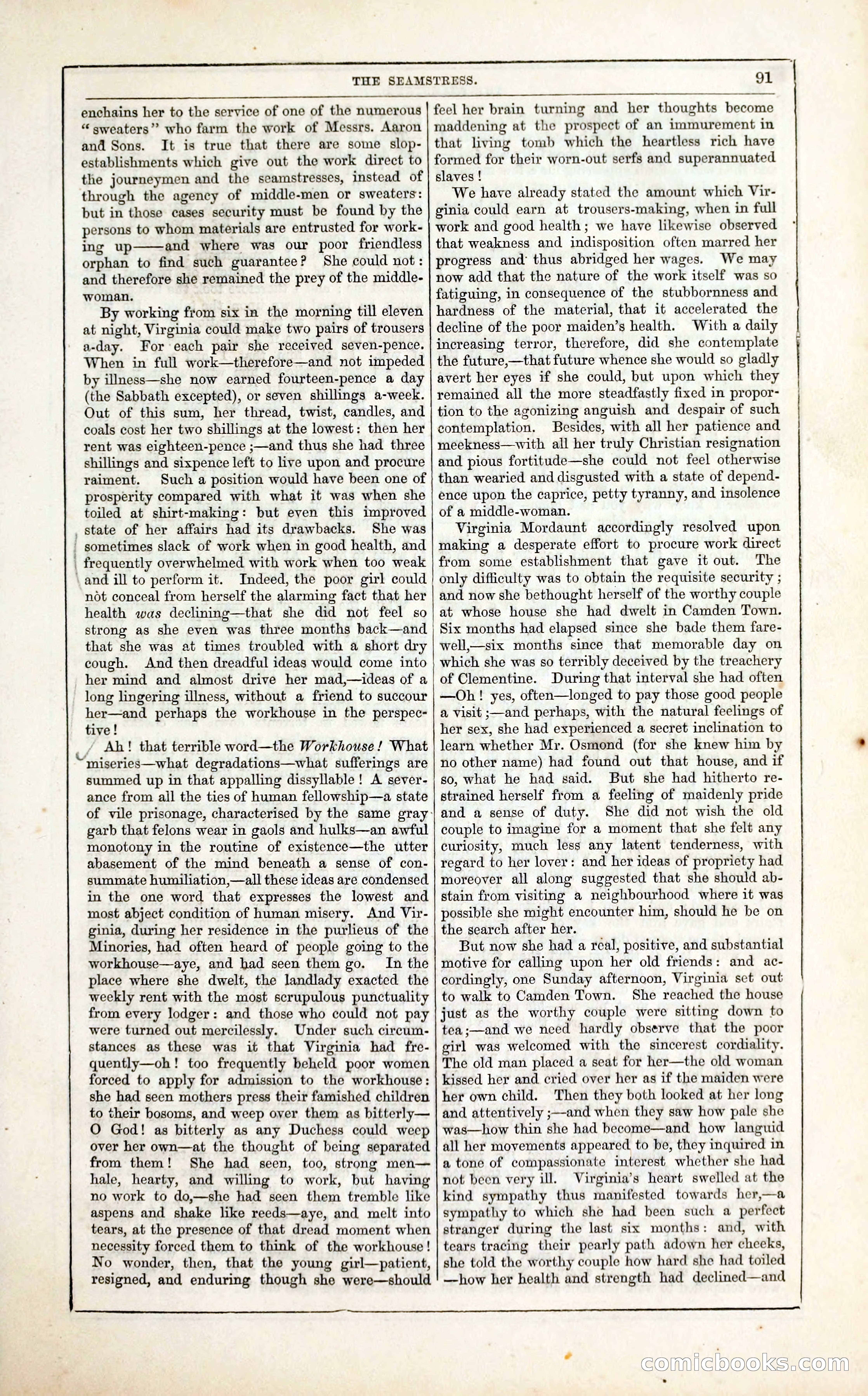
A restored page from Penny Dreadfuls, 1853. Page through the whole issue in the reader above.
📄 Transcribed text from this page (OCR, searchable)
Machine-transcribed from the original scan — historical spelling and the odd misread are preserved.
THE SEAMSTRESS. enchains her to the service of one of the numerous “ sweaters”? who farm the work of Messrs. Aaron and Sons. It is true that there are some slop- establishments which give out the work direct to the journeymen and the seamstresses, instead of through the agency of middle-men or sweaters: but in those cases security must be found by the persons to whom materials are entrusted for work- ing up and where was our poor friendless orphan to find such guarantee? She could not: and therefore she remained the prey of the middle- woman. By working from six in the morning till eleven at night, Virginia could make two pairs of trousers a-day. For each pair she received seven-pence. When in full work—therefore—and not impeded by illness—she now earned fourteen-pence a day (the Sabbath excepted), or seven shillings a-week. Out of this sum, her thread, twist, candles, and coals cost her two shillings at the lowest: then her rent was eighteen-pence ;—and thus she had three shillings and sixpence left to live upon and procure raiment. Such a position would have been one of prosperity compared with what it was when she toiled at shirt-making: but even this improved state of her affairs had its drawbacks. She was ' sometimes slack of work when in good health, and _ frequently overwhelmed with work when too weak -and ill to perform it. Indeed, the poor girl could not conceal from herself the alarming fact that her health was declining—that she did not feel so strong as she even was three months back—and that she was at times troubled with a short dry cough. And then dreadful ideas would come into her mind and almost drive her mad,—ideas of a long lingering illness, without a friend to succour her—and perhaps the workhouse in the perspec- tive! / Ah! that terrible word—the Workhouse! What miseries—what degradations—what sufferings are summed up in that appalling dissyllable! A sever- ance from ail the ties of human fellowship—a state of vile prisonage, characterised by the same gray: garb that felons wear in gaols and hulks—an awful monotony in the routine of existence—the utter abasement of the mind beneath a sense of con- summate humiliation,—all these ideas are condensed. in the one word that expresses the lowest and most abject condition of human misery. And Vir- ginia, during her residence in the purlieus of the Minories, had often heard of people going to the workhouse—aye, and had seen them go. In the place where she dwelt, the landlady exacted the weekly rent with the most scrupulous punctuality from every lodger: and those who could not pay were turned out mercilessly. Under such circum- stances as these was it that Virginia had fre- quently—oh! too frequently beheld poor women forced to apply for admission to the workhouse: she had seen mothers press their famished children to their bosoms, and weep oyer them as bitterly— O God! as bitterly as any Duchess could weep over her own—at the thought of being separated from them! She had seen, too, strons men— hale, hearty, and willing to work, but having no work to do,—she had seen them tremble like aspens and shake like reeds—aye, and melt into tears, at the presence of that dread moment when necessity forced them to think of the workhouse ! No wonder, then, that the young girl—patient, resigned, and enduring though she were—should 91 feel her brain turning and her thoughts become maddening at the prospect of an immurement in that living tomb which the heartless rich have formed for their worn-out serfs and superannuated slaves ! We have already stated the amount which Vir- ginia could earn at trousers-making, when in full work and good health; we have likewise observed that weakness and indisposition often marred her progress and’ thus abridged her wages. We may now add that the nature of the work itself was so fatiguing, in consequence of the stubbornness and hardness of the material, that it accelerated the decline of the poor maiden’s health. With a daily increasing terror, therefore, did she contemplate the future,—that future whence she would so gladly avert her eyes if she could, but upon which they remained all the more steadfastly fixed in propor- tion to the agonizing anguish and despair of such contemplation. Besides, with all her patience and meekness—with all her truly Christian resignation and pious fortitude—she could not feel otherwise than wearied and disgusted with a state of depend- ence upon the caprice, petty tyranny, and insolence of a middle-woman. Virginia Mordaunt accordingly resolved upon making a desperate effort to procure work direct from some establishment that gave it out. The only difficulty was to obtain the requisite security ; and now she bethought herself of the worthy couple at whose house she had dwelt in Camden Town. Six months had elapsed since she bade them fare- well,—six months since that memorable day on which she was so terribly deceived by the treachery of Clementine. During that interval she had often —Oh! yes, often—longed to pay those good people a visit ;—and perhaps, with the natural feelings of her sex, she had experienced a secret inclination to learn whether Mr. Osmond (for she knew him by no other name) had found out that house, and if so, what he had said. But she had Iitherto re- strained herself from a feeling of maidenly pride and a sense of duty. She did not wish the old couple to imagine for a moment that she felt any curiosity, much less any latent tenderness, with regard to her lover: and her ideas of propriety had moreover all alone suggested that she should ab- stain from visiting a neighbourhood where it was possible she might encounter him, should he be on the search after her. But now she had a real, positive, and substantial motive for calling upon her old friends: and ac- cordingly, one Sunday afternoon, Virginia set out to walk to Camden Town. She reached the house just as the worthy couple were sitting down to tea ;—and we need hardly observe that the poor girl was welcomed with the sincerest cordiality. The old man placed a seat for her—the old woman kissed her and cried over her as if the maiden were her own child. Then they both looked at her long and attentively ;—and when they saw how pale she was—how thin she had become—and how langwid all her movements appeared to be, they inquired in a tone of compassionate interest whether she had not been very ill. Virginia’s heart swelled at the kind sympathy thus manifested towards her,—a sympathy to which she had been such a perfect stranger during the last six months: and, with tears tracing their pearly path adown her cheeks, she told the worthy couple how hard she had toiled —how her health and strength had declined—and (CO) SS OO (Cc (0)