
Penny Dreadfuls, 1853 · page 172 of 231
The Soldier's Wife — page 172: what you’re looking at
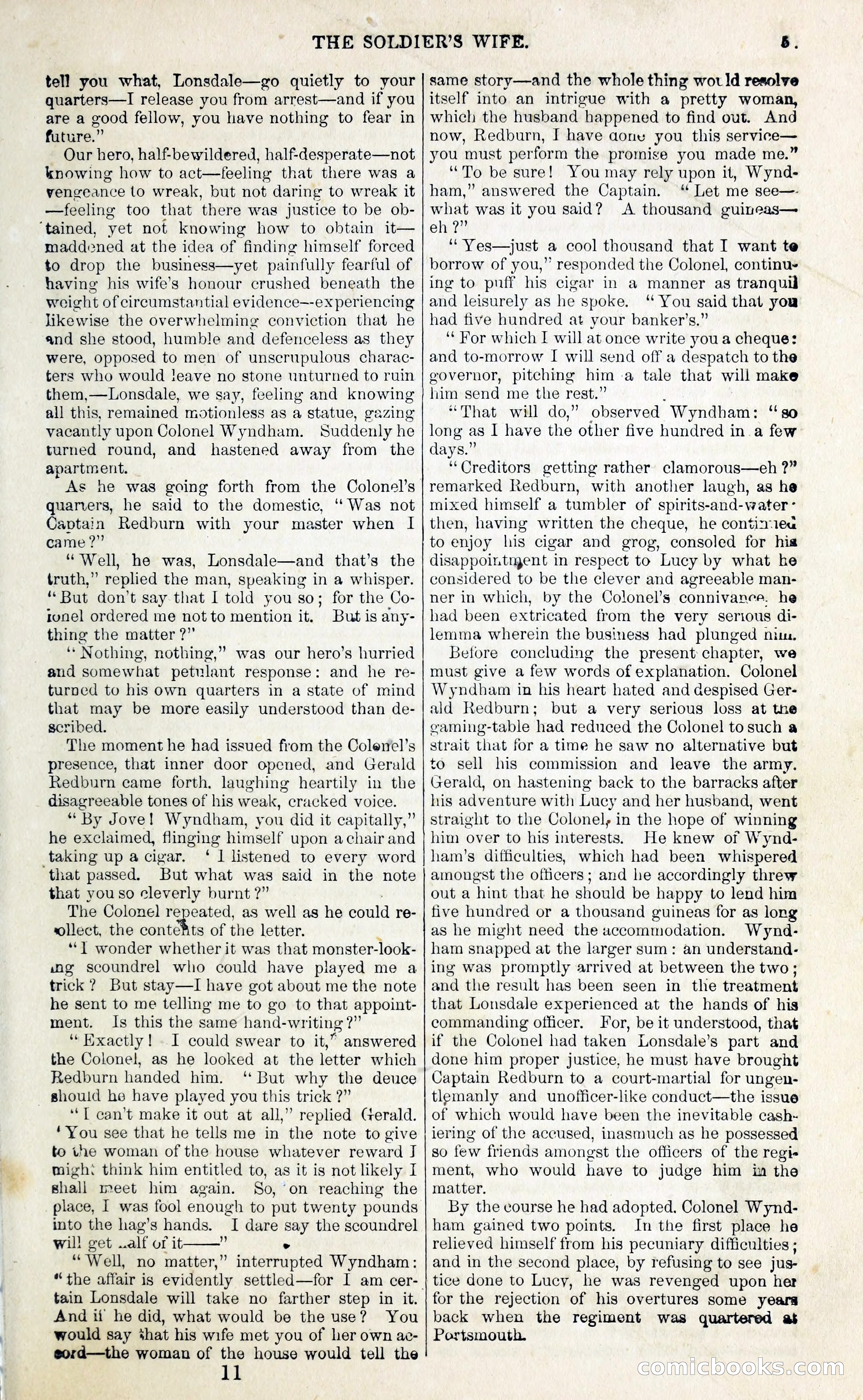
A restored page from Penny Dreadfuls, 1853. Page through the whole issue in the reader above.
📄 Transcribed text from this page (OCR, searchable)
Machine-transcribed from the original scan — historical spelling and the odd misread are preserved.
THE SOLDIER’S WIFE. 5. tell you what, Lonsdale—go quietly to your quarters—I release you from arrest—and if you are a good fellow, you have nothing to fear in future.” Our hero, half-bewildered, half-desperate—not knowing how to act—feeling that there was a vengeance to wreak, but not daring to wreak it —feeling too that there was justice to be ob- ‘tained, yet not knowing how to obtain it— maddened at the idea of finding himself forced to drop the business—yet painfully fearful of having his wife’s honour crushed beneath the weight of circumstantial evidence—-ex periencing likewise the overwhelming conviction that he and she stood, humble and defenceless as they were, opposed to men of unscrupulous charac- ters who would leave no stone unturned to ruin them,—Lonsdale, we say, feeling and knowing all this, remained motionless as a statue, gazing vacantly upon Colonel Wyndham. Suddenly he turned round, and hastened away from the apartment. As he was going forth from the Colonel’s quarters, he said to the domestic, “ Was not Captain Redburn with your master when I came ?” “Well, he was, Lonsdale—and that’s the truth,” replied the man, speaking in a whisper. “But don’t say that I told you so; for the Co- tunel ordered me not to mention it. But is any- thing the matter ?”’ ‘* Nothing, nothing,” was our hero’s hurried and somewhat petulant response: and he re- turoed to his own quarters in a state of mind that may be more easily understood than de- scribed. The moment he had issued from the Colerrel’s presence, that inner door opened, and Gerald Redburn came forth. laughing heartily in the disagreeable tones of his weak, cracked voice. * By Jove! Wyndham, you did it capitally,” he exclaimed, flinging himself upon a chair and taking up a cigar. ‘ | listened to every word ‘that passed. But what was said in the note that youso cleverly burnt ?” The Colonel repeated, as well as he could re- ollect, the conteBts of the letter. : ‘‘t wonder whether it was that monster-look- ung scoundrel who could have played me a trick ? But stay—I have got about me the note he sent to me telling me to go to that appoint- ment. Is this the same hand-wr iting ibs ‘Exactly! I could swear to it,” answered the Colonel, as he looked at the letter which Redburn handed him. ‘‘ But why the deuce should he have played you this trick ?” ‘‘T can’t make it out at all,” replied Gerald. ‘You see that he tells me in the note to give to the woman of the house whatever reward J migh: think him entitled to, as it is not likely I shall meet him again. So, on reaching the place, 1 was fool enough to put twenty pounds into the hag’s hands. I dare say the scoundrel will get walf or it “Well, no matter,” ” interrupted Wyndham: “the affair is evidently settled—for I am cer- tain Lonsdale will take no farther step in it. And if he did, what would be the use? You would say shat his wife met you of her own ae- eord—the woman of the house would tell the I] same story—and the whole thing would resolve itself into an intrigue with a pretty woman, which the husband happened to find out. And now, Redburn, I have done you this service— you must perform the promise you made me.” ‘“To be sure! You may rely upon it, Wynd- ham,” answered the Captain. ‘ Let me see— what was it you said? A thousand guineas— eh ?” ‘ Yes—just a cool thousand that I want te borrow of you,” responded the Colonel, continue ing to puff his cigar in a manner as tranquil and leisurely as he spoke. ‘ You said that you had five hundred at your banker’s.”’ ‘* For which I will at once write you a cheque: and to-morrow I will send off a despatch to the oovernor, pitching hima tale that will make him send me the rest.” “That will do,” observed Wyndham: “so long as I have the other five hundred in a few days.” ‘Creditors getting rather clamorous—eh ?” remarked Kedburn, with another laugh, as he mixed himself a tumbler of spirits-and-water- then, having written the cheque, he contineu to enjoy lis cigar and grog, consoled for his disappointment in respect to Lucy by what he considered to be the clever and agreeable man- ner in which, by the Colonel’s connivance. he had been extricated from the very serious di- lemma wherein the business had plunged nium. Before concluding the present chapter, we must give a few words of explanation. Colonel Wyndham in his heart hated and despised Ger- ald Redburn; but a very serious loss at the oaming-table had reduced the Colonel to such a strait that for a time he saw no alternative but to sell his commission and leave the army. Gerald, on hastening back to the barracks after his adventure with Lucy and her husband, went straight to the Colonel, in the hope of winning him over to his interests. He knew of Wynd- ham’s difficulties, which had been whispered amongst the officers; and he accordingly threw out a hint that he should be happy to lend him five hundred or a thousand guineas for as long as he might need the accommodation. Wynd- ham snapped at the larger sum: an understand: ing was promptly arrived at between the two; and the result has been seen in the treatment that Lonsdale experienced at the hands of his commanding officer. For, be it understood, that if the Colonel had taken Lonsdale’s part and done him proper justice, he must have brought Captain Redburn to a court-martial for ungen- tlemanly and unofficer-like conduct—the issue of which would have been the inevitable cash-~ iering of the accused, inasmuch as he possessed so few friends amongst the officers of the regi« ment, who would have to judge him in the matter. By the course he had adopted. Colonel Wynd- ham gained two points. In the first place he relieved himself from his pecuniary difficulties ; and in the second place, by refusing to see jus- tice done to Lucy, he was revenged upon her for the rejection of his overtures some years back when the regiment was quartered at Portsmouth. CORNIELIOO @ Sp (GO)