
Penny Dreadfuls, 1853 · page 181 of 231
The Soldier's Wife — page 181: what you’re looking at
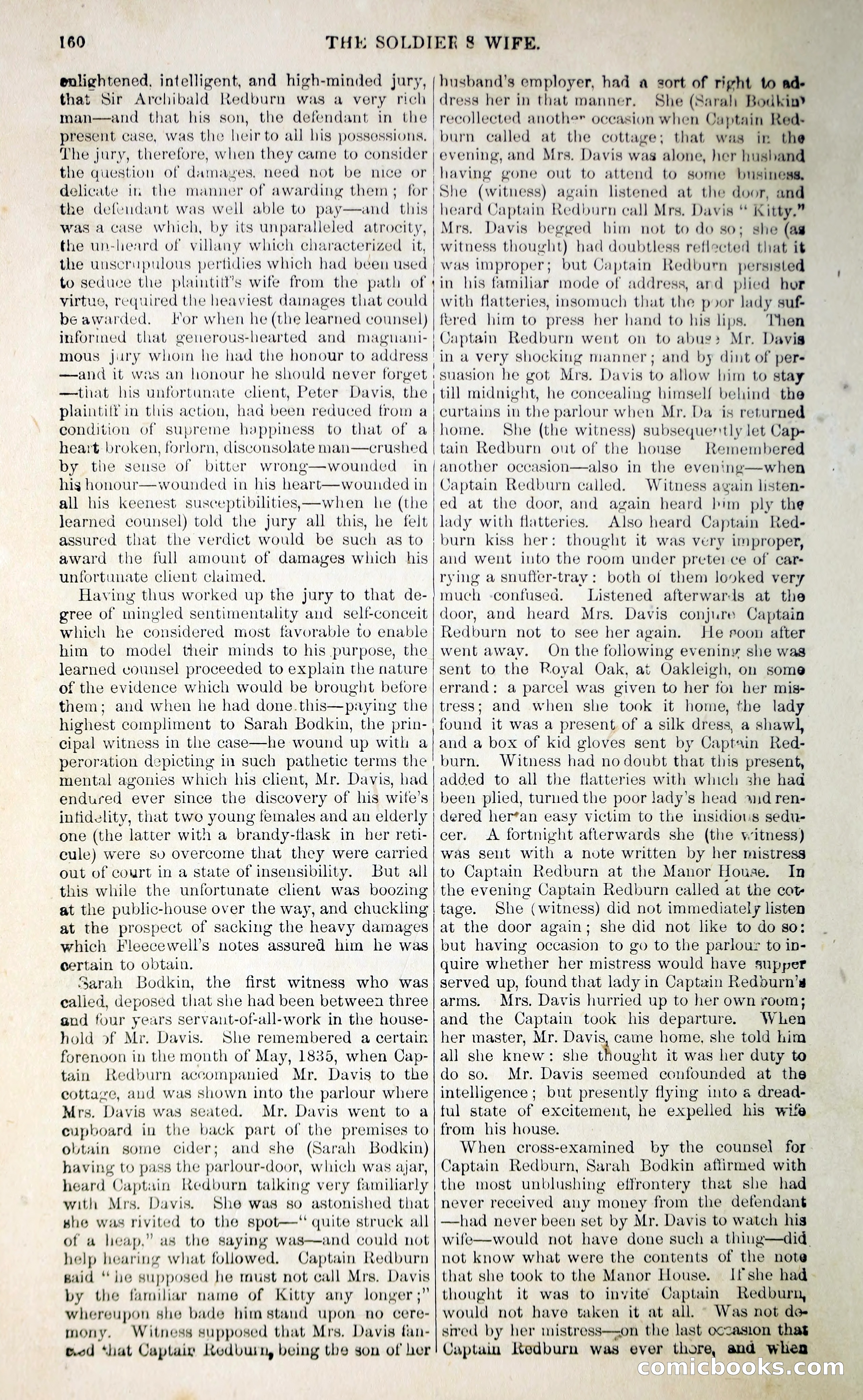
A restored page from Penny Dreadfuls, 1853. Page through the whole issue in the reader above.
📄 Transcribed text from this page (OCR, searchable)
Machine-transcribed from the original scan — historical spelling and the odd misread are preserved.
160 THE SOLDIER & WIFE. enlightened, intelligent, and high-minded jury, | husband’s employer, had a sort of right to ad- that Sir Archibald Redburn was a very rich | dress her in that manner. She (Sarah Bodkin’ man—and that his son, the defendant in the | recollected another occasion when Captain Red- present case, was the heir to all his possessions. | The jury, therefore, when they came to consider the question of damayes. need not be nice or delicate in the manner of awarding them; for the defendant was well able y—and this was a case which, by its unparalleled atrocity, the un-heard of villany which characterized it, the unscrupulous pertidies which had been used to seduce the plaintitl’s wife from the path of virtue, required the heaviest damages that could be awarded. For when he (the learned counsel) burn called at the cottage; that was in the evening, and Mrs. Davis was alone, her hushand having gone out to attend to some business, She (witness) again listened at the door, and heard Captain Redburn call Mrs. Davis “ Kitty.” Mrs. Davis begged him not to do so; she (as witness thought) had doubtless reflected that it was improper; but Captain Redburn persisted In his familiar mode of address, ard plied her with flatteries, insomuch that the poor lady suf- fered him to press her hand to his lips. Then informed that generous-hearted and maguani- | Captain Redburn went on to abus> Mr. Davis mous jury whoin he had the honour to address’ in a very shocking manner; and by dint of pers —and it was an honour he should never forget: suasion he got Mrs. Davis to allow him to stay —that his unfortunate chent, Peter Davis, the plaintiff in this action, had been reduced from a condition of Supreme happiness to that of a heart broken, forlorn, disconsolate man—crushed by the sense of bitter wrong—wounded in hig honour—wounded in his heart—wounded in all his keenest susceptibilities, —when he (the Jearned counsel) told the jury all this, he felt assured that the verdict would be such as to award the full amount of damages which his unfortunate client claimed. Having thus worked up the Jury to that de- gree of mingled sentimentality and self-conceit which he considered most favorable to enable him to model their minds to his purpose, the learned counsel proceeded to explain the nature of the evidence which would be brought before them; and when he had done.this—paying the highest compliment to Sarah Bodkin, the prin- cipal witness in the case—he wound up with a peroration depicting in such pathetic terms the mental agonies which his chent, Mr. Davis, had endured ever since the discovery of his wite’s infidelity, that two young females and an elderly one (the latter with a brandy-flask in her reti- cule) were sv overcome that they were carried out of court in a state of insensibility. But all this while the unfortunate chent was boozing at the public-house over the way, and chuckling at the prospect of sacking the heavy damages which Fleecewell’s notes assured him he was certain to obtain. Sarah Bodkin, the first witness who was called, deposed that she had been between three god four years servant-of-all-work in the house- hold of Mr. Davis. She remembered a certain forenoon in the month of May, 1835, when Cap- tain Redburn accompanied Mr. Davis to the eottaze, aud was shown into the parlour where Mrs. Davis was seated. Mr. Davis went to a cupboard in the back part of the premises to obtain some cider; and she (Sarah Bodkin) having to pass the p: arlour- door, which was ajar, heard Captain Redburn talking very familiarly with Mrs. Davis. She was so astonished that Khe was rivited to the spot—* quite struck all of a heap,” as the saying was—and could not help hearing what followed. Captain Redburn gaid “lie supposed he must not call Mrs. Davis by the familiar name of Kitty any longer ;’ whereupon she bade him stand upon no cere- mony. Witness supposed that Mrs. Davis fan- cod ‘hat Captain Redburn, being the son of her a ee a ae eeceesbeml ananassae, MERLE UTE ee ETT OS Ee ETS a RS GT a SR GE EE A a a <a ee a till midnight, he concealing himself behind the curtains in the parlour when Mr. Da is returned home. She (the witness) subsequertly let Cap- tain Redburn out of the house Remembered another occasion—also in the evening—when Captain Redburn called. Witness again listen- ed at the door, and again heard bim ply the lady with flatteries. Also heard Captain Red- burn kiss her: thought it was very improper, and went into the room under pretei ce of car- rying a snuffer-tray: both of them looked very much -confusea. Listened afterwards at the door, and heard Mrs. Davis conjure Captain Redburn not to see her again. He soon after went away. On the following eveniny she was sent to the Royal Oak, at Oakleigh, on some errand: a parcel was given to her foi her mis- tress; and when she took it home, the lady found it was a present of a silk dress, a shawl, and a box of kid gloves sent by Captain Red- burn. Witness had nodoubt that this present, added to all the flatteries with which 3he had been plied, turned the poor lady’s head and ren- dered her*an easy victim to the insidious sedu- cer. A fortnight afterwards she (the witness) was sent with a note written by her mistress to Captain Redburn at the Manor House. In the evening Captain Redburn called at the cot tage. She (witness) did not immediately listen at the door again; she did not like to do so: but having occasion to go to the parlour to in- quire whether her mistress would have supper served up, found that lady in Captain Reddurn’s arms. Mrs. Davis hurried up to her own room; and the Captain took his departure. When her master, Mr. Davis, came home, she told him all she knew : she thought it was her duty to do so. Mr. Davis seemed confounded at the intelligence ; but presently flying into a dread- ful state of excitement, he expelled his wife from his house. When cross-examined by the counsel for Captain Redburn, Sarah Bodkin affirmed with the most unblushing effrontery that she had never received any money from the defendant —had never been set by Mr. Davis to watch his wife—would not have done such a thing—did. not know what were the contents of the note that she took to the Manor House. Ifshe had thought it was to invite Captain Redburn, would not have taken it at all. © Was not do- sired by her mistress—on the last oczasion thas Captain Kedburn was ever thore, and whea « GOmMmiGDOOKS co