
Penny Dreadfuls, 1853 · page 182 of 231
The Soldier's Wife — page 182: what you’re looking at
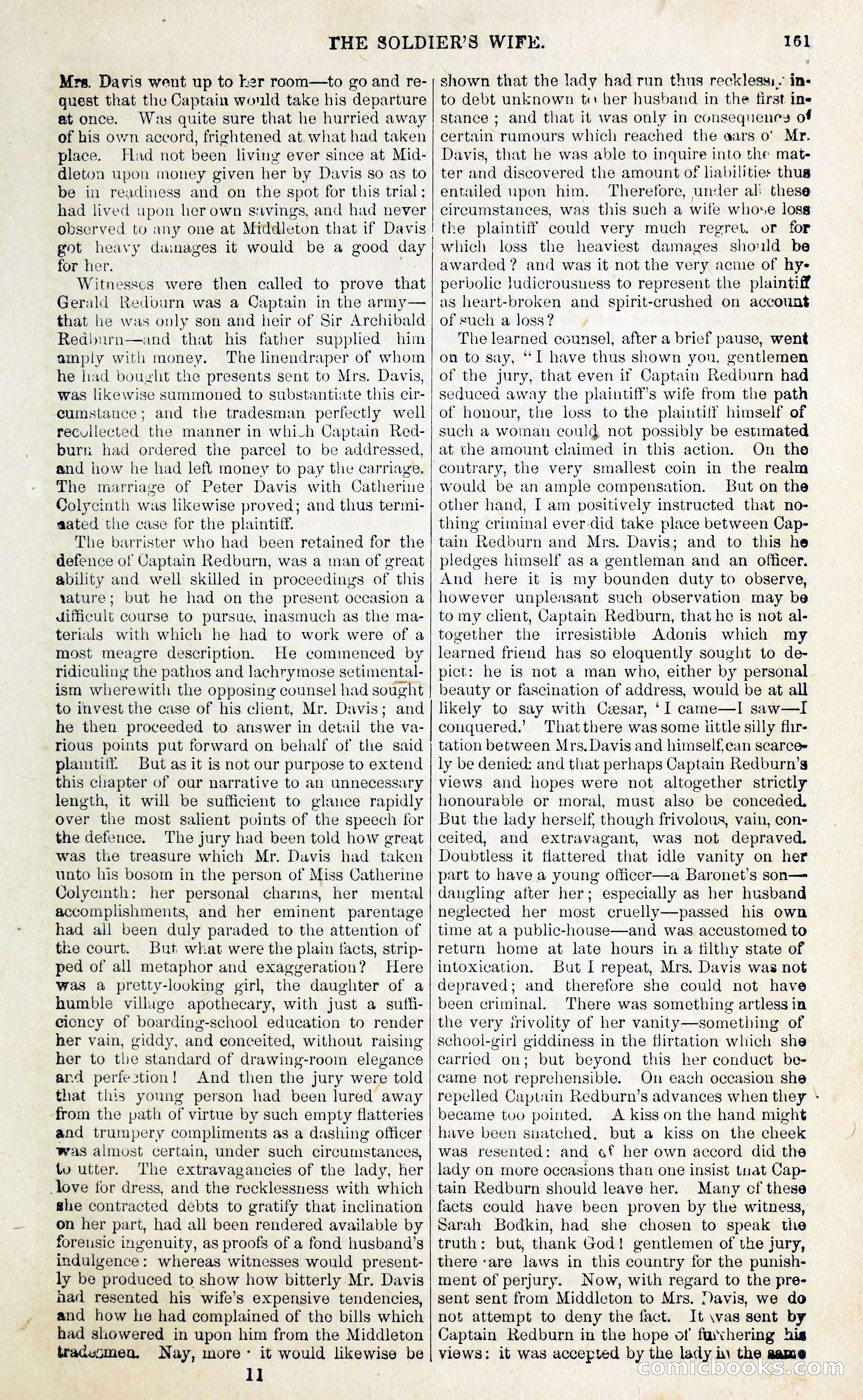
A restored page from Penny Dreadfuls, 1853. Page through the whole issue in the reader above.
📄 Transcribed text from this page (OCR, searchable)
Machine-transcribed from the original scan — historical spelling and the odd misread are preserved.
THE SOLDIER’S WIFE. Mrs. Davis went up to ker room—to go and re- guest that the Captain would take his departure at once. Was quite sure that he hurried away of his own accord, frightened at. what had taken place. Had not been living ever since at Mid- dleton upon money given her by Davis so as to be in readiness and on the spot for this trial: had lived upon herown savings, and had never observed to any one at Middleton that if Davis got heavy dainages it would be a good day for her. Witnesses were then called to prove that Gerald Redburn was a Captain in the army— that he was only son and heir of Sir Archibald Redburn—and that his father supplied him amply with money. The linendraper of whom he had bought the presents sent to Mrs. Davis, was likewise summoned to substantiate this etr- cumstance; and the tradesman perfectly well recullected the manner in whi_h Captain Red- burn had ordered the parcel to be addressed, and how he had left money to pay the carriage. The marriage of Peter Davis with Catherine OColyeinth was likewise proved; and thus termi- aated the case for the plaintiff. The barrister who had been retained for the defence of Captain Redburn, was a man of great ability and well skilled in proceedings of this yature; but he had on the present occasion a difficult course to pursue, Inasmuch as the ma- terials with which he had to work were of a most meagre description. He commenced by ridiculing the pathos and lachrymose setimental- ism wherewith the opposing counsel had sought to invest the case of his client, Mr. Davis; and he then proceeded to answer in detail the va- rious points put forward on behalf of the said plaintifi, But as it is not our purpose to extend this chapter of our narrative to an unnecessary length, it will be sufficient to glance rapidly over the most salient pvints of the speech for the defence. The jury had been told how great was the treasure which Mr. Davis had taken unto his bosom in the person of Miss Catherine Colyeinth: her personal charms, her mental accomplishments, and her eminent parentage had all been duly paraded to the attention of the court. But what were the plain facts, strip- ped of all metaphor and exaggeration? Here was a pretty-looking girl, the daughter of a humble village apothecary, with just a suffi- cicney of boarding-school education to render her vain, giddy, and conceited, without raising her to the standard of drawing: room elevance and perfection! And then the jury were told that this young person had been lured away from the path of virtue by such empty flatteries and trumpery compliments as a dashing officer was almost certain, under such circumstances, tv utter. The extravagancies of the lady, her love for dress, and the recklessness with which she contracted debts to gratify that inclination on her part, had all been rendered available by forensic ingenuity, as proofs of a fond husband’s indulgence: whereas witnesses would present- ly be produced to show how bitterly Mr. Davis nad resented his wife’s expensive tendencies, and how he had complained of the bills which had showered in upon him from the Middleton traducmen. Nay, more’ it would likewise be 1] 161 shown that the lady had run thus reckless. in- to debt unknown tu her husband in the first ins stance ; and that it was only in consequenes of certain rumours which reached the ears o' Mr. Davis, that he was able to ae Into the mate ter and discovered the amount of liabilities thus entailed upon him. Therefore, under ali these circumstances, was this such a wife whose loss the plaintiff could very much regret. or for which loss the heaviest damages should be awarded ? and was it not the very acme of hys perbolic ludicrousness to represent the plaintiff as heart-broken and spirit-crushed on account of such a loss? The learned counsel, after a brief pause, went on to say, “I have thus shown yon, gentlemen of the jury, that even if Captain Redburn had seduced away the plaintiff's wife from the path of honour, the loss to the plaintiff himself of such a woman could not possibly be estimated at the amount claimed in this action. On the contrary, the very smallest coin in the realm would be an ample compensation. But on the other hand, I am positively instructed that no- thing criminal ever-did take place between Cap- tain Redburn and Mrs. Davis; and to this he pledges himself as a gentleman and an officer. And here it is my bounden duty to observe, however unpleasant such observation may be to my client, Captain Redburn, that he is not al- together the irresistible Adonis which my learned friend has so eloquently sought to de- pict: he is not a man who, either by personal beauty or fascination of address, would be at all likely to say with Cesar, ‘I came—I saw—lI conquered.’ Thatthere was some tittle silly flir- tation between Mrs. Davis and himself,can searcee ly be denied: and that perhaps Captain Redburn’s views and hopes were not altogether strictly honourable or moral, must also be conceded. But the lady herself, though frivolous, vain, con- ceited, and extravagant, was not depraved. Doubtless it flattered that idle vanity on her part to have a young officer—a Baronet’s son— dangling after her; especially as her husband neglected her most cruelly—passed his own time at a public-house—and was accustomed to return home at late hours in a filthy state of intoxication. But I repeat, Mrs. Davis was not depraved; and therefore she could not have been criminal. There was something artless in the very trivolity of her vanity—something of school-girl giddiness in the flirtation which she carried on; but beyond this her conduct be- came not reprehensible. On each occasion she repelled Captain Redburn’s advances when they became too pointed. A kiss on the hand might have been snatched, but a kiss on the cheek was resented: and of her own accord did the lady on more occasions than one insist tuat Cap- tain Redburn should leave her. Many cf these facts could have been proven by the witness, Sarah Bodkin, had she chosen to speak the truth: but, thank God! gentlemen of the Jury, there are laws in this country for the punish- ment of perjury. Now, with regard to the pre- sent sent from Middleton to Mrs. Davis, we do nots attempt to deny the fact. It \vas sent by Captain Redburn in the hope of fur bat i MIGDOo! G. views: it was accepted by Lei Tite n\ th G (©)