
Penny Dreadfuls, 1853 · page 22 of 231
The Soldier's Wife — page 22: what you’re looking at
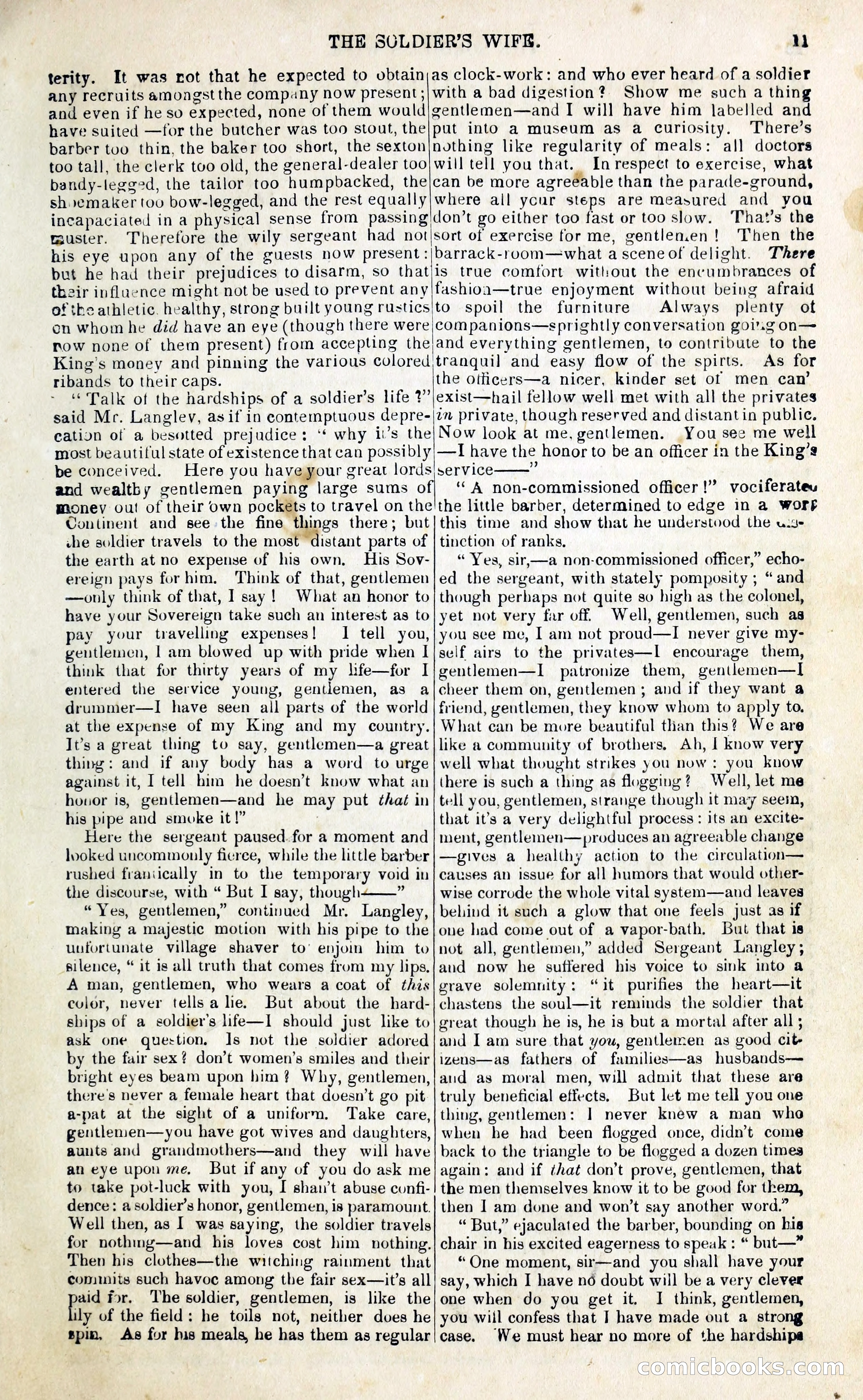
A restored page from Penny Dreadfuls, 1853. Page through the whole issue in the reader above.
📄 Transcribed text from this page (OCR, searchable)
Machine-transcribed from the original scan — historical spelling and the odd misread are preserved.
THE SOLDIER'S WIFE. P| terity. It was rot that he expected to obtain;as clock-work: and who ever heard of a soldier any recruits amongst the company now present, with a bad digestion?. Show me such a thing and even if he so expected, none of them would|/gentlemen—and I will have him labelled and have suited —for the butcher was too stout, the|/put into a museum as a Curiosity. There’s barber tuo thin, the baker too short, the sexton|nothing like regularity of meals: al] doctors too tall, the clerk too old, the general-dealer too|will tell you that. In respect to exercise, what bandy-legged, the tailor too humpbacked, thejcan be more agreeable than the parade-ground, shoemaker too bow-legged, and the rest equally|where ail your steps are measured and you incapaciated in a physical sense from passing/don’t go either too fast or too slow. That’s the muster. Therefore the wily sergeant had not|sort of exercise for me, gentlemen! Then the his eye upon any of the guests now present: barrack-room—what a scene of delight. There but he had their prejudices to disarm, so thatjis true comfort without the encumbrances of their influence might not be used to prevent any|fashioa—true enjoyment without being afraid of the athletic. healthy, strong built young rustics|to spoil the furniture Always plenty of on whom he did have an eye (though there were|companions—sprightly conversation going on— now none of them present) from accepting the) and everything gentlemen, to contribute to the King’s money and pinning the various colored tranquil and easy flow of the spirts. As for ribands to their caps. the otficers—a nicer, kinder set of men can’ “Talk of the hardships of a soldier’s life ?”’|exist—hail fellow well met with all the privates said Mr. Langley, asif in contemptuous depre-|27 private, though reserved and distantin public. cation of a besotted prejudice: ‘* why i’s the|Now look at me, gentlemen. You see me well most beautiful state of existence that can possibly|—I have the honor to be an officer in the King’s be conceived. Here you haveyour great lords and wealthy gentlemen paying large sums of money out of their own pockets to travel on the Continent and see the fine things there; but ihe soldier travels to the most distant parts of the earth at no expense of his own, His Sov- ereign pays forhim. Think of that, gentlemen —ooly think of that, I say! What an honor to have your Sovereign take such an interest as to pay your travelling expenses! I tell you, gentlemen, | am blowed up with pride when I think that for thirty years of my hfe—for I entered the service young, gentlemen, as a drummer—I have seen all parts of the world at the expense of my King and my country. It’s a great thing to say, gentlemen—a great thing: and if any body has a word to urge against it, I tell him he doesn’t know what an houor is, gentlemen—and he may put ¢thaté in his pipe and smoke it!” 3 Here the sergeant paused.for a moment and looked uncommonly ficree, while the little barber rushed franiically in to the temporary void in the discourse, with “ But I say, thougha—” “Yes, gentlemen,” continued Mr. Langley, making a majestic motion with his pipe to the unfortunate village shaver to’ enjoin him to silence, “ it is all truth that comes from my lips, A man, gentlemen, who wears a coat of this color, never tells a lie. But about the hard- ships of a soldier's life—I1 should just like to ask one question. Is not the soldier adored by the fair sex? don’t women’s smiles and their bright eyes beam upon him? Why, gentlemen, there's never a female heart that doesn’t go pit a-pat at the sight of a uniform. Take care, gentlemen—you have got wives and daughters, aunts and granudmothers—and they will have an eye upon me, But if any of you do ask me to take pot-luck with you, I shan’t abuse cunfi- dence: a soldier’s honor, gentlemen, is paramount. Well then, as I was saying, the soldier travels for nothmg—and his loves cost him nothing. Then his clothes—the witching rainment that commits such havoc among the fair sex—it’s all paid For. The soldier, gentlemen, is like the uly of the field: he toils not, neither does he spin, As for his meals, he has them as regular 13 service ‘A non-commissioned officer!” vociferatey the little barber, determined to edge in a Wworp this time and show that he understood the use tinction of ranks, “Yes, sir,—a non-commissioned officer,” echo- ed the sergeant, with stately pomposity ; “and though perhaps not quite so high as the colonel, yet not very far off. Well, gentlemen, such as you see me, I am not proud—I never give my- self airs to the privates—I encourage them, gentlemen—I patronize them, gentlemen—I cheer them on, gentlemen; and if they want a friend, gentlemen, they know whom to appry to. What can be more beautiful than this? We are like a community of brothers, Ah, | know very well what thought strikes you nuw: you know (here is such a thing as flogging? Well, let me tell you, gentlemen, strange though it may seem, that it’s a very delightful process: its an excite- ment, gentlemen—produces an agreeable change —gives a healthy action to the cireulatlon— causes an issue for all humors that would other- wise corrode the whole vital system—and leaves behind it such a glow that one feels just as if one had come out of a vapor-bath. But that is not all, gentlemen,” added Sergeant Langley ; aud now he suffered his voice to sink into a grave solemnity: “it purifies the heart—it chastens the soul—it reminds the soldier that great though he is, he is but a mortal after all ; aid I am sure that you, gentlemen as good cit izens—as fathers of families—as husbands— aud as moral men, will admit that these are truly beneficial effects. But let me tell you one thing, gentlemen: I never knew a man who when he had been flogged once, didn’t come back to the triangle to be flogged a dozen times again: and if that don’t prove, gentlemen, that the men themselves know it to be good for them, then I am done and won’t say another word.” “ But,” ejaculated the barber, bounding on his chair in his excited eagerness to speak : “ but—” “One moment, sir—and you shall have your say, Which I have no doubt will be a very clever one when do you get it. 1 think, gentlemen, you will confess that I have made out a strong case. We must hear no more of the hardshipa G CONNIELOC Ss (EO)