
Penny Dreadfuls, 1853 · page 56 of 231
The Soldier's Wife — page 56: what you’re looking at
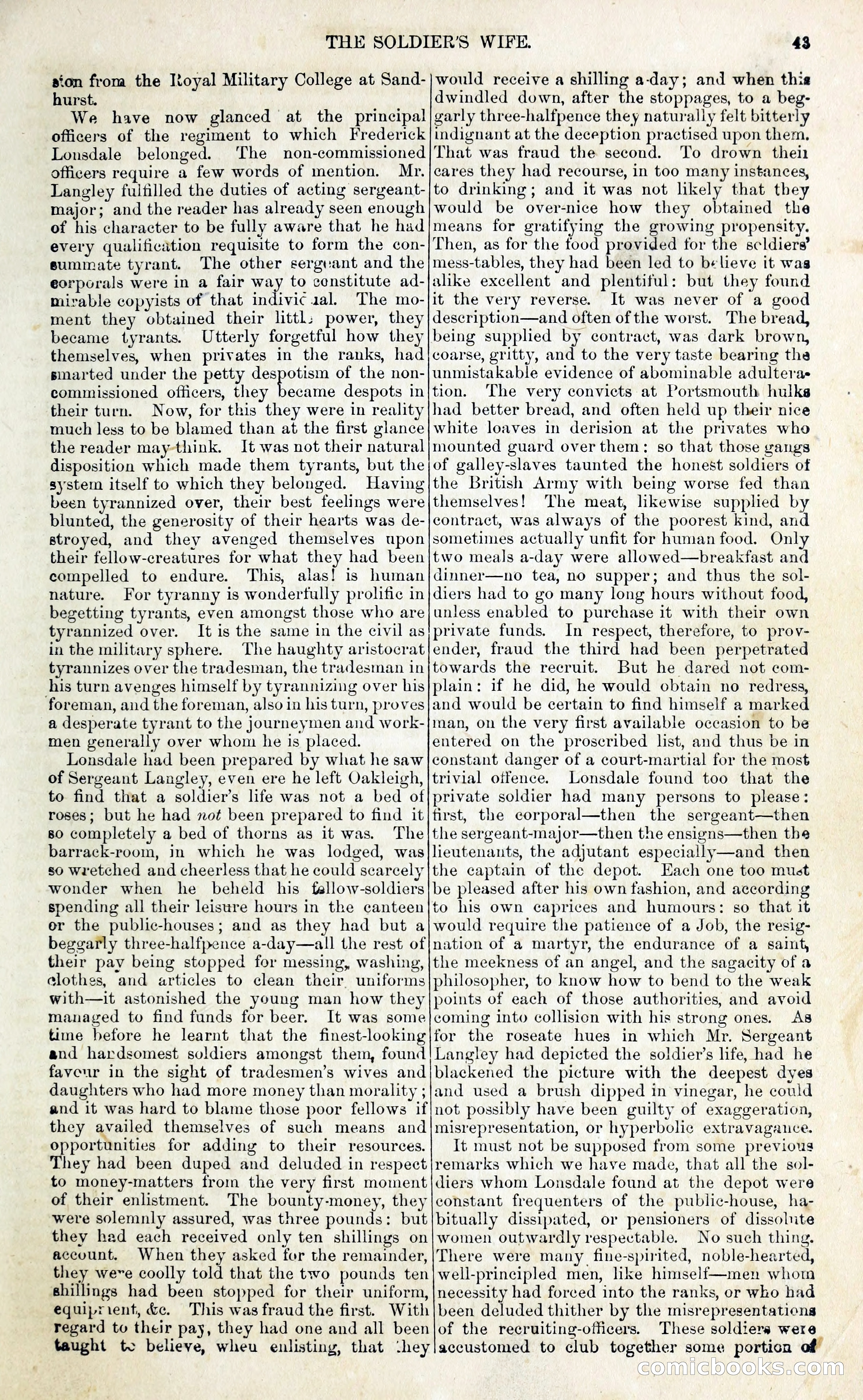
A restored page from Penny Dreadfuls, 1853. Page through the whole issue in the reader above.
📄 Transcribed text from this page (OCR, searchable)
Machine-transcribed from the original scan — historical spelling and the odd misread are preserved.
THE SOLDIER'S WIFE. aton from the Itoyal Military College at Sand- hurst. 43 would receive a shilling a-day; and when this dwindled down, after the stoppages, to a beg- We have now glanced at the principal|garly three-halfpence they naturally felt bitterly officers of the regiment to which Frederick Lonsdale belonged. ‘The non-commissioned officers require a few words of mention. Mr. Langley fulfilled the duties of acting sergeant- major; and the reader has already seen enough of his character to be fully aware that he had every qualification requisite to form the con- eummate tyrant. The other sergeant and the eorporals were in a fair way to censtitute ad- mirable copyists of that indivic zal. The mo- indignant at the deception practised upon them. That was fraud the second. To drown then cares they had recourse, in too many instances, to drinking; and it was not likely that they would be over-nice how they obtained the means for gratifying the growing propensity. Then, as for the food provided for the scldiers’ mess-tables, they had been led to believe it was alike excellent and plentiful: but they found it the very reverse. It was never of a good ment they obtained their littl: power, they|description—and often of the worst. The bread, became tyrants. Utterly forgetful how they|being supplied by contract, was dark brown, themselves, when privates in the ranks, had|coarse, gritty, and to the very taste bearing the smarted under the petty Seely danny of the non-|unmistakable evidence of abominable adulterae commissioned officers, they their turn. much less to be blamed than at the first glance the reader may-think. It was not their natural disposition which made them tyrants, but the system itself to which they belonged. Having been tyrannized over, their best feelings were blunted, the generosity of their hearts was de- stroyed, and they avenged themselves upon their fellow-creatures for what they had been compelled to endure. This, alas! is human nature. For tyranny is wondertully prolific in begetting tyrants, even amongst those who are tyrannized over. It is the same in the civil as in the military sphere. The haughty aristocrat tyrannizes over the tradesman, the tradesman In his turn avenges himself by tyrannizing over his foreman, and the foreman, also in his turn, proves a desperate tyrant to the Journeymen and work- men generally over whom he 1s placed. Lonsdale had been prepared by what he saw ecame despots in|tion. Now, for this they were in reality|had better bread, and often held up their nice The very convicts at Portsmouth hulks white loaves in derision at the privates who mounted guard over them: so that those gangs of galley-slaves taunted the honest soldiers of the British Army with being worse fed than themselves! The meat, likewise supplied by contract, was always of the poorest kind, and sometimes actually unfit for human food. Only two meals a-day were allowed—breakfast and dinner—no tea, no supper; and thus the sol- diers had to go many long hours without food, unless enabled to purchase it with their own private funds. In respect, therefore, to prov- ender, fraud the third had been perpetrated towards the recruit. But he dared not com- plain: if he did, he would obtain no redress, and would be certain to find himself a marked man, on the very first available occasion to be entered on the proseribed list, and thus be in constant danger of a court-martial for the most of Sergeant Langley, even ere he left Oakleigh, |trivial offence. Lonsdale found too that the to find that a soldier’s life was not a bed of|private soldier had many persons to please: roses; but he had not been prepared to find it/first, the corporal—then the sergeant—then s0 completely a bed of thorns as it was. The|the sergeant-major—then the ensigns—then the barrack-room, in which he was lodged, was|lieutenants, the adjutant especially—and then so wretched and cheerless that he could scarcely |the captain of the depot. Each one too must wonder when he beheld his fsllow-soldiers|be pleased after his own fashion, and according spending all their leisure hours in the canteen|to his own caprices and humours: so that it or the public-houses; and as they had but a}would require the patience of a Job, the resig- beggarly three-halfpence a-day—all the rest of|nation of a martyr, the endurance of a saint, their pay being stopped for messing, washing, |the meekness of an angel, and the sagacity of a clothes, and articles to clean their. uniforms|philosopher, to know how to bend to the weak with—it astonished the young man how they|points of each of those authorities, and avoid managed to find funds for beer. It was some}coming into collision with his strong ones. As time before he learnt that the finest-looking|for the roseate hues in which Mr. Sergeant and hardsomest soldiers amongst them, found! Langley had depicted the soldier’s life, had he favyeur in the sight of tradesmen’s wives andjblackened the picture with the deepest dyes daughters who had more money than morality ;|and used a brush dipped in vinegar, he could and it was hard to blame those poor fellows if|not possibly have been guilty of exaggeration, they availed themselves of such means andjmisrepresentation, or hyperbolic extravagance. opportunities for adding to their resources. It must not be supposed from some previous They had been duped and deluded in respect|remarks which we have made, that all the sol- to money-matters from the very first moment of their enlistment. The bounty-money, they were solemnly assured, was three pounds: but they had each received only ten shillings on account. When they asked for the remainder, they were coolly told that the two pounds ten shillings had been stopped for their uniform, equiprient, &e. This was fraud the first. With regard to their pay, they had one and all been taught te believe, wheu enlisting, that theylaccustomed to club together some portion of (E@) diers whom Lonsdale found at the depot were constant frequenters of the public-house, ha- bitually dissipated, or pensioners of dissolute women outwardly respectable. No such thing. There were many fine-spirited, noble-hearted, well-prineipled men, hke himself—men whom necessity had forced into the ranks, or who had been deluded thither by the misrepresentations of the recruiting-officers. These soldiers were GOMiiGcdoo (C cS