
Penny Dreadfuls, 1853 · page 57 of 231
The Soldier's Wife — page 57: what you’re looking at
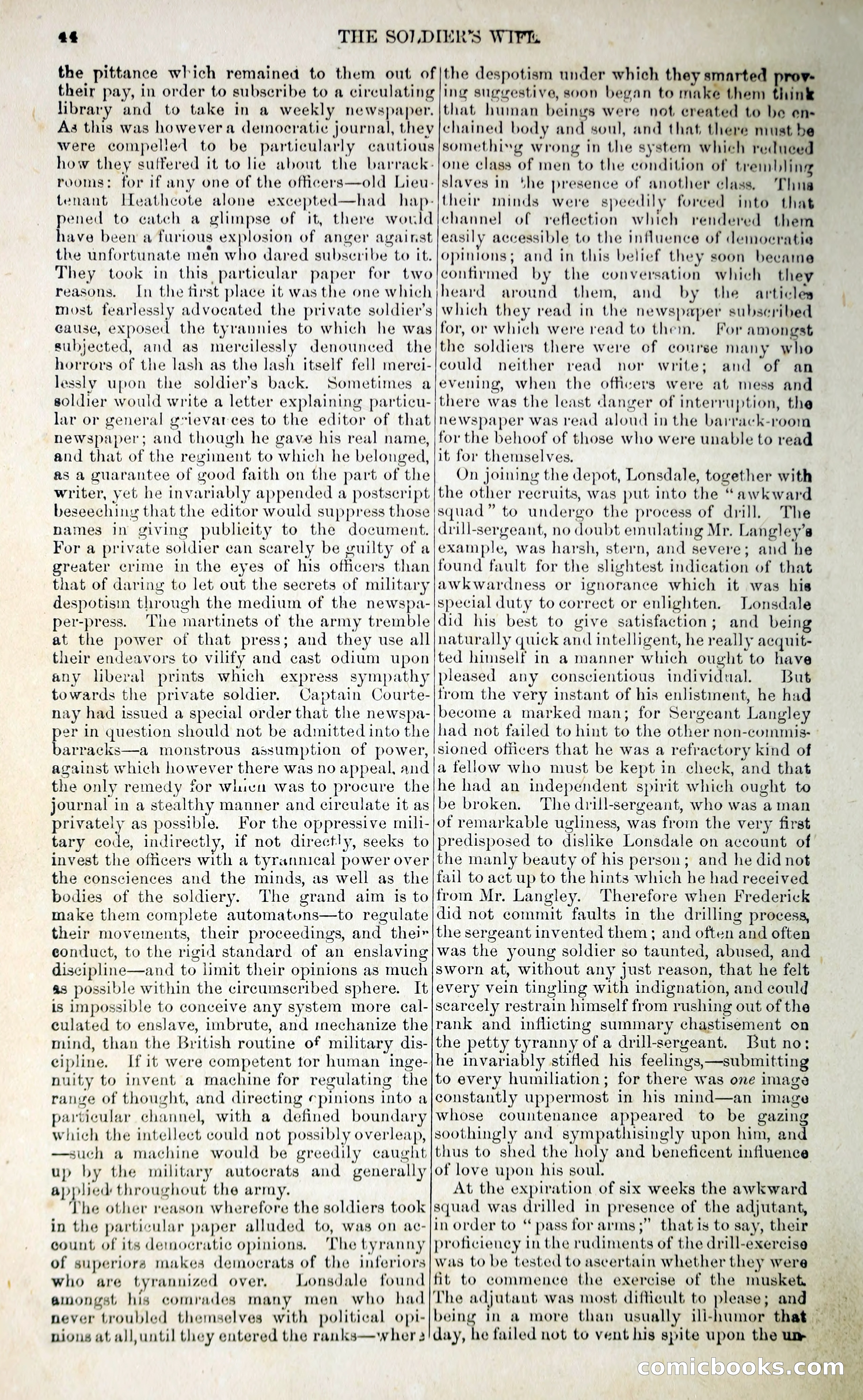
A restored page from Penny Dreadfuls, 1853. Page through the whole issue in the reader above.
📄 Transcribed text from this page (OCR, searchable)
Machine-transcribed from the original scan — historical spelling and the odd misread are preserved.
a4 the pittance which remained to them out of|the despotism under which they smarted their pay, in order to subseribe to a circulating jing suggestive, soon began to mak library and to take in a weekly newspaper. As this was howevera democratic journal, they were compelled to be particularly cautious how they suffered it to lie about the barrack. rooms; for if any one of the officers—old Lieu. tenant Heathcote alone excepted—had_ hap. pened to catch a glimpse of it, there would have been a furious explosion of anger against the unfortunate men who dared subseribe to it. They took in this particular paper for two reasons. In the first place it was the one which most fearlessly advocated the private soldier's cause, exposed the tyrannies to which he was subjected, and as mercilessly denounced the horrors of the lash as the lash itself fell merei- lessly upon the soldier's back. Sometimes a soldier would write a letter explaining particu- lar or general gievarees to the editor of that newspaper; and though he gave his real name, and that of the regiment to which he belonged, as a guarantee of good faith on the part of the writer, yet he invariably appended a postscript beseeching that the editor would suppress those names in giving publicity to the document. For a private soldier can searely be guilty of a greater crime in the eyes of Ins officers than that of daring to let out the secrets of military despotism through the medium of the newspa- per-press. The martinets of the army tremble at the power of that press; and they use all their endeavors to vilify and cast odium upon any liberal prints which express sympathy towards the private soldier. Captain Courte- nay had issued a special order that the newspa- per in question should not be admitted into the barracks—a monstrous assumption of power, against which however there was no appeal, and the only remedy for wlucu was to procure the journal in a stealthy manner and circulate it as privately as possible. For the oppressive mili- tary code, indirectly, if not directly, seeks to invest the officers with a tyrannical power over the consciences and the minds, as well as the bodies of the soldiery. The grand aim is to make them complete automatuns—to regulate their movements, their proceedings, and thei» eonduct, to the rigid standard of an enslaving discipline—and to limit their opinions as much as possible within the circumscribed sphere. It is impossible to conceive any system more cal- culated to enslave, inbrute, and rnechanize the mind, than the British routine of military dis- cipline. If it were competent tor human inge- nuity to invent a machine for regulating the range of thought, and directing ¢pinions into a particular channel, with a defined boundary which the intellect could not possibly overleap, —such a machine would be greedily caught up by the military autocrats and generally applied throughout the army. The other reason wherefore the soldiers took in the particular paper alluded to, was on ac- count of its democratic opinions. ‘The tyranny of superiors makes democrats of the inferiors who are tyrannized over. Lonsdale found amongst his comrades many men who had never troubled themselves with political opt- nions at all,until they entered the ranks—wher a!day, THE SOLDIER'S WIFh hem ¢hi that human beings were not created to be en- chained body and soul, and that there must be somethivg wrong in the system which reduced one class of men to the condition of trembling slaves in the presence of another class. Thna their minds were speedily forced into that channel of reflection which rendered them easily accessible to the influence of democratia opinions; and in this belief they soon became confirmed by the conversation which they heard around them, and by the articles which they read in the newspaper subscribed for, or which were read to them. For amongst the soldiers there were of course many who could neither read nor write; and of an evening, when the officers were at mess and there was the least danger of interruption, the newspaper was read aloud in the barrack-room for the behoof of those who were unable to read it for themselves. On joining the depot, Lonsdale, together with the other recruits, was put into the “awkward squad” to undergo the process of drill. The drill-sergeant, no doubt emulating Mr. Langley’s example, was harsh, stern, and severe; and he found fault for the slightest indication of that awkwardness or ignorance which it was his special duty to correct or enlighten. Lonsdale did his best to give satisfaction; and being naturally quick and intelligent, he really aequit- ted himself in a manner which ought to have pleased any conscientious individual. But from the very instant of his enlistment, he had become a marked man; for Sergeant Langley had not failed to hint to the other non-commis- - sioned officers that he was a refractory kind of a fellow who must be kept in check, and that he had an independent spirit which ought to be broken. The drill-sergeant, who was a man of remarkable ugliness, was from the very first predisposed to dislike Lonsdale on account of the manly beauty of his person; and he did not fail to act up to the hints which he had received from Mr. Langley. Therefore when Frederick did not commit faults in the drilling process, the sergeant invented them; and often and often was the young soldier so taunted, abused, and sworn at, without any just reason, that he felt every vein tingling with indignation, and could scarcely restrain himself from rushing out of the rank and inflicting summary chastisement on the petty tyranny of a drill-sergeant. But no; he invariably stifled his feelings,—submitting to every humiliation; for there was one imaga constantly uppermost in his mind—an image whose countenance appeared to be gazing soothingly and sympathisingly upon him, and thus to shed the holy and beneficent influence of love upon his soul. At the expiration of six weeks the awkward squad was drilled in presence of the adjutant, in order to “pass for arms ;” that is to say, their proficiency inthe rudiments of the drill-exercise was to be tested to ascertain whether they were fit to commence the exercise of the musket. The adjutant was most difficult to please; and ae in a more than usually ill-humor that — 1¢ failed not to vent his spite upon the we ~ wf ; « a tal y Gomicbooks