
Penny Dreadfuls, 1850 · page 87 of 400
The Gift of the Sailor: The String of Pearls & Sweeney Todd, the Demon Barber of Fleet Street — page 87: what you’re looking at
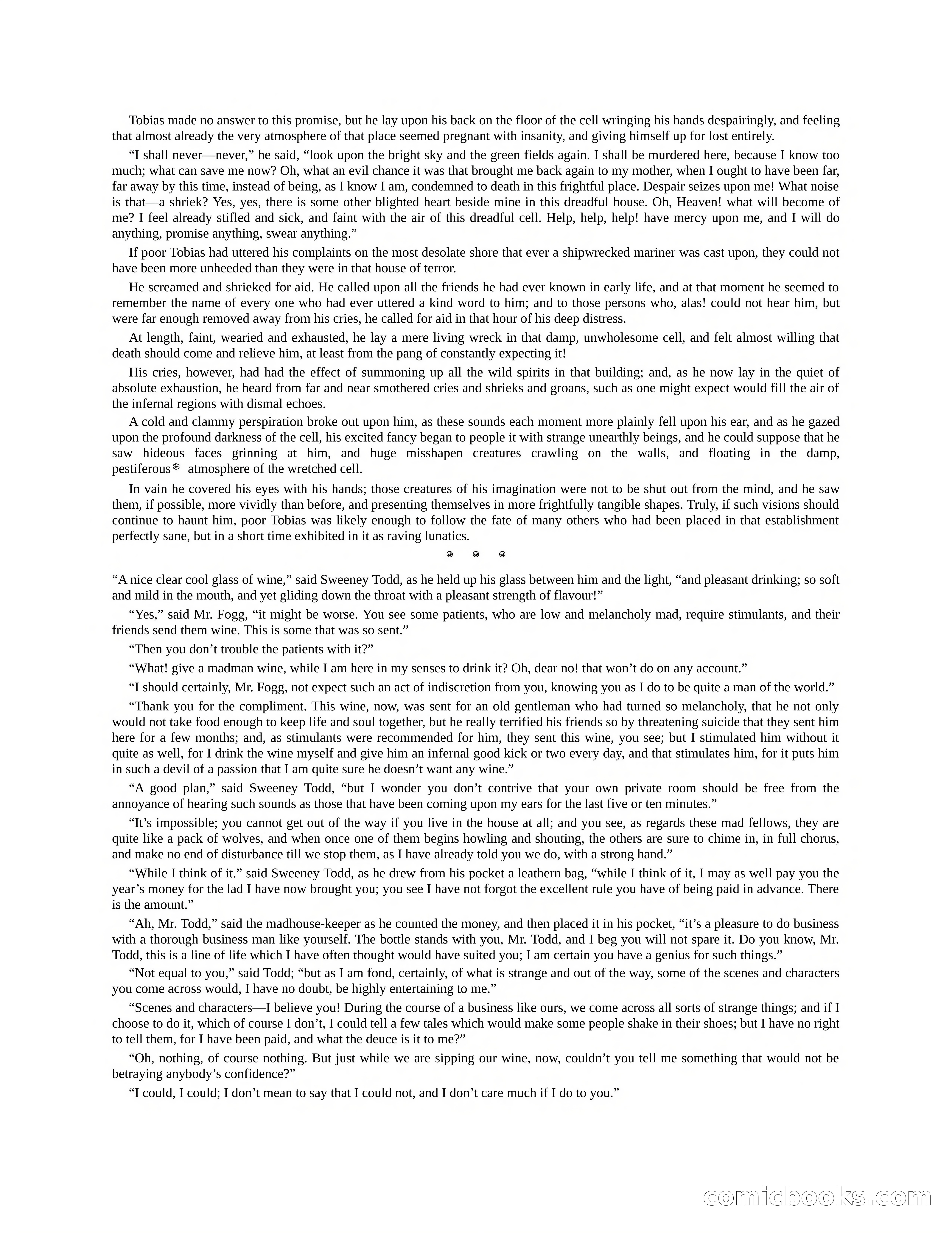
A restored page from Penny Dreadfuls, 1850. Page through the whole issue in the reader above.
📄 Transcribed text from this page (OCR, searchable)
Machine-transcribed from the original scan — historical spelling and the odd misread are preserved.
Tobias made no answer to this promise, but he lay upon his back on the floor of the cell wringing his hands despairingly, and feeling that almost already the very atmosphere of that place seemed pregnant with insanity, and giving himself up for lost entirely. “T shall never—never,” he said, “look upon the bright sky and the green fields again. I shall be murdered here, because I know too much; what can save me now? Oh, what an evil chance it was that brought me back again to my mother, when I ought to have been far, far away by this time, instead of being, as I know I am, condemned to death in this frightful place. Despair seizes upon me! What noise is that—a shriek? Yes, yes, there is some other blighted heart beside mine in this dreadful house. Oh, Heaven! what will become of me? I feel already stifled and sick, and faint with the air of this dreadful cell. Help, help, help! have mercy upon me, and I will do anything, promise anything, swear anything.” If poor Tobias had uttered his complaints on the most desolate shore that ever a shipwrecked mariner was cast upon, they could not have been more unheeded than they were in that house of terror. He screamed and shrieked for aid. He called upon all the friends he had ever known in early life, and at that moment he seemed to remember the name of every one who had ever uttered a kind word to him; and to those persons who, alas! could not hear him, but were far enough removed away from his cries, he called for aid in that hour of his deep distress. At length, faint, wearied and exhausted, he lay a mere living wreck in that damp, unwholesome cell, and felt almost willing that death should come and relieve him, at least from the pang of constantly expecting it! His cries, however, had had the effect of summoning up all the wild spirits in that building; and, as he now lay in the quiet of absolute exhaustion, he heard from far and near smothered cries and shrieks and groans, such as one might expect would fill the air of the infernal regions with dismal echoes. A cold and clammy perspiration broke out upon him, as these sounds each moment more plainly fell upon his ear, and as he gazed upon the profound darkness of the cell, his excited fancy began to people it with strange unearthly beings, and he could suppose that he saw hideous faces grinning at him, and huge misshapen creatures crawling on the walls, and floating in the damp, pestiferous ® atmosphere of the wretched cell. In vain he covered his eyes with his hands; those creatures of his imagination were not to be shut out from the mind, and he saw them, if possible, more vividly than before, and presenting themselves in more frightfully tangible shapes. Truly, if such visions should continue to haunt him, poor Tobias was likely enough to follow the fate of many others who had been placed in that establishment perfectly sane, but in a short time exhibited in it as raving lunatics. ® oe @o “A nice clear cool glass of wine,” said Sweeney Todd, as he held up his glass between him and the light, “and pleasant drinking; so soft and mild in the mouth, and yet gliding down the throat with a pleasant strength of flavour!” “Yes,” said Mr. Fogg, “it might be worse. You see some patients, who are low and melancholy mad, require stimulants, and their friends send them wine. This is some that was so sent.” “Then you don’t trouble the patients with it?” “What! give a madman wine, while I am here in my senses to drink it? Oh, dear no! that won’t do on any account.” “T should certainly, Mr. Fogg, not expect such an act of indiscretion from you, knowing you as I do to be quite a man of the world.” “Thank you for the compliment. This wine, now, was sent for an old gentleman who had turned so melancholy, that he not only would not take food enough to keep life and soul together, but he really terrified his friends so by threatening suicide that they sent him here for a few months; and, as stimulants were recommended for him, they sent this wine, you see; but I stimulated him without it quite as well, for I drink the wine myself and give him an infernal good kick or two every day, and that stimulates him, for it puts him in such a devil of a passion that I am quite sure he doesn’t want any wine.” “A good plan,” said Sweeney Todd, “but I wonder you don’t contrive that your own private room should be free from the annoyance of hearing such sounds as those that have been coming upon my ears for the last five or ten minutes.” “Tt’s impossible; you cannot get out of the way if you live in the house at all; and you see, as regards these mad fellows, they are quite like a pack of wolves, and when once one of them begins howling and shouting, the others are sure to chime in, in full chorus, and make no end of disturbance till we stop them, as I have already told you we do, with a strong hand.” “While I think of it.” said Sweeney Todd, as he drew from his pocket a leathern bag, “while I think of it, I may as well pay you the year’s money for the lad I have now brought you; you see I have not forgot the excellent rule you have of being paid in advance. There is the amount.” “Ah, Mr. Todd,” said the madhouse-keeper as he counted the money, and then placed it in his pocket, “it’s a pleasure to do business with a thorough business man like yourself. The bottle stands with you, Mr. Todd, and I beg you will not spare it. Do you know, Mr. Todd, this is a line of life which I have often thought would have suited you; I am certain you have a genius for such things.” “Not equal to you,” said Todd; “but as I am fond, certainly, of what is strange and out of the way, some of the scenes and characters you come across would, I have no doubt, be highly entertaining to me.” “Scenes and characters—I believe you! During the course of a business like ours, we come across all sorts of strange things; and if I choose to do it, which of course I don’t, I could tell a few tales which would make some people shake in their shoes; but I have no right to tell them, for I have been paid, and what the deuce is it to me?” “Oh, nothing, of course nothing. But just while we are sipping our wine, now, couldn’t you tell me something that would not be betraying anybody’s confidence?” “T could, I could; I don’t mean to say that I could not, and I don’t care much if I do to you.” CORniclooo S CO)