
Penny Dreadfuls, 1850 · page 88 of 400
The Gift of the Sailor: The String of Pearls & Sweeney Todd, the Demon Barber of Fleet Street — page 88: what you’re looking at
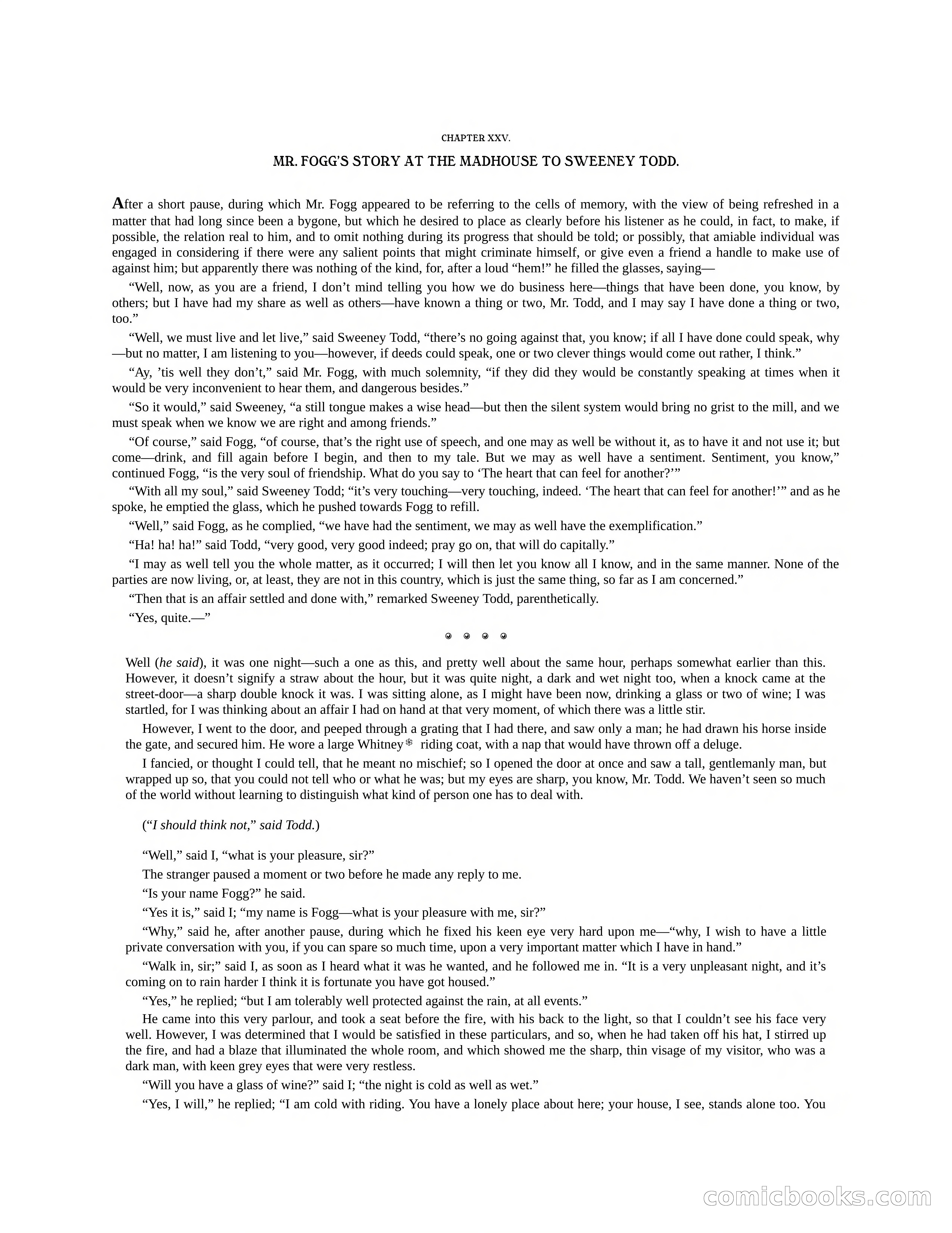
A restored page from Penny Dreadfuls, 1850. Page through the whole issue in the reader above.
📄 Transcribed text from this page (OCR, searchable)
Machine-transcribed from the original scan — historical spelling and the odd misread are preserved.
CHAPTER XXV. MR. FOGG’S STORY AT THE MADHOUSE TO SWEENEY TODD. After a short pause, during which Mr. Fogg appeared to be referring to the cells of memory, with the view of being refreshed in a matter that had long since been a bygone, but which he desired to place as clearly before his listener as he could, in fact, to make, if possible, the relation real to him, and to omit nothing during its progress that should be told; or possibly, that amiable individual was engaged in considering if there were any salient points that might criminate himself, or give even a friend a handle to make use of against him; but apparently there was nothing of the kind, for, after a loud “hem!” he filled the glasses, saying— “Well, now, as you are a friend, I don’t mind telling you how we do business here—things that have been done, you know, by others; but I have had my share as well as others—have known a thing or two, Mr. Todd, and I may say I have done a thing or two, too.” “Well, we must live and let live,” said Sweeney Todd, “there’s no going against that, you know; if all I have done could speak, why —but no matter, I am listening to you—however, if deeds could speak, one or two clever things would come out rather, I think.” “Ay, ’tis well they don’t,” said Mr. Fogg, with much solemnity, “if they did they would be constantly speaking at times when it would be very inconvenient to hear them, and dangerous besides.” “So it would,” said Sweeney, “a still tongue makes a wise head—but then the silent system would bring no grist to the mill, and we must speak when we know we are right and among friends.” “Of course,” said Fogg, “of course, that’s the right use of speech, and one may as well be without it, as to have it and not use it; but come—drink, and fill again before I begin, and then to my tale. But we may as well have a sentiment. Sentiment, you know,” continued Fogg, “is the very soul of friendship. What do you say to ‘The heart that can feel for another?’” “With all my soul,” said Sweeney Todd; “it’s very touching—very touching, indeed. ‘The heart that can feel for another!’” and as he spoke, he emptied the glass, which he pushed towards Fogg to refill. “Well,” said Fogg, as he complied, “we have had the sentiment, we may as well have the exemplification.” “Ha! ha! ha!” said Todd, “very good, very good indeed; pray go on, that will do capitally.” “T may as well tell you the whole matter, as it occurred; I will then let you know all I know, and in the same manner. None of the parties are now living, or, at least, they are not in this country, which is just the same thing, so far as I am concerned.” “Then that is an affair settled and done with,” remarked Sweeney Todd, parenthetically. “Yes, quite.—” ® © @ @ Well (he said), it was one night—such a one as this, and pretty well about the same hour, perhaps somewhat earlier than this. However, it doesn’t signify a straw about the hour, but it was quite night, a dark and wet night too, when a knock came at the street-door—a sharp double knock it was. I was sitting alone, as I might have been now, drinking a glass or two of wine; I was startled, for I was thinking about an affair I had on hand at that very moment, of which there was a little stir. However, I went to the door, and peeped through a grating that I had there, and saw only a man; he had drawn his horse inside the gate, and secured him. He wore a large Whitney® riding coat, with a nap that would have thrown off a deluge. I fancied, or thought I could tell, that he meant no mischief; so I opened the door at once and saw a tall, gentlemanly man, but wrapped up so, that you could not tell who or what he was; but my eyes are sharp, you know, Mr. Todd. We haven’t seen so much of the world without learning to distinguish what kind of person one has to deal with. (“I should think not,” said Todd.) “Well,” said I, “what is your pleasure, sir?” The stranger paused a moment or two before he made any reply to me. “Ts your name Fogg?” he said. “Yes it is,” said I; “my name is Fogg—what is your pleasure with me, sir?” “Why,” said he, after another pause, during which he fixed his keen eye very hard upon me—“why, I wish to have a little private conversation with you, if you can spare so much time, upon a very important matter which I have in hand.” “Walk in, sir;” said I, as soon as I heard what it was he wanted, and he followed me in. “It is a very unpleasant night, and it’s coming on to rain harder I think it is fortunate you have got housed.” “Yes,” he replied; “but I am tolerably well protected against the rain, at all events.” He came into this very parlour, and took a seat before the fire, with his back to the light, so that I couldn’t see his face very well. However, I was determined that I would be satisfied in these particulars, and so, when he had taken off his hat, I stirred up the fire, and had a blaze that illuminated the whole room, and which showed me the sharp, thin visage of my visitor, who was a dark man, with keen grey eyes that were very restless. “Will you have a glass of wine?” said I; “the night is cold as well as wet.” “Yes, I will,” he replied; “I am cold with riding. You have a lonely place about here; your house, I see, stands alone too. You CORniclooo S CO)