
Penny Dreadfuls, 1870 · page 164 of 400
Penny Blood Serial Fiction — page 164: what you’re looking at
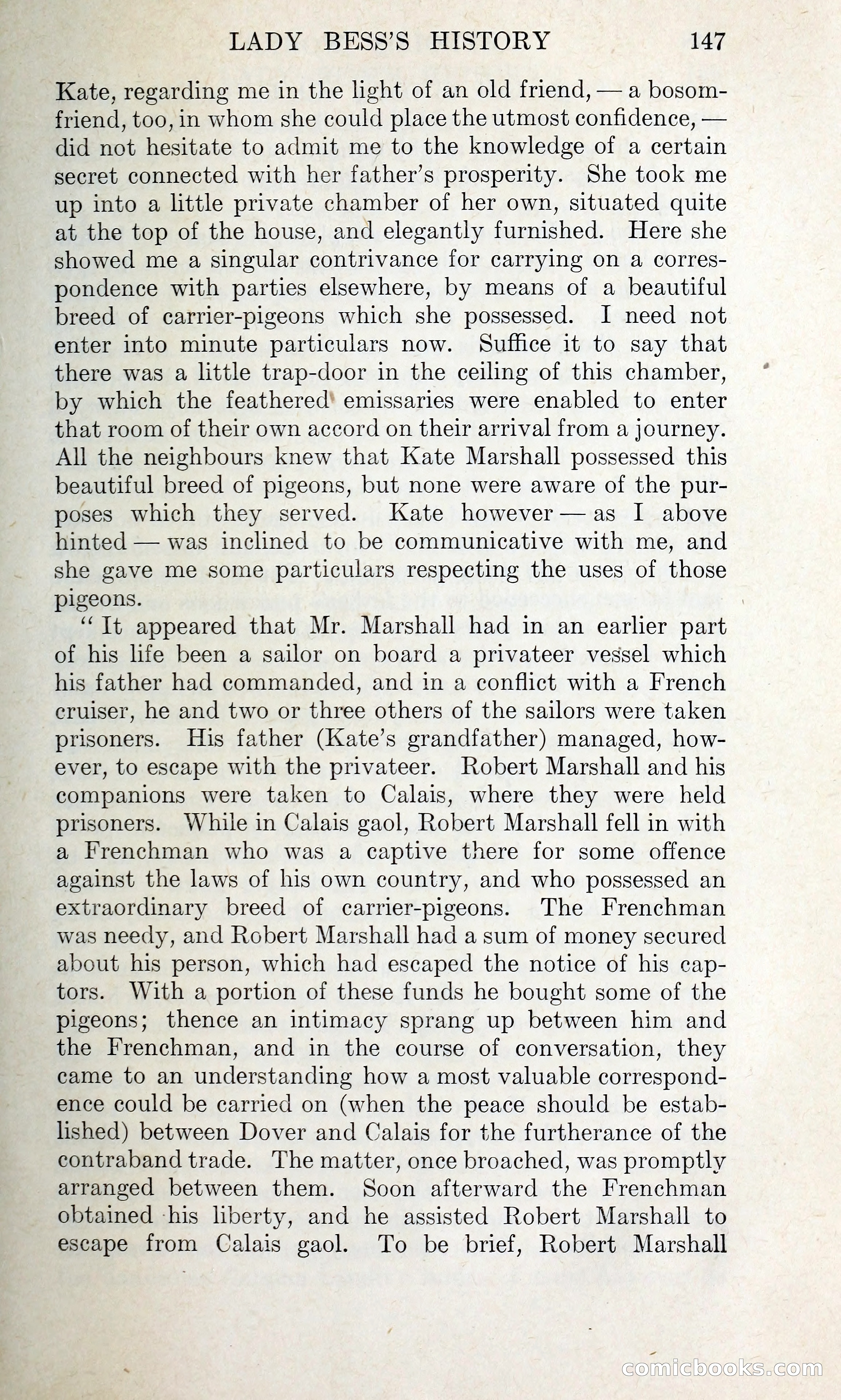
A restored page from Penny Dreadfuls, 1870. Page through the whole issue in the reader above.
📄 Transcribed text from this page (OCR, searchable)
Machine-transcribed from the original scan — historical spelling and the odd misread are preserved.
LADY BESS’S HISTORY 147 Kate, regarding me in the hght of an old friend, — a bosom- friend, too, in whom she could place the utmost confidence, — did not hesitate to admit me to the knowledge of a certain secret connected with her father’s prosperity. She took me up into a little private chamber of her own, situated quite at the top of the house, and elegantly furnished. Here she showed me a singular contrivance for carrying on a corres- pondence with parties elsewhere, by means of a beautiful breed of carrier-pigeons which she possessed. I need not enter into minute particulars now. Suffice it to say that there was a little trap-door in the ceiling of this chamber, by which the feathered’ emissaries were enabled to enter that room of their own accord on their arrival from a journey. All the neighbours knew that Kate Marshall possessed this beautiful breed of pigeons, but none were aware of the pur- poses which they served. Kate however—as I above hinted — was inclined to be communicative with me, and she gave me some particulars respecting the uses of those pigeons. ‘It appeared that Mr. Marshall had in an earlier part of his life been a sailor on board a privateer vessel which his father had commanded, and 1n a conflict with a French eruiser, he and two or three others of the sailors were taken prisoners. His father (Kate’s grandfather) managed, how- ever, to escape with the privateer. Robert Marshall and his companions were taken to Calais, where they were held prisoners. While in Calais gaol, Robert Marshall fell in with a Frenchman who was a captive there for some offence against the laws of his own country, and who possessed an extraordinary breed of carrier-pigeons. The Frenchman was needy, and Robert Marshall had a sum of money secured about his person, which had escaped the notice of his cap- tors. With a portion of these funds he bought some of the pigeons; thence an intimacy sprang up between him and the Frenchman, and in the course of conversation, they came to an understanding how a most valuable correspond- ence could be carried on (when the peace should be estab- lished) between Dover and Calais for the furtherance of the contraband trade. The matter, once broached, was promptly arranged between them. Soon afterward the Frenchman obtained -his liberty, and he assisted Robert Marshall to escape from Calais gaol. To be brief, Robert Marshall GoOmicdoo ‘Ss (C(O)