
Penny Dreadfuls, 1870 · page 165 of 400
Penny Blood Serial Fiction — page 165: what you’re looking at
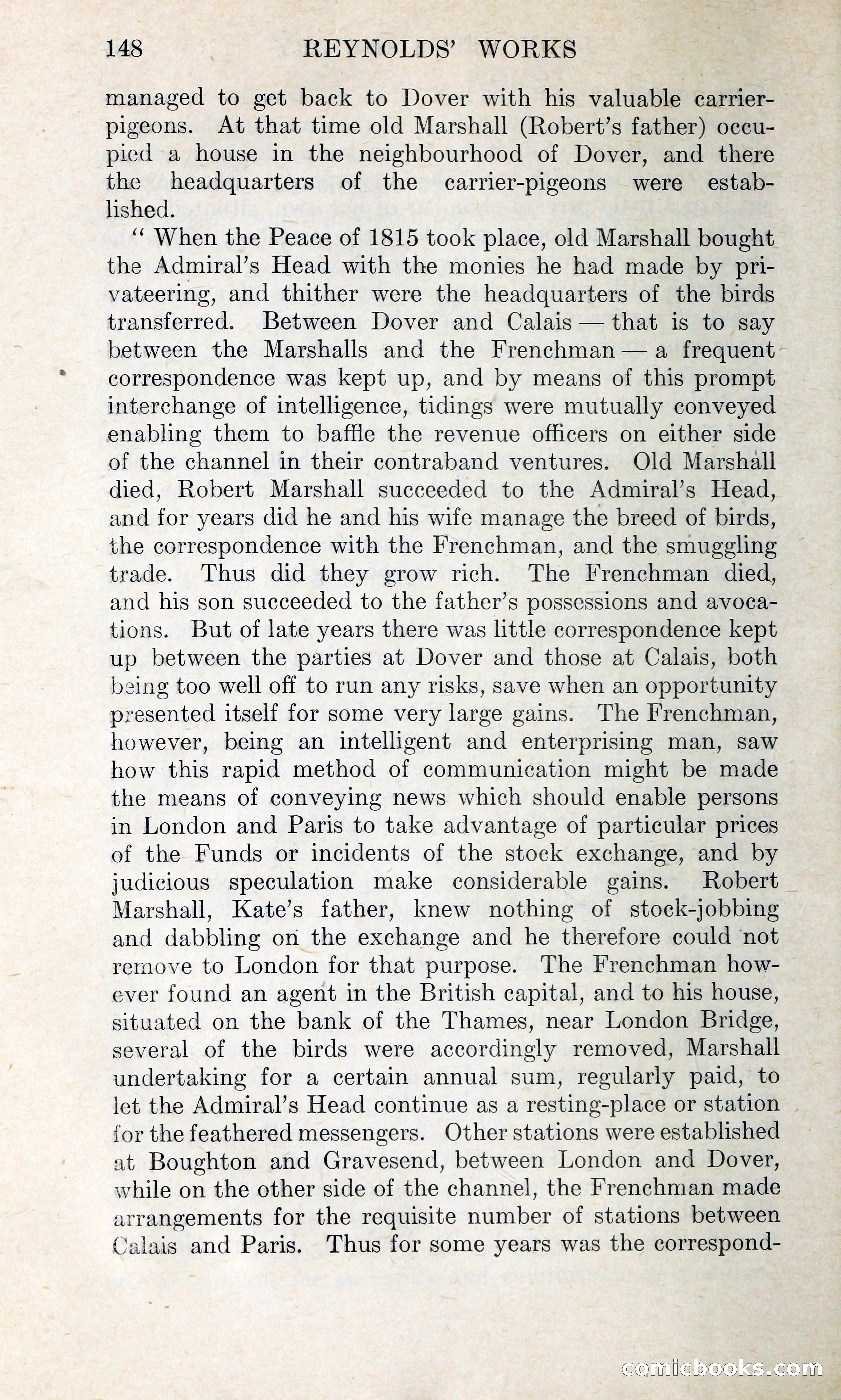
A restored page from Penny Dreadfuls, 1870. Page through the whole issue in the reader above.
📄 Transcribed text from this page (OCR, searchable)
Machine-transcribed from the original scan — historical spelling and the odd misread are preserved.
148 REYNOLDS’ WORKS managed to get back to Dover with his valuable carrier- pigeons. At that time old Marshall (Robert’s father) occu- pied a house in the neighbourhood of Dover, and there the headquarters of the carrier-pigeons were estab- lished. ‘“ When the Peace of 1815 took place, old Marshall bought the Admiral’s Head with the monies he had made by pri- vateering, and thither were the headquarters of the birds transferred. Between Dover and Calais —that is to say between the Marshalls and the Frenchman — a frequent’ correspondence was kept up, and by means of this prompt interchange of intelligence, tidings were mutually conveyed enabling them to baffle the revenue officers on either side of the channel in their contraband ventures. Old Marshall died, Robert Marshall succeeded to the Admiral’s Head, and for years did he and his wife manage the breed of birds, the correspondence with the Frenchman, and the smuggling trade. Thus did they grow rich. The Frenchman died, and his son succeeded to the father’s possessions and avoca- tions. But of late years there was little correspondence kept up between the parties at Dover and those at Calais, both being too well off to run any risks, save when an opportunity presented itself for some very large gains. The Frenchman, however, being an intelligent and enterprising man, saw how this rapid method of communication might be made the means of conveying news which should enable persons in London and Paris to take advantage of particular prices of the Funds or incidents of the stock exchange, and by judicious speculation make considerable gains. Robert _ Marshall, Kate’s father, knew nothing of stock-jobbing and dabbling on the exchange and he therefore could not remove to London for that purpose. The Frenchman how- ever found an agent in the British capital, and to his house, situated on the bank of the Thames, near London Bridge, several of the birds were accordingly removed, Marshall undertaking for a certain annual sum, regularly paid, to let the Admiral’s Head continue as a resting-place or station — for the feathered messengers. Other stations were established at Boughton and Gravesend, between London and Dover, while on the other side of the channel, the Frenchman made arrangements for the requisite number of stations between Calais and Paris. Thus for some years was the correspond- Gomicbooks.-co