
Pulp Fiction, 1950 · page 108 of 134
A. Merritt's Fantasy Magazine, February 1950 — page 108: what you’re looking at
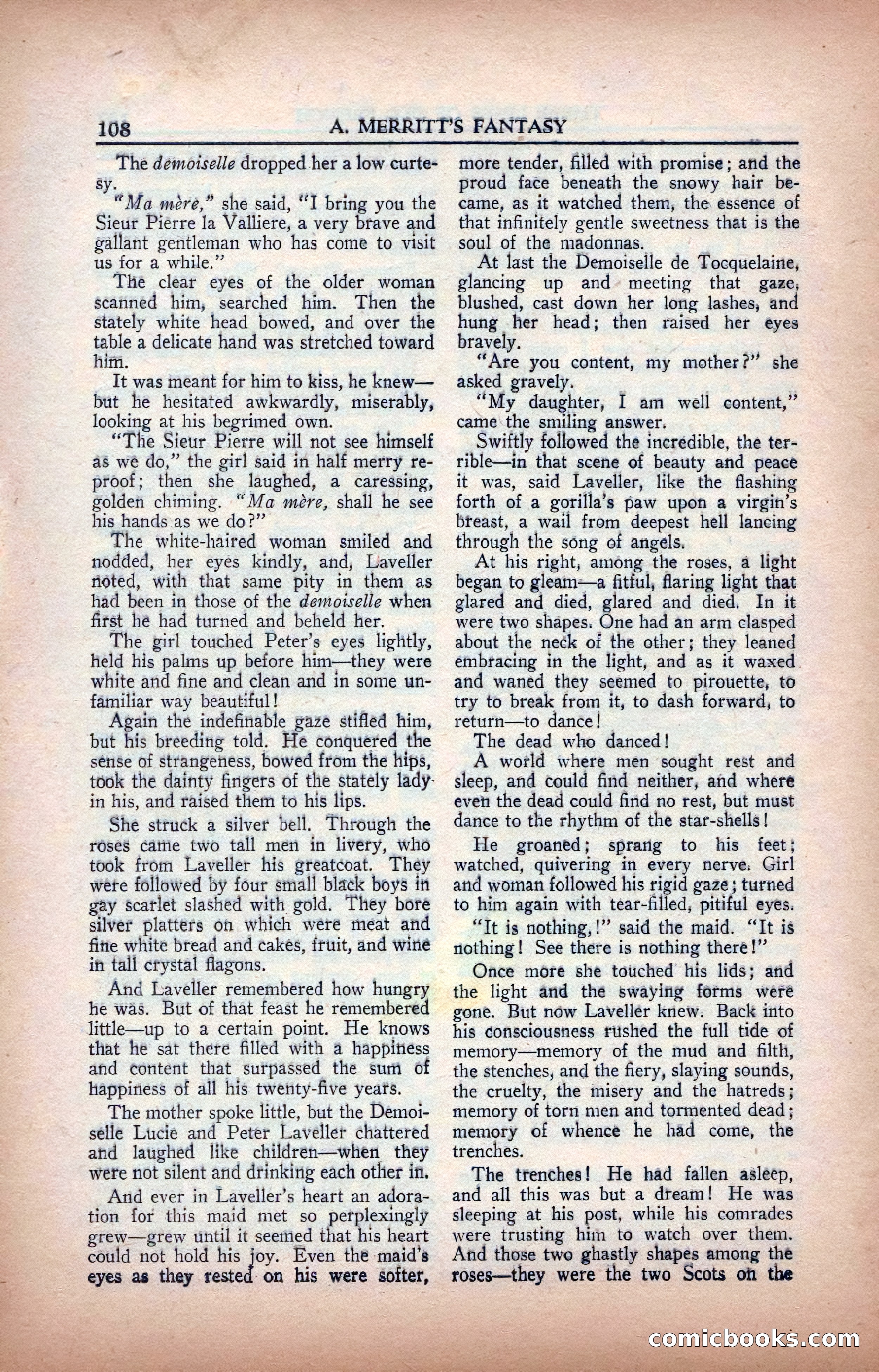
A restored page from Pulp Fiction, 1950. Page through the whole issue in the reader above.
📄 Transcribed text from this page (OCR, searchable)
Machine-transcribed from the original scan — historical spelling and the odd misread are preserved.
108 A. MERRITT’S FANTASY The demoiselle dropped her a low curte- sy. “Ma mere,” she said, “I bring you the Sieur Pierre la Valliere, a very brave and gallant gentleman who has come to visit us for a while.” The clear eyes of the older woman scanned him, searched him. Then the stately white head bowed, and over the table a delicate hand was stretched toward him. _ It was meant for him to kiss, he knew— but he hesitated awkwardly, miserably, looking at his begrimed own. : “The Sieur Pierre will not see himself as we do,” the girl said in half merry re- proof; then she laughed, a caressing, golden chiming. “Ma mére, shall he see his hands as we do?” The white-haired woman smiled and nodded, her eyes kindly, and, Laveller noted, with that same pity in them as had been in those of the demoiselle when first hé had turned and beheld her. The girl touched Peter’s eyes lightly, held his palms up before him—they were white and fine and clean and in some un- familiar way beautiful! : Again the indefinable gaze stifled him, but his breeding told. He conquered the sense of strangeness, bowed from the hips, took the dainty fingers of the stately lady- in his, and raised them to his lips. She struck a silver bell. Through the roses cattie two tall men in livery, who took from Laveller his greatcoat. They wete followed by four small black boys in gay scarlet slashed with gold. They bore silver platters on which were meat and fie white bread and cakés, fruit, and wine in tall ctystal fiagons. And Laveller remembered how hungry he was. But of that feast he remembered little—up to a certain point. He knows that he sat there filled with a happitiess and content that surpassed the sum of happiriess of all his twenty-five years. The mother spoke little, but the Demoi- sélle Lucie and Peter Laveller chattered and laughed like children—when they were not silent and drinking each otlier in. And ever in Laveller’s heart an adora- tion for this maid met so petplexingly grew—grew until it seetied that his heart could not hold his joy. Even the maid’s eyes as they rested on his were soiter, more tender, filled with promise; and the proud face beneath the snowy hair be- came, as it watched them, the essence of that infinitely gentle sweetness that is the soul of the madonnas. At last the Demoiselle de Tocquelaine, glancing up and meeting that gaze, blushed, cast down her long lashes, and hung her head; then raised her eyes bravely. “Are you content, my mother?” she asked gravely. “My daughter, I am well content,” came the smiling answer. Swiftly followed the incredible, the ter- rible—in that scene of beauty and peace it was, said Laveller, like the flashing forth of a gorilla’s paw upon a virgin’s breast, a wail from deepest hell lancing through the song of angels. At his right, among the roses, a light began to gleam—a fitful, flaring light that glared and died, glared and died, In it were two shapes. One had an arm clasped about the neék of the other; they leaned embracing in the light, and as it waxed. and waned they seemed to pirouette, to try to break from it, to dash forward, to return—to dance! The dead who danced! A world where mén sought rest and sleep, and could find neither, and where even the dead could find no rest, but must dance to the rhythm of the star-shells! He groaned; sprarig to his feet; watched, quivering in every nerve: Girl and woman followed his rigid gaze; turned to him again with tear-filled, pitiful eyes. “Tt is nothing,!”’ said the maid. “It is nothing! See there is nothing there!” Once more she totiched his lids; arid the light arid the swaying forms were gone. But now Laveller knew. Back into his consciousness rtished the full tide of memory—memory of the mud and filth, the stenches, and the fiery, slaying sounds, the cruelty, the misery and the hatreds; memory of torn men and tormented dead; memory of whence he had come, the trenches. The trenches! He had fallen asleep, and all this was but a dream! He was sleeping at his post, while his comrades were trusting him to watch over them. And those two ghastly shapes among the roses—they were the two Scots of the