
Pulp Fiction, 1950 · page 109 of 134
A. Merritt's Fantasy Magazine, February 1950 — page 109: what you’re looking at
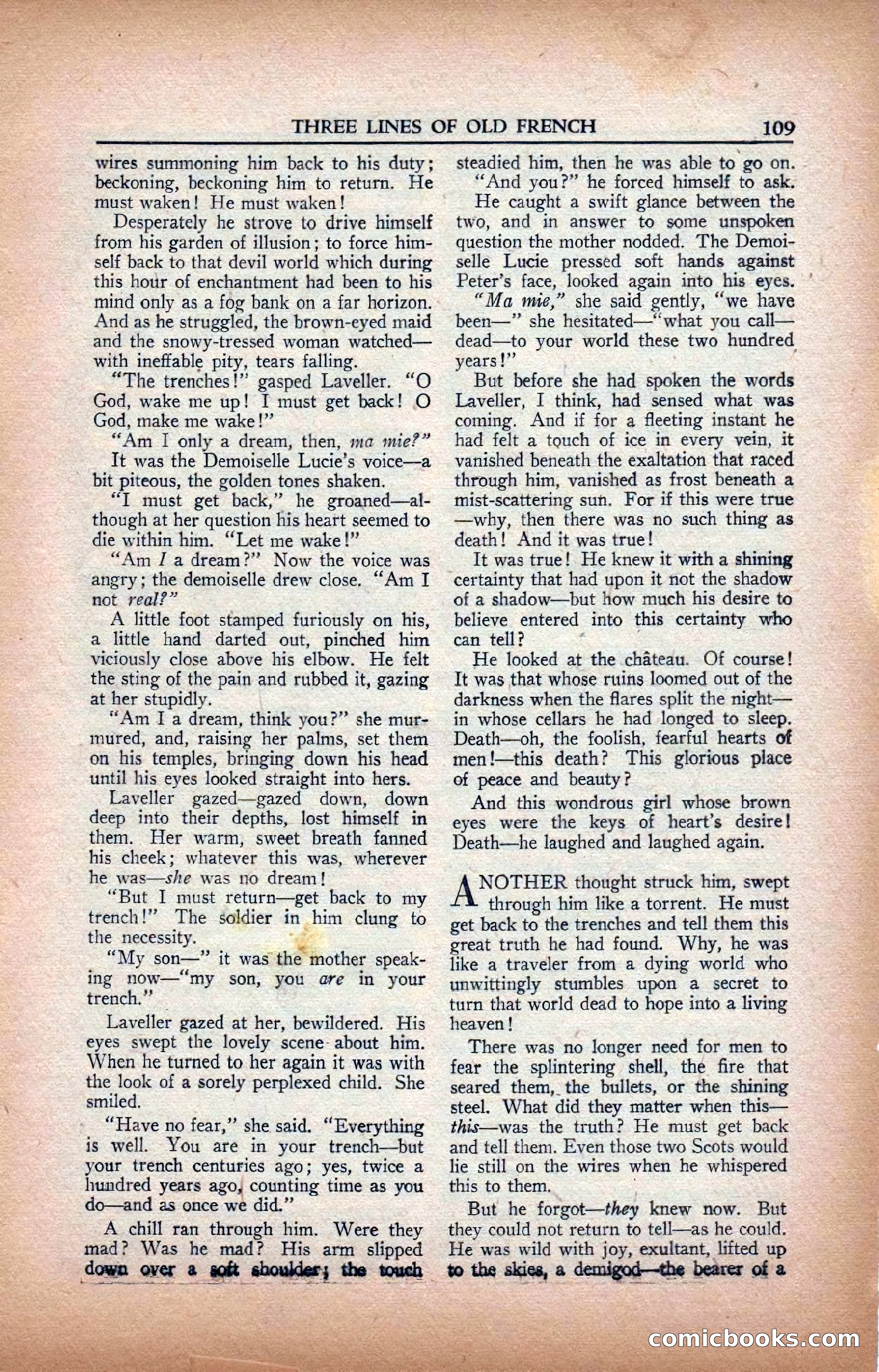
A restored page from Pulp Fiction, 1950. Page through the whole issue in the reader above.
📄 Transcribed text from this page (OCR, searchable)
Machine-transcribed from the original scan — historical spelling and the odd misread are preserved.
THREE LINES OF OLD FRENCH 109 wires summoning him back to his duty; beckoning, beckoning him to return. He must waken! He must waken! Desperately he strove to drive himself from his garden of illusion; to force him- self back to that devil world which during this hour of enchantment had been to his mind only as a fog bank on a far horizon. And as he struggled, the brown-eyed maid and the snowy-tressed woman watched— with ineffable pity, tears falling. “The trenches!”’ gasped Laveller. “O God, wake me up! I must get back! O God, make me wake!”’ “Am I only a dream, then, ma mie?” It was the Demoiselle Lucie’s voice—a bit piteous, the golden tones shaken, “I must get back,” he groaned—al- though at her question his heart seemed to die within him. “Let me wake!” “Am J a dream?” Now the voice was angry; the demoiselle drew close. “Am I not real?” A little foot stamped furiously on his, a little hand darted out, pinched him viciously close above his elbow. He felt the sting of the pain and rubbed it, gazing at her stupidly. “Am I a dream, think you?” she mur- mured, and, raising her palms, set them on his temples, bringing down his head until his eyes looked straight into hers. Laveller gazed—gazed down, down deep into their depths, lost himself in them. Her warm, sweet breath fanned his cheek; whatever this was, wherever he was—she was no dream! “But I must return—get back to my trench!’’ The soldier in him clung to the necessity. ‘¢ “My son—” it was the mother speak- ing now—‘my son, you are in your trench.” — Laveller gazed at her, bewildered. His eyes swept the lovely scene- about him. When he turned to her again it was with the look of a sorely perplexed child. She smiled, “Have no fear,” she said. “Everything is well. You are in your trench—but your trench centuries ago; yes, twice a hundred years ago, counting time as you do—and as once we did.” A chill ran through him. Were they mad? Was he mad? His arm slipped steadied him, then he was able to go On. - “And you?” he forced himself to ask. He caught a swift glance between the two, and in answer to some unspoken question the mother nodded. The Demoi- selle Lucie pressed soft hands against Peter’s face, looked again into his eyes. “Ma me,” she said gently, “we have been—” she hesitated—‘‘what you call— dead—to your world these two hundred years!” But before she had spoken the words Laveller, I think, had sensed what was coming. And if for a fleeting instant he had felt a touch of ice in every vein, it vanished beneath the exaltation that raced through him, vanished as frost beneath a mist-scattering sun. For if this were true —why, then there was no such thing as death! And it was true! It was true! He knew it with a shining certainty that had upon it not the shadow of a shadow—but how much his desire to believe entered into this certainty who can tell? : : He looked at the chateau. Of course! It was that whose ruins loomed out of the darkness when the flares split the night— in whose cellars he had longed to sleep. Death—oh, the foolish, fearful hearts of men!—this death? This glorious place of peace and beauty? And this wondrous girl whose brown eyes were the keys of heart’s desire] Death—he laughed and laughed again. ACTH. thought struck him, swept through him like a torrent. He must get back to the trenches and tell them this great truth he had found. Why, he was like a traveler from a dying world who unwittingly stumbles upon a secret to turn that world dead to hope into a living heaven ! There was no longer need for men to fear the splintering shell, the fire that seared them, the bullets, or the shining steel. What did they matter when this— this—was the truth? He must get back and tell them. Even those two Scots would lie still on the wires when he whispered this to them. : But he forgot—they knew now. But they could not return to tell—as he could. He was wild with joy, exultant, lifted up — to the skies, a demigod—the bearer of a i ‘ ty ‘i 2 4 a A, os ee