
Pulp Fiction, 1915 · page 151 of 228
Adventure, November 1915 — page 151: what you’re looking at
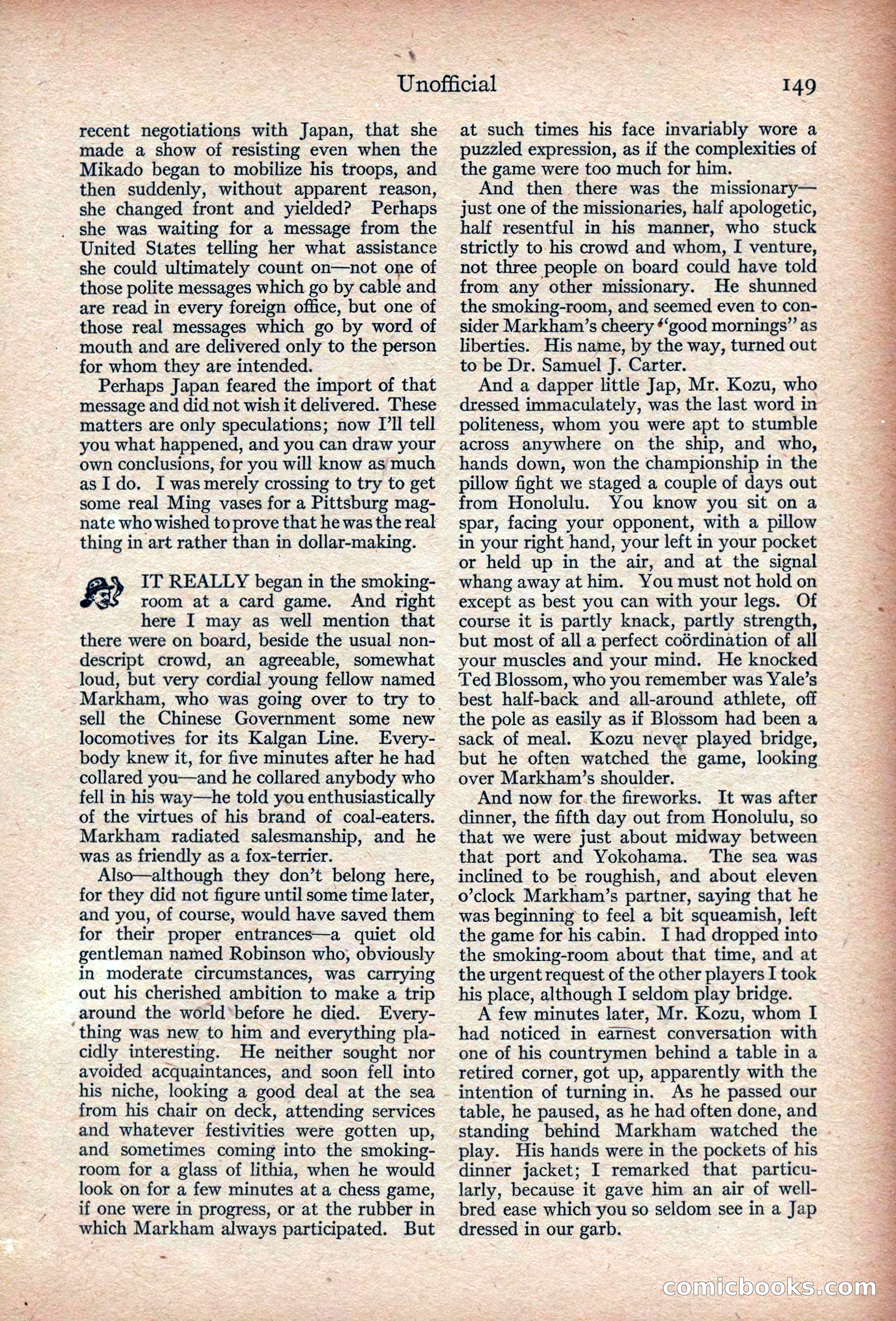
A restored page from Pulp Fiction, 1915. Page through the whole issue in the reader above.
📄 Transcribed text from this page (OCR, searchable)
Machine-transcribed from the original scan — historical spelling and the odd misread are preserved.
~% Unofficial recent negotiations with Japan, that she made a show of resisting even when the Mikado began to mobilize his troops, and then suddenly, without apparent reason, she changed front and yielded? Perhaps _ she was waiting for a message from the United States telling her what assistance she could ultimately count on—not one of those polite messages which go by cable and are read in every foreign office, but one of those real messages which go by word of mouth and are delivered only to the person for whom they are intended. Perhaps Japan feared the import of that message and did not wish it delivered. These matters are only speculations; now I'll tell you what happened, and you can draw your own conclusions, for you will know as'much as I do. I was merely crossing to try to get some real Ming vases for a Pittsburg mag- nate who wished to prove that he was the real thing in art rather than i in dollar-making. IT REALLY began in the smoking- room at a card game. And right here I may as well mention that there were on board, beside the usual non- descript crowd, an agreeable, somewhat loud, but very cordial young fellow named _. Markham, who was going over to try to. sell the Chinese Government some new locomotives for its Kalgan Line. Every- body knew it, for five minutes after he had collared you—and he collared anybody who fell in his way—he told you enthusiastically of the virtues of his brand of coal-eaters. Markham radiated salesmanship, and he was as friendly as a fox-terrier. Also—although they don’t belong here, for they did not figure until some time later, and you, of course, would have saved them for their proper entrances—a quiet old gentleman named Robinson who, obviously in moderate circumstances, was carrying out his cherished ambition to make a trip around the world ‘before he died. Every- thing was new to him and everything pla- cidly interesting. He neither sought nor avoided acquaintances, and soon fell into his niche, looking a good deal at the sea from his chair on deck, attending services and whatever festivities were gotten up, and sometimes coming into the smoking- room for a glass of lithia, when he would look on for a few minutes at a chess game, if one were in progress, or at the rubber in which Markham always participated. But 149 at such times his face invariably wore a puzzled expression, as if the complexities of the game were too much for him. And then there was the missionary— just one of the missionaries, half apologetic, half resentful in his manner, who stuck strictly to his crowd and whom, I venture, not three people on board could have told from any other missionary. He shunned the smoking-room, and seemed even to ae sider Markham’s cheery *‘good mornings” a liberties. His name, by the way, turned ae to be Dr. Samuel J. Carter. And a dapper little Jap, Mr. Kozu, who dressed immaculately, was the last word in politeness, whom you were apt to stumble across anywhere on the ship, and who, hands down, won the championship in the pillow fight we staged a couple of days out from Honolulu. You know you sit on a spar, facing your opponent, with a pillow in your right hand, your left in your pocket or held up in the air, and at the signal whang away at him. You must not hold on except as best you can with your legs. Of course it is partly knack, partly strength, but most of all a perfect codrdination of all your muscles and your mind. He knocked Ted Blossom, who you remember was Yale’s best half-back and all-around athlete, off the pole as easily as if Blossom had been a sack of meal. Kozu never played bridge, but he often watched the game, looking over Markham’s shoulder. And now for.the fireworks. It was after dinner, the fifth day out from Honolulu, so that we were just about midway between that port and Yokohama. ‘The sea was inclined to be roughish, and about eleven -o’clock Markham’s partner, saying that he was beginning to feel a bit squeamish, left the game for his cabin. I had dropped into the smoking-room about that time, and at the urgent request of the other players I took his place, although I seldom play bridge. A few minutes later, Mr. Kozu, whom I had noticed in earnest conversation with one of his countrymen behind a table in a retired corner, got up, apparently with the intention of turning in. As he passed our table, he paused, as he had often done, and standing behind Markham watched the - play. His hands were in the pockets of his dinner jacket; I remarked that particu- larly, because it gave him an air of well- bred ease which you so seldom | see in a Jap dressed in our garb. 0)(0)(6) S (E@) 7 7 is d a : : , AS? } _ 2 TY. : ; Sar ae 7 sr ah us 4 a, rae si i ae gibt s Mig yg im ‘A rae hg cbs MER Ve Ppa ee . CTPA AR UE IA AS Guey TPP bee PTL The COn e t oket | af ' . 7 ¥ diut c : oP . : : Pate Bi VED oe o Cd bh oe z - ays bs Le , ; : ab shat ' 7 “eal Ars ¢ = , +) ie Si SY ie 4 #3 4 Sire ee te Sita RAEN ne Ne ge Les: Fo SSD OS Serta nk ee ee I ~ 4 A a 4 SST - *