
Pulp Fiction, 1915 · page 152 of 228
Adventure, November 1915 — page 152: what you’re looking at
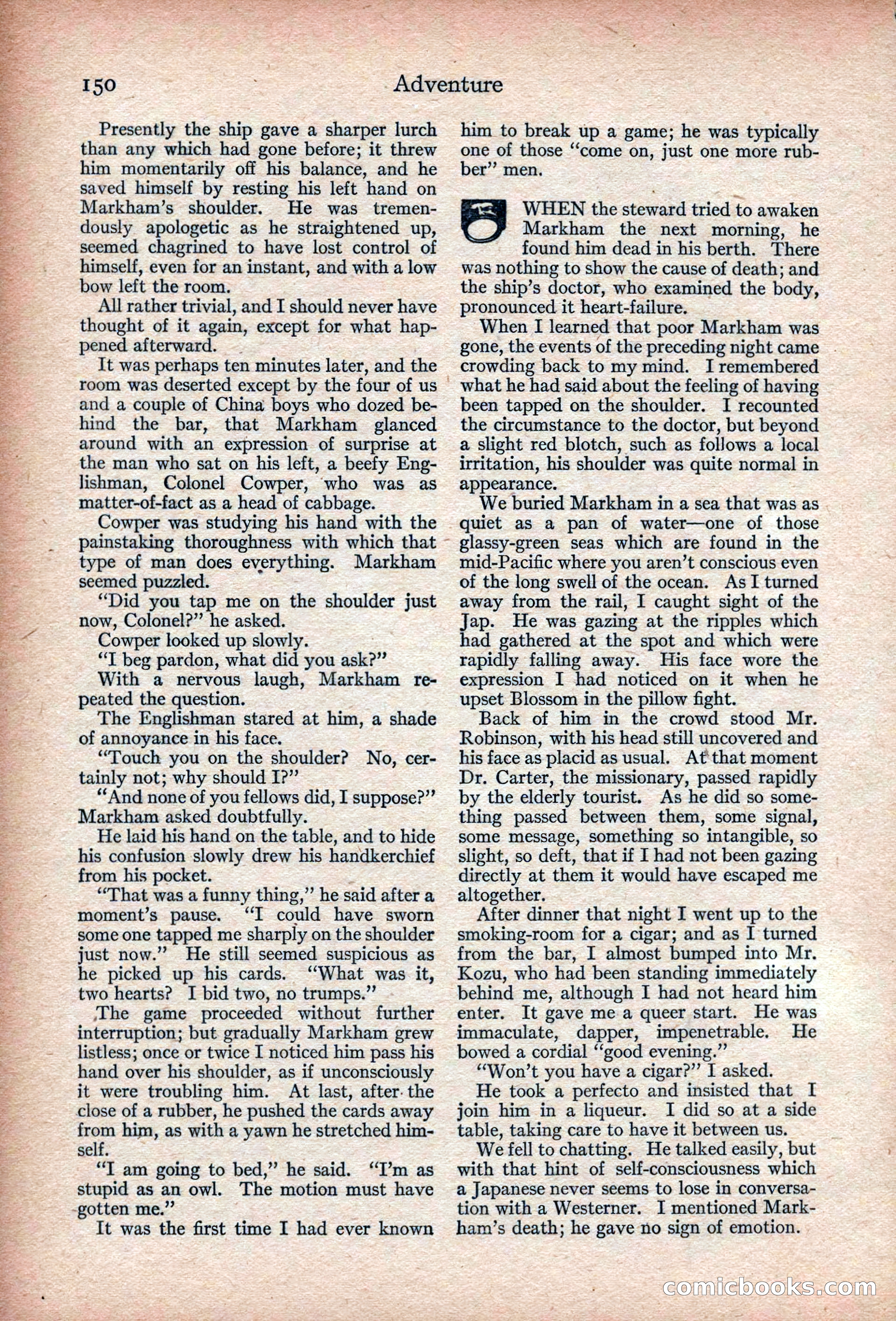
A restored page from Pulp Fiction, 1915. Page through the whole issue in the reader above.
📄 Transcribed text from this page (OCR, searchable)
Machine-transcribed from the original scan — historical spelling and the odd misread are preserved.
cates ms “3s Te x = a z, 2 a ~ Ww PE aS PAU WR gee Tee ey CONST SER 7 : ~ se TG iN Bae ds 4a? * “ Cis Vea ANIA: AAS hy aN, to die is ha Ua ‘> Pyrat 5s? * aa’ ’ - + ‘ 1 ad a | 7 i eh ae ey) Nie r. Viel Wy i 14-7 e \ Aw 150 Presently the ship gave a sharper lurch than any which had gone before; it threw him momentarily off his balance, and he saved himself by resting his left hand on Markham’s shoulder. He was tremen- dously apologetic as he straightened up, seemed chagrined to have lost control of himself, even for an instant, and with a low bow left the room. All rather trivial, and I should never have thought of it again, except for what hap- pened afterward. It was perhaps ten minutes later, and the room was deserted except by the four of us © and a couple of China boys who dozed be- hind the bar, that Markham glanced around with an expression of surprise at the man who sat on his left, a beefy Eng- lishman, Colonel Cowper, who was as matter-of-fact as a head of cabbage. Cowper was studying his hand with the painstaking thoroughness with which that ~ type of man does everything. Markham seemed puzzled. “Did you tap me on the shoulder just now, Colonel?” he asked. Cowper looked up slowly. : “T beg pardon, what did you ask?” With a nervous laugh, Markham re- peated the question. The Englishman stared at him, a shade of annoyance in his face. “Touch you on the shoulder? No, cer- tainly not; why should I?” ‘And none of you fellows did, I suppose?”’ Markham asked doubtfully. He laid his hand on the table, and to hide his confusion slowly drew his handkerchief from his pocket. : “That was a funny thing,” he said after a moment’s pause. “I could have sworn some one tapped me sharply on the shoulder just now.” He still seemed suspicious as he picked up his cards. “What was it, two hearts? I bid two, no trumps.”’ ‘The game proceeded without further interruption; but gradually Markham grew listless; once or twice I noticed him pass his hand over his shoulder, as if unconsciously it were troubling him. At last, after- the close of a rubber, he pushed the cards away from him, as with a yawn he stretched him- self. “T am going to bed,” he said. “I’m as stupid as an owl. The motion must have -gotten me.” It was the first time I had ever known Adventure him to break up a game; he was typically one of those “come on, just one more rub- ber” men. weg §=WHEN the steward tried to awaken (| Markham the next morning, he found him dead in his berth. There was nothing to show the cause of death; and the ship’s doctor, who examined the body, pronounced it heart-failure. When I learned that poor Markham was gone, the events of the preceding night came . crowding back to my mind. I remembered what he had said about the feeling of having been tapped on the shoulder. I recounted the circumstance to the doctor, but beyond a slight red blotch, such as follows a local irritation, his shoulder was quite normal in appearance. We buried Markham in a sea that was as . quiet as a pan of water—one of those glassy-green seas which are found in the mid-Pacific where you aren’t conscious even of the long swell of the ocean. As I turned away from the rail, I caught sight of the Jap. He was gazing at the ripples which had gathered at the spot and which were rapidly falling away. His face wore the expression I had noticed on it when he upset Blossom in the pillow fight. Back of him in the crowd stood Mr. Robinson, with his head still uncovered and his face as placid as usual. At'that moment Dr. Carter, the missionary, passed rapidly by the elderly tourist. As he did so some- thing passed between them, some signal, some message, something so intangible, so slight, so deft, that if I had not been gazing directly at them it would have escaped me altogether. After dinner that night I went up to the smoking-room for a cigar; and as I turned from the bar, I almost bumped into Mr. Kozu, who had been standing immediately behind me, although I had not heard him enter. It gave mea queer start. He was immaculate, dapper, impenetrable. He bowed a cordial ‘‘good evening.”’ “Won't you have a cigar?” I asked. He took a perfecto and insisted that I join him in a liqueur. I did so at a side table, taking care to have it between us. We fell to chatting. He talked easily, but — with that hint of self-consciousness which a Japanese never seems to lose in conversa- tion with a Westerner. I mentioned Mark- ham’s death; he gave no sign of emotion. iGO IOOKS MIG (C©@)