
Pulp Fiction, 1915 · page 80 of 228
Adventure, November 1915 — page 80: what you’re looking at
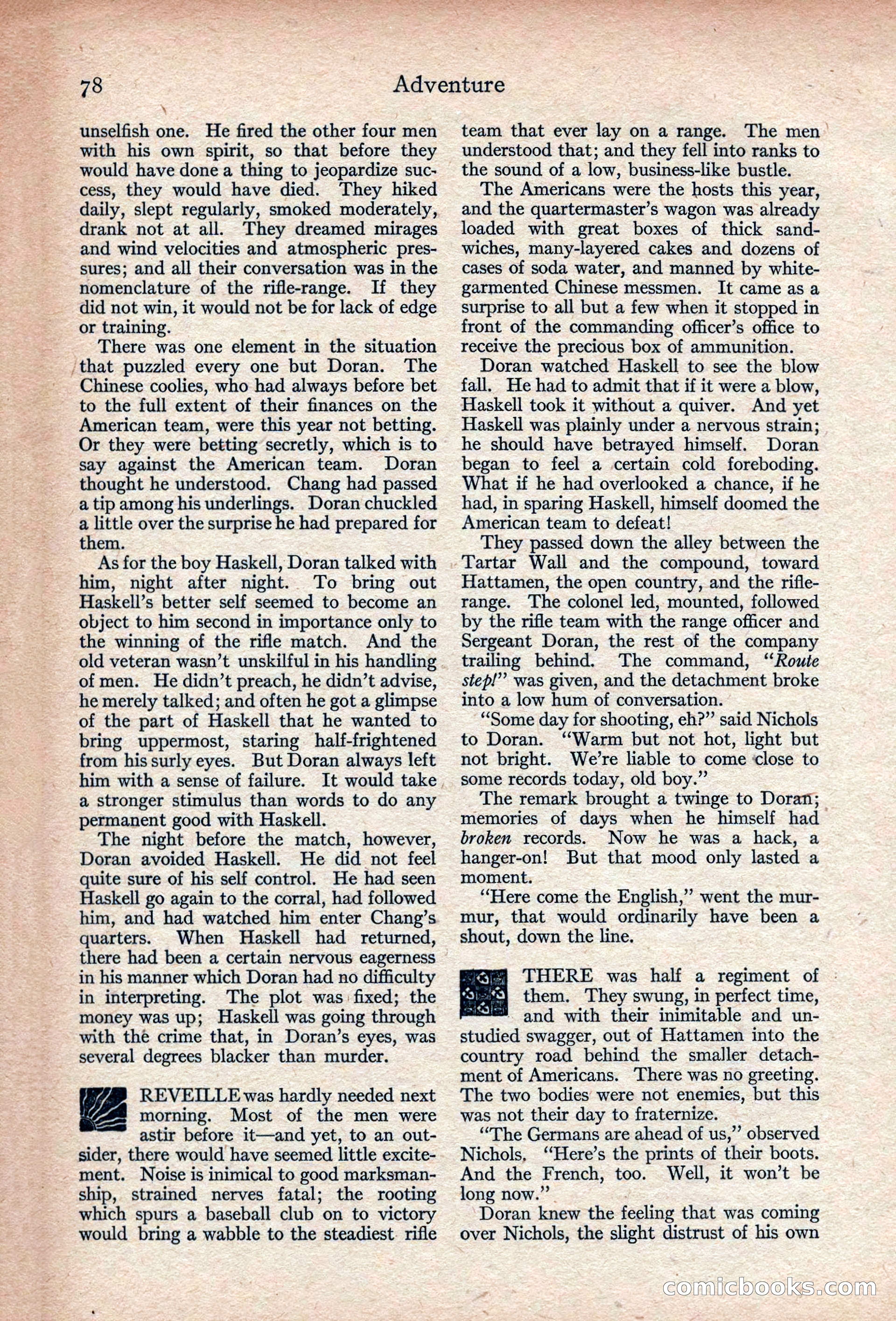
A restored page from Pulp Fiction, 1915. Page through the whole issue in the reader above.
📄 Transcribed text from this page (OCR, searchable)
Machine-transcribed from the original scan — historical spelling and the odd misread are preserved.
‘that puzzled every one but Doran. \ unselfish one. He fired the other four men with his own spirit, so that before they would have done a thing to jeopardize suc- cess, they would have died. They hiked daily, slept regularly, smoked moderately, drank not at all. They dreamed mirages and wind velocities and atmospheric pres- sures; and all their conversation was in the nomenclature of the rifle-range. If they did not win, it would not be for lack of edge or training. There was one element in the situation The Chinese coolies, who had always before bet to the full extent of their finances on the American team, were this year not betting. Or they were betting secretly, which is to say against the American team. Doran thought he understood. Chang had passed _atip among his underlings. Doran chuckled a little over the surprise he had prepared for them. As for the boy Haskell, Doran talked with him, night after night. To bring out Haskell’s better self seemed to become an object to him second in importance only to the winning of the rifle match. And the old veteran wasn’t unskilful in his handling. of men. He didn’t preach, he didn’t advise, he merely talked; and often he got a glimpse of the part of Haskell that he wanted to bring uppermost, staring half-frightened from his surly eyes. But Doran always left him with a sense of failure. a stronger stimulus than words to do any permanent good with Haskell. The night before the match, however, Doran avoided Haskell. He did not feel quite sure of his self control. He had seen Haskell go again to the corral, had followed him, and had watched him enter Chang’s quarters. When Haskell had returned, there had been a certain nervous eagerness in his manner which Doran had no difficulty in interpreting. The plot was: fixed; the money was up; Haskell was going through with thé crime that, in Doran’s eyes, was several degrees blacker than murder. REVEILLE was hardly needed next morning. Most of the men were astir before it—and yet, to an out- sider, there would have seemed little excite- - ment. Noise is inimical to good marksman- ship, strained nerves fatal; the rooting which spurs a baseball club on to victory would bring a wabble to the steadiest. rifle It would take. 78 Adventure team that ever lay on a range. understood that; and they fell into ranks to the sound of a low, business-like bustle. The Americans were the hosts this year, and the quartermaster’s wagon was already loaded with great boxes of thick sand- wiches, many-layered cakes and dozens of cases of soda water, and manned by white- garmented Chinese messmen. It came as a surprise to all but a few when it stopped in front of the commanding officer’s office to receive the precious box of ammunition. Doran watched Haskell to see the blow fall. He had to admit that if it were a blow, Haskell took it without a quiver. And yet Haskell was plainly under a nervous strain; he should have betrayed himself. Doran began to feel a certain cold foreboding. What if he had overlooked a chance, if he had, in sparing Haskell, himself doomed the American team to defeat! They passed down the alley between the Tartar Wall and the compound, toward Hattamen, the open country, and the rifle- range. The colonel led, mounted, followed by the rifle team with the range officer and Sergeant Doran, the rest of the company trailing behind. The command, “Rowie stepl’’ was given, and the detachment broke into a low hum of conversation. “Some day for shooting, eh?” said Nichols to Doran. ‘Warm but not hot, light but not bright. We’re liable to come lose to some records today, old boy.” The remark brought a twinge to Doran; The men memories of days when he himself had broken records. Now he was a hack, a hanger-on! But that mood only lasted a moment. “Here come the English,” went the mur- mur, that would ordinarily have been a shout, down the line. Db: =) them. They swung, in perfect time, le} ond with their inimitable and un- studied swagger, out of Hattamen into the country road behind the smaller detach- ment of Americans. There was no greeting. The two bodies were not enemies, but this was not their day to fraternize. “The Germans are ahead of us,”’ observed Nichols, ‘Here’s the prints of their boots. And the F rench, too. Well, it won’t be long now.’ Doran knew the feeling that was coming over Nichols, the slight distrust of his own THERE was half a regiment of - Conuicoookes