
Pulp Fiction, 1915 · page 81 of 228
Adventure, November 1915 — page 81: what you’re looking at
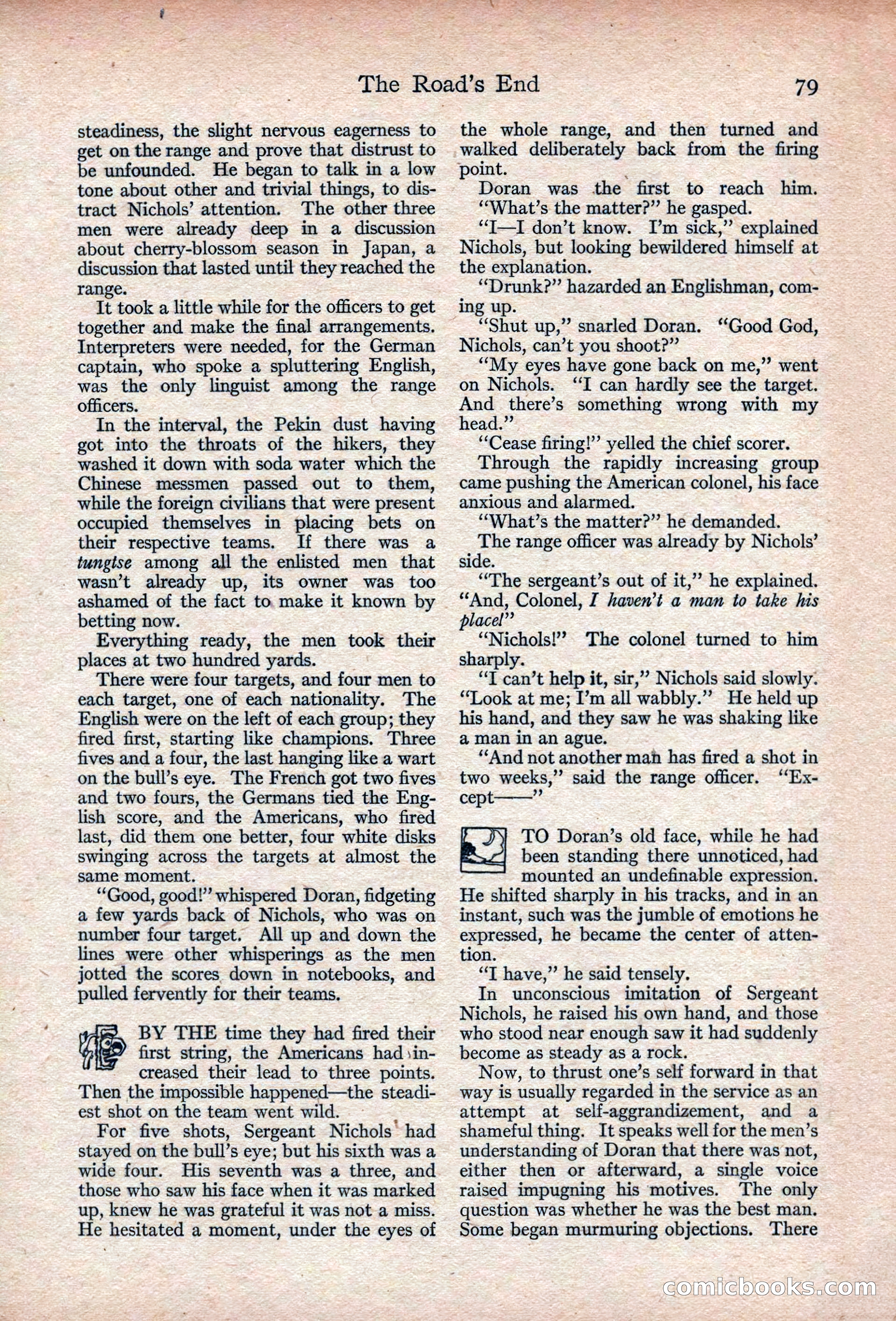
A restored page from Pulp Fiction, 1915. Page through the whole issue in the reader above.
📄 Transcribed text from this page (OCR, searchable)
Machine-transcribed from the original scan — historical spelling and the odd misread are preserved.
The Road’s End steadiness, the slight nervous eagerness to get on the range and prove that distrust to be unfounded. He began to talk in a low tone about other and trivial things, to dis- tract Nichols’ attention. The other three men were already deep in a discussion about cherry-blossom season in Japan, a discussion that lasted until they reached the range. it took a little while for the officers to get together and make the final arrangements. Interpreters were needed, for the German captain, who spoke a spluttering English, was the only linguist among the range officers. In the interval, the Pekin dust having got into the throats of the hikers, they washed it down with soda water which the Chinese messmen passed out to them, while the foreign civilians that were present occupied themselves in placing bets on their respective teams. If there was a tungise among all the enlisted men that - wasn’t already up, its owner was too ashamed of the fact to. make it known by betting now. Everything ready, the men took their places at two hundred yards. There were four targets, and four men to each target, one of each nationality. The English were on the left of each group; they fired first, starting like champions. Three fives and a four, the last hanging like a wart on the bull’s eye. The French got two fives and two fours, the Germans tied the Eng- lish score, and the Americans, who fired last, did them one better, four white disks swinging across the targets at almost the same moment. “Good, good!’ whispered Doran, fidgeting a few yards back of Nichols, who was on number four target. All up and down the lines were other whisperings as the men jotted the scores down in notebooks, and pulled fervently for their teams. BY THE time they had fired their first string, the Americans had )\in- creased their lead to three points. Then the impossible happened—the steadi- est shot on the team went wild. For five shots, Sergeant Nichols had stayed on the bull’s eye; but his sixth was a wide four. His seventh was a three, and those who saw his face when it was marked up, knew he was grateful it was not a miss. He hesitated a moment, under the eyes of 79 the whole range, and then turned and walked deliberately back from the firing point. Doran was the first to reach him. ‘“‘What’s the matter?” he gasped. “I—I don’t know. I’m sick,” explained Nichols, but looking bewildered himself at the explanation. “Drunk?” hazarded an Englishman, com- ing up. “Shut up,” snarled Doran. “Good God, Nichols, can’t you shoot?” “My eyes have gone back on me,” went on Nichols. “I can hardly see the target. And there’s something wrong with my head.” “Cease firing!’’ yelled the chief scorer. Through the rapidly increasing group came pushing the American colonel, his face anxious and alarmed. ‘“‘What’s the matter?”’ he demanded. The range officer was already by Nichols’ side. “The sergeant’s out of it,’”’ he explained. ‘And, Colonel, J haven’t a man to take his placel”’ “Nichols!” sharply. “T can’t help it, sir,’ Nichols said slowly. “Look at me; I’m all wabbly.” He held up his hand, and they saw he was shaking like a man in an ague. ‘And not another mah has fired a shot in two weeks,” said the range officer. ‘“Ex- cept——”’ pm?) TO Doran’s old face, while he had BR -} been standing there unnoticed, had tacues mounted an undefinable expression. He shifted sharply in his tracks, and in an instant, such was the jumble of emotions he expressed, he became the center of atten- tion. “T have,” he said tensely. In unconscious imitation of Sergeant Nichols, he raised his own hand, and those who stood near enough saw it had suddenly become as steady as a rock. Now, to thrust one’s self forward in that way is usually regarded in the service as an attempt at self-aggrandizement, and a shameful thing. It speaks well for the men’s understanding of Doran that there was not, either then or afterward, a single voice raised impugning his motives. The only question was whether he was the best man. Some began murmuring objections. There The colonel turned to him EORICLOOO© SS com