
Pulp Fiction, 1916 · page 14 of 228
Adventure Magazine, March 1916 — page 14: what you’re looking at
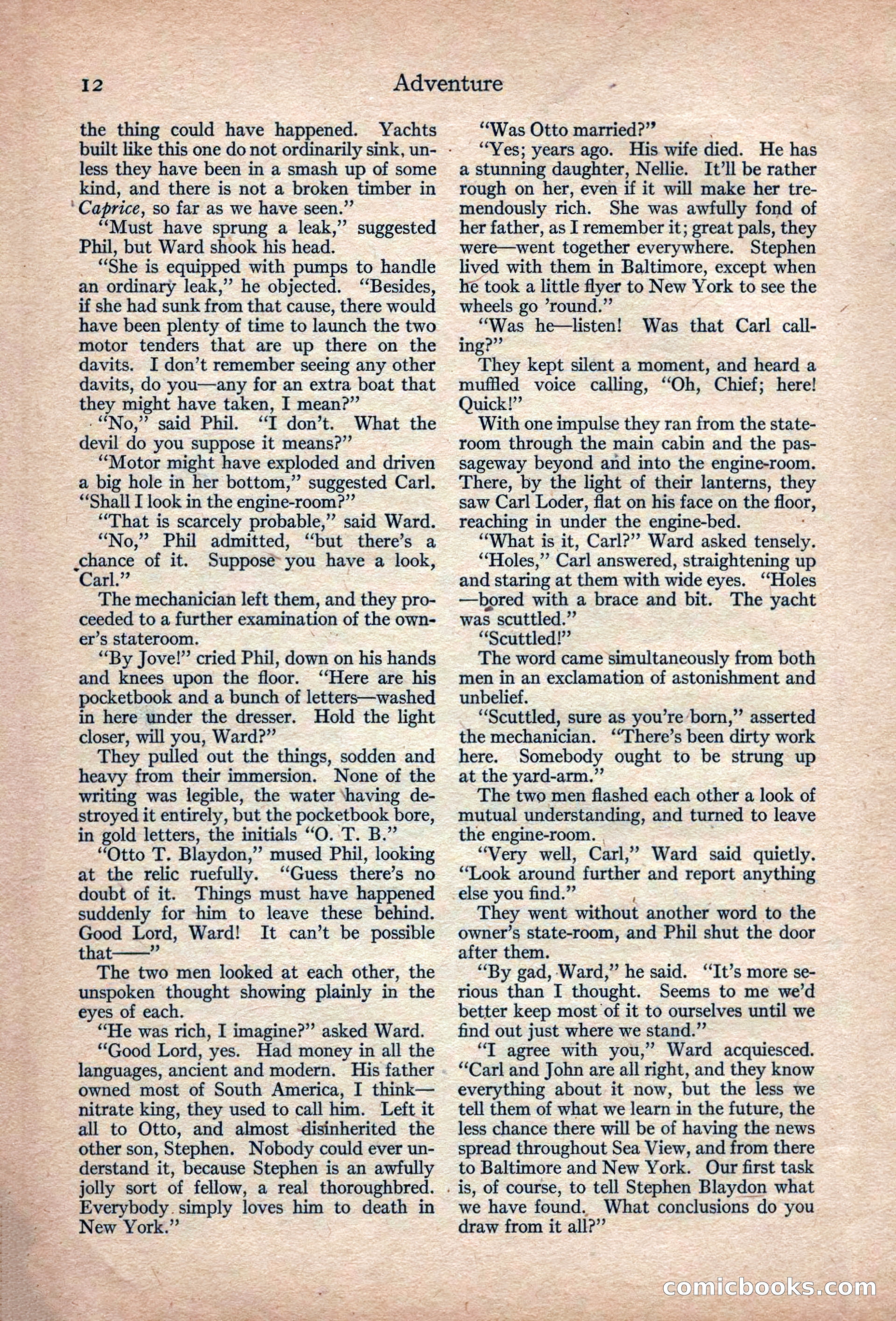
A restored page from Pulp Fiction, 1916. Page through the whole issue in the reader above.
📄 Transcribed text from this page (OCR, searchable)
Machine-transcribed from the original scan — historical spelling and the odd misread are preserved.
I2 the thing could have happened. Yachts built like this one do not ordinarily sink, un- - less they have been in a smash up of some kind, and there is not a broken timber in ‘Caprice, so far as we have seen.’ “Must have sprung a leak,” suggested Phil, but Ward shook his head. : “She is equipped with pumps to handle an ordinary leak,’”’ he objected. ‘‘Besides, if she had sunk from that cause, there would have been plenty of time to launch the two motor tenders that are up there on the davits. davits, do you—any for an extra boat that they might have taken, I mean?” -“No,” said Phil. “I don’t. What the devil do you suppose it means?” “Motor might have exploded and driven a big hole in her bottom,” suggested Carl. “Shall I look in the engine-room?”’ “‘That is scarcely probable,” said Ward. “No,’ Phil admitted, “‘but there’s a chance of it. Suppose you have a look, Carl.” The mechanician left them, and they pro- ceeded to a further examination of the own- er’s stateroom. “By Jove!” cried Phil, down on his hands and knees upon the floor. ‘Here are his pocketbook and a bunch of letters—washed in here under the dresser. Hold the light closer, will you, Ward?” They pulled out the things, sodden and heavy from their immersion. None of the writing was legible, the water ‘having de- stroyed it entirely, but the pocketbook | bore, in gold letters, the initials “O. T. B.” “Otto T. Blaydon,” mused Phil, looking at the relic ruefully. ‘Guess there’s no doubt of it. Things must have happened suddenly for him to leave these behind. Good Lord, Ward! It can’t be possible that——” The two men looked at each other, the unspoken thought showing plainly in the eyes of each. “He was rich, I imagine?” asked Ward. “Good Lord, yes. Had money in all the languages, ancient and modern. His father owned most of South America, I think— nitrate king, they used to call him. Left it all to Otto, and almost -disinherited the other son, Stephen. Nobody could ever un- derstand it, because Stephen is an awfully jolly sort of fellow, a real charoustivred. Everybody. simply loves him to death in New York.” I don’t remember seeing any other _ Adventure “Was Otto married?” “Ves; years ago. His wife died. He has a stunning daughter, Nellie. It’ll be rather rough on her, even if it will make her tre- mendously rich. She was awfully fond of her father, as I remember it; great pals, they were—went together everywhere. Stephen lived with them in Baltimore, except when he took a little flyer to New York to see the wheels go ’round.” “Was he—listen! ing?” They kept silent a moment, and heard a muffled voice calling, “Oh, Chief; here! Quick!” With one impulse they ran from the state- room through the main cabin and the pas- sageway beyond and into the engine-room. There, by the light of their lanterns, they saw Carl Loder, flat on his face on the floor, reaching in under the engine-bed. ‘What is it, Carl?’ Ward asked sensély. “Holes,” Carl answered, straightening up and staring at them with wide eyes. ‘Holes —hbored with a brace and bit. The yacht was scuttled.” “Scuttled!”’ The word came simultaneously from both men in an exclamation of astonishment and unbelief. “Scuttled, sure as you’re ‘born,”’ asserted the mechanician. ‘““There’s been dirty work here. Somebody ought to be strung up at the yard-arm.”’ The two men flashed each other a look of mutual understanding, and turned to leave the engine-room. | “Very well, Carl, ” Ward said quietly. “Look around further and report anything Was that Carl call- -else you find.” They went without another word to the owner’s state-room, and Phil shut the door after them. “By gad, Ward,” he said. ‘It’s more se- rious than I thought. Seems to me we'd better keep most of it to ourselves until we find out just where we stand.” “T agree with you,’ Ward acquiesced. “Carl and John are all right, and they know everything about it now, but the less we tell them of what we learn in the future, the less chance there will be of having the news | spread throughout Sea View, and from there to Baltimore and New York. Our first task . is, of course, to tell Stephen Blaydon what we have found. What conclusions do you draw from it all?” com (Q) S) oye) (EO)