
Pulp Fiction, 1916 · page 15 of 228
Adventure Magazine, March 1916 — page 15: what you’re looking at
A restored page from Pulp Fiction, 1916. Page through the whole issue in the reader above.
📄 Transcribed text from this page (OCR, searchable)
Machine-transcribed from the original scan — historical spelling and the odd misread are preserved.
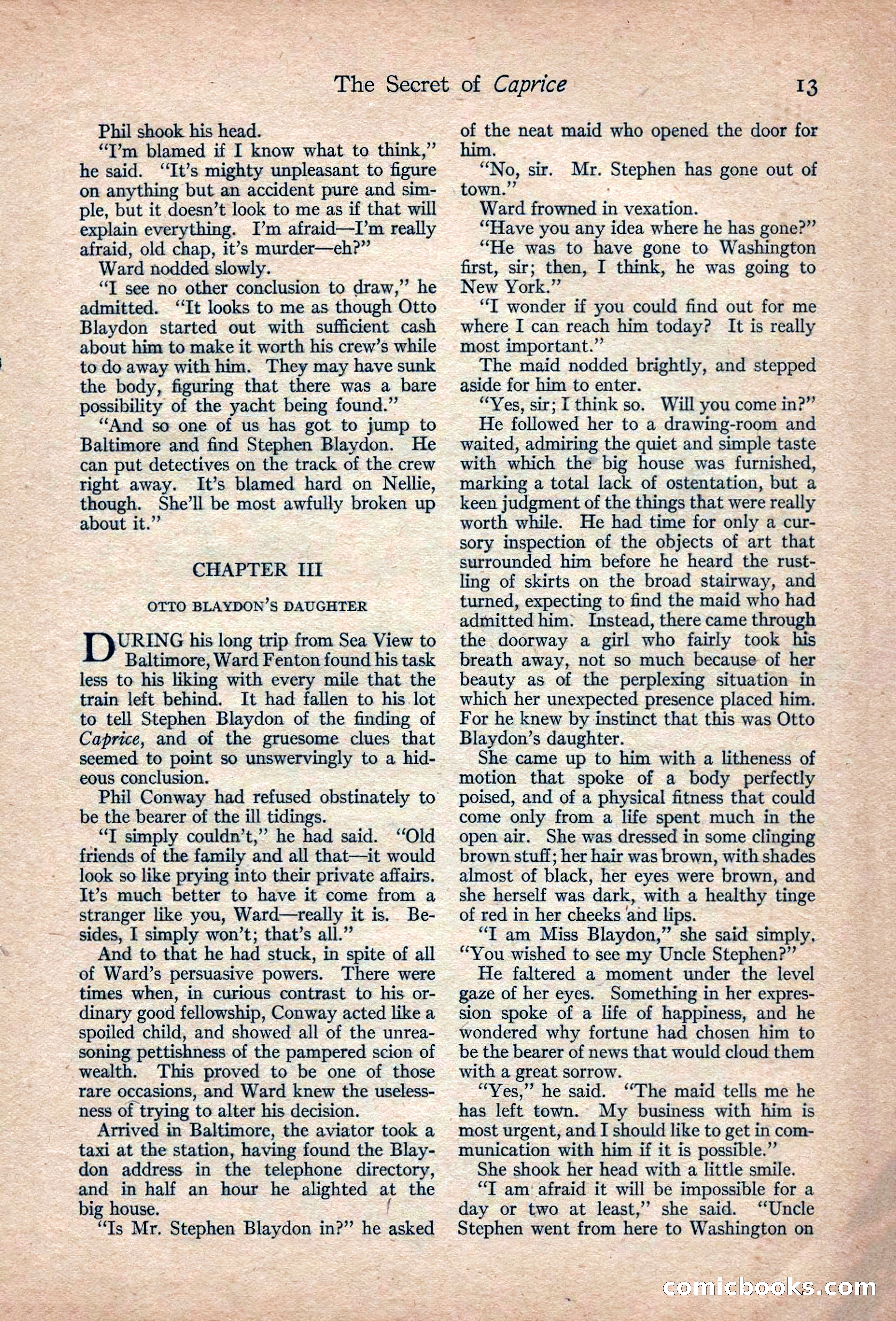
The Secret of Caprice Phil shook his head. “T’m blamed if I know what to think,” he said. “It’s mighty unpleasant to figure on anything but an accident pure and sim- ple, but it doesn’t look to me as if that will explain everything. I’m afraid—I’m really afraid, old chap, it’s murder—eh?” Ward nodded slowly. “T see no other conclusion to draw,” he admitted. ‘It looks to me as though Otto Blaydon started out with sufficient cash about him to make it worth his crew’s while to do away with him. They may have sunk the body, figuring that there was a bare possibility of the yacht being found.” “And so one of us has got to jump to Baltimore and find Stephen Blaydon. He can put detectives on the track of the crew right away. It’s blamed hard on Nellie, though. She’ll be most awfully broken up about it.” CHAPTER III OTTO BLAYDON’S DAUGHTER 7 peRING his long trip from Sea View to Baltimore, Ward Fenton found his task less to his liking with every mile that the train left behind. It had fallen to his lot to tell Stephen Blaydon of the finding of Caprice, and of the gruesome clues that seemed to point so unswervingly to a hid- eous conclusion. Phil Conway had refused obstinately to be the bearer of the ill tidings. “T simply couldn’t,” he had said. “Old friends of the family and all that—it would look so like prying into their private affairs. It’s much better to have it come from a stranger like you, Ward—treally it is. Be- sides, I simply won’t, that’s all.” And to that he had stuck, in spite of all of Ward’s persuasive powers. There were times when, in curious contrast to his or- dinary good fellowship, Conway acted like a spoiled child, and showed all of the unrea- soning pettishness of the pampered scion of ‘ wealth. This proved to be one of those rare occasions, and Ward knew the useless- ness of trying to alter his decision. Arrived in Baltimore, the aviator took a taxi at the station, having found the Blay- don address in the telephone directory, and in half an hour he alighted at the big house. “Ts Mr. Stephen Blaydon in?” he ee 13 of the neat maid who opened the door for him. “N 0, sir. Mr. Stephen has gone out of town.”’ Ward frowned in vexation. “Have you any idea where he has gone?” “He was to have gone to Washington first, sir; then, I think, he was going to New York.” “T wonder if you could find out for me where I can reach him today? It is really most important.” The maid nodded brightly, and steppes aside for him to enter. “Yes, sir; 1 think so. Will you come in?” He followed her to a drawing-room and waited, admiring the quiet and simple taste with which the big house was furnished, marking a total lack of ostentation, but a keen judgment of the things that were really worth while. He had time for only a cur- sory inspection of the objects of art that surrounded him before he heard the rust- ling of skirts on the broad stairway, and turned, expecting to find the maid who had admitted him: Instead, there came through the doorway a girl who fairly took his breath away, not so much because of her beauty as of the perplexing situation in which her unexpected presence placed him. For he knew by instinct that this was Otto Blaydon’s daughter. She came up to him with a litheness of motion that spoke of a body perfectly poised, and of a physical fitness that could come only from a life spent much in the open air. She was dressed in some clinging brown stuff; her hair was brown, with shades almost of black, her eyes were brown, and she herself was dark, with a healthy tinge of red in her cheeks and lips. “T am Miss Blaydon,” she said simply, “You wished to see my Uncle Stephen?” He faltered a moment under the level gaze of her eyes. Something in her expres- sion spoke of a life of happiness, and he wondered why fortune had chosen him to be the bearer of news that would cloud them with a great sorrow. “Yes,” he said. ‘*“The maid tells me he has left town. My business with him is most urgent, and I should like to get in com- munication with him if it is possible.” She shook her head with a little smile. “T am’ afraid it will be impossible for a day or two at least,’ she said. ‘Uncle Stephen went from here to Washington on <S Gomichboo