
Pulp Fiction, 1916 · page 173 of 228
Adventure Magazine, March 1916 — page 173: what you’re looking at
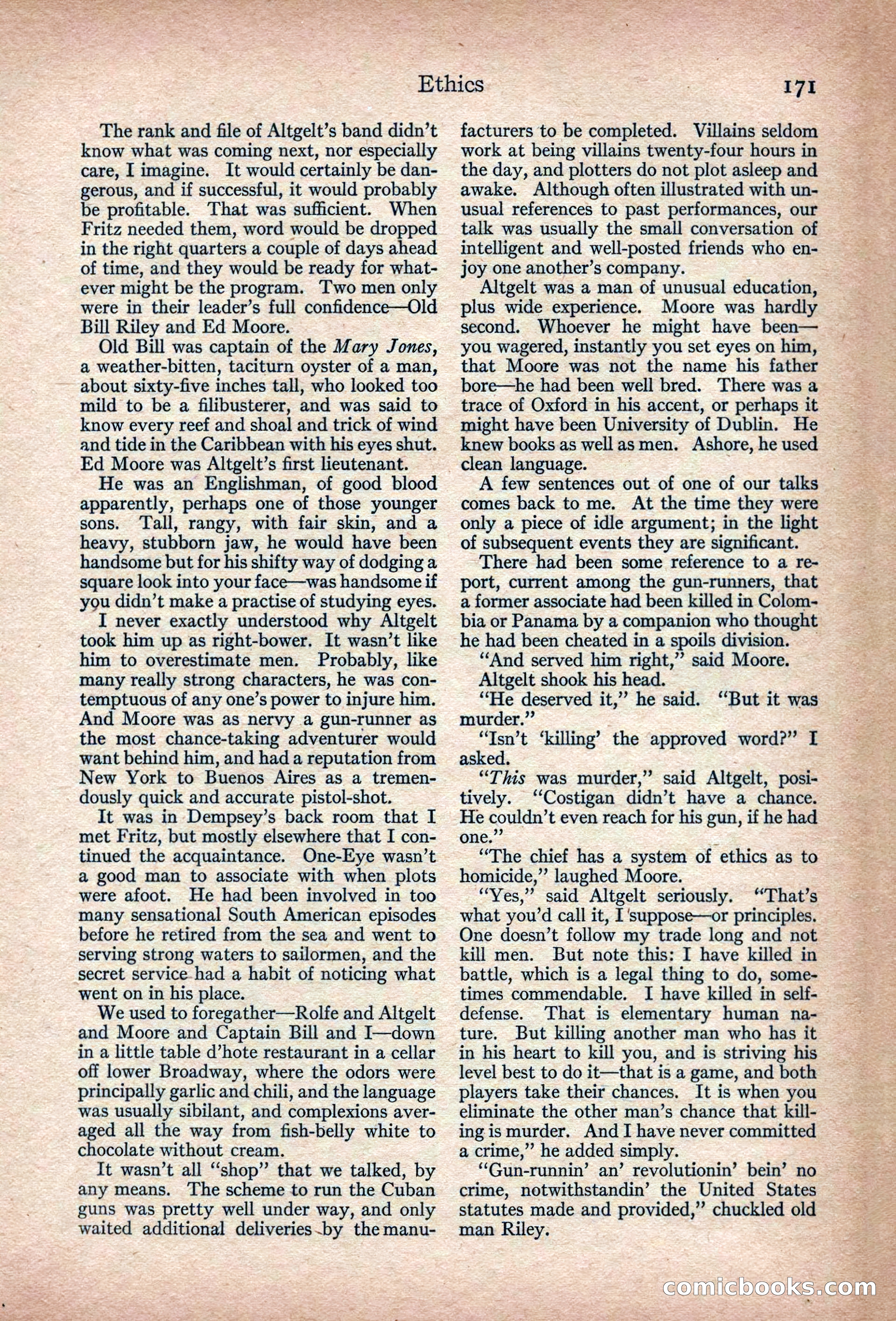
A restored page from Pulp Fiction, 1916. Page through the whole issue in the reader above.
📄 Transcribed text from this page (OCR, searchable)
Machine-transcribed from the original scan — historical spelling and the odd misread are preserved.
Ethics The rank and file of Altgelt’s band didn’t know what was coming next, nor especially care, I imagine. It would certainly be dan- gerous, and if successful, it would probably be profitable. That was sufficient. When Fritz needed them, word would be dropped in the right quarters a couple of days ahead of time, and they would be ready for what- ever might be the program. Two men only were in their leader’s full confidence—Old Bill Riley and Ed Moore. Old Bill was captain of the Mary Jones, a weather-bitten, taciturn oyster of a man, about sixty-five inches tall, who looked too mild to be a filibusterer, and was said to know every reef and shoal and trick of wind and tide in the Caribbean with his eyes shut. Ed Moore was Altgelt’s first lieutenant. He was an Englishman, of good blood apparently, perhaps one of those younger sons. ‘Tall, rangy, with fair skin, and a heavy, stubborn jaw, he would have been handsome but for his shifty way of dodging a square look into your face—was handsome if you didn’t make a practise of studying eyes. I never exactly understood why Altgelt took him up as right-bower. It wasn’t like him to overestimate men. Probably, like many really strong characters, he was con- temptuous of any one’s power to injure him. And Moore was as nervy a gun-runner as the most chance-taking adventurer would want behind him, and had a reputation from New York to Buenos Aires as a tremen- dously quick and accurate pistol-shot. It was in Dempsey’s back room that I met Fritz, but mostly elsewhere that I con- tinued the acquaintance. One-Eye wasn’t a good man to associate with when plots were afoot. He had been involved in too many sensational South American episodes before he retired from the sea and went to serving strong waters to sailormen, and the secret service-had a habit of noticing what went on in his place. We used to foregather—Rolfe and Altgelt and Moore and Captain Bill and I—down in a little table d’hote restaurant in a cellar off lower Broadway, where the odors were principally garlic and chili, and the language was usually sibilant, and complexions aver- aged all the way from fish-belly white to chocolate without cream. It wasn’t all “shop” that we talked, by any means. The scheme to run the Cuban guns was pretty well under way, and only waited additional deliveries~by the manu- 17! facturers to be completed. Villains seldom work at being villains twenty-four hours in the day, and plotters do not plot asleep and awake. Although often illustrated with un- usual references to past performances, our talk was usually the small conversation of intelligent and well-posted friends who en- joy one another’s company. Altgelt was a man of unusual education, plus wide experience. Moore was hardly second. Whoever he might have been— you wagered, instantly you set eyes on him, that Moore was not the name his father bore—he had been well bred. There was a trace of Oxford in his accent, or perhaps it might have been University of Dublin. He knew books as wellasmen. Ashore, he used clean language. A few sentences out of one of our talks comes back to me. At the time they were only a piece of idle argument; in the light of subsequent events they are significant. There had been some reference to a re- port, current among the gun-runners, that a former associate had been killed in Colom- bia or Panama by a companion who thought he had been cheated in a spoils division. “‘And served him right,” said Moore. Altgelt shook his head. “‘He deserved it,” he said. murder.” “Tsn’t ‘killing’ the approved word?” I asked, “This was murder,” said Altgelt, posi- tively. “Costigan didn’t have a chance. He couldn’t even reach for his gun, if he had one.”’ “The chief has a system of ethics as to homicide,”’ laughed Moore. “Yes,” said Altgelt seriously. “That’s what you’d call it, I 'suppose—or principles. One doesn’t follow my trade long and not kill men. But note this: I have killed in battle, which is a legal thing to do, some- times commendable. I have killed in self- defense. That is elementary human na- ture. But killing another man who has it in his heart to kill you, and is striving his level best to do it—that is a game, and both players take their chances. It is when you eliminate the other man’s chance that kill- ing is murder. And I have never committed a crime,” he added simply. “Gun-runnin’ an’ revolutionin’ bein’ no crime, notwithstandin’ the United States statutes made and provided,” chuckled old man Riley. “But it was . . 4 a Lat OX ap. = »* -Y we Palo! 6.42.0 (Eo) 000) S