
Pulp Fiction, 1916 · page 174 of 228
Adventure Magazine, March 1916 — page 174: what you’re looking at
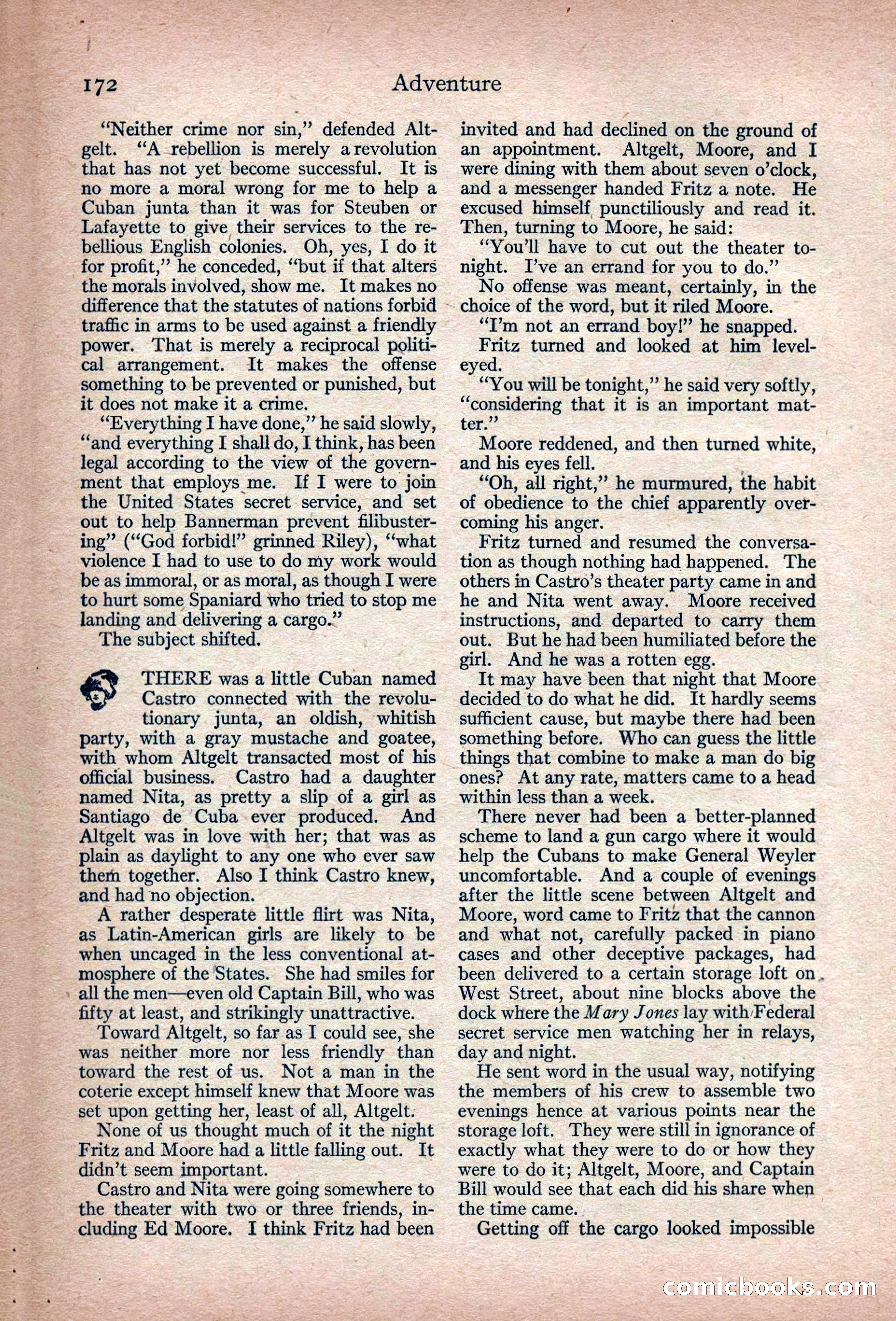
A restored page from Pulp Fiction, 1916. Page through the whole issue in the reader above.
📄 Transcribed text from this page (OCR, searchable)
Machine-transcribed from the original scan — historical spelling and the odd misread are preserved.
say — Bee - KS Aig > rs a Vie ras abs y eae veer ty 172 - ment that employs me. J “Neither crime nor sin,’ defended Alt- gelt. “A rebellion is merely a revolution that has not yet become successful. It is no more a moral wrong for me to help a Cuban junta than it was for Steuben or Lafayette to give their services to the re- bellious English colonies. Oh, yes, I do it for profit,” he conceded, “but if that alters the morals involved, show me. It makes no difference that the statutes of nations forbid — traffic in arms to be used against a friendly power. That is merely a reciprocal politi- cal arrangement. It makes the offense something to be prevented or punished, but it does not make it a crime. “Everything I have done,” he said slowly, “and everything I shall do, I think, has been legal according to the view of the govern- If I were to join the United States secret service, and set out to help Bannerman prevent filibuster- ing” (“God forbid!” grinned Riley), “what violence I had to use to do my work would be as immoral, or as moral, as though I were to hurt some Spaniard who tried to stop me landing and delivering a cargo.” The subject shifted. THERE was a little Cuban named Castro connected with the revolu- tionary junta, an oldish, whitish party, with a gray mustache and goatee, with whom Altgelt transacted most of his official business. Castro had a daughter named Nita, as pretty a slip of a girl as Santiago de ‘Cuba ever produced. And Altgelt was in love with her; that was as plain as daylight to any one who ever saw thern together. Also I think Castro knew, and had no objection. A rather desperate little flirt was Nita, as Latin-American girls are likely to be when uncaged in the less conventional at- mosphere of the States. She had smiles for all the men—even old Captain Bill, who was fifty at least, and strikingly unattractive. Toward Altgelt, so far as I could see, she was neither more nor less friendly than toward the rest of us. Not a man in the coterie except himself knew that Moore was set upon getting her, least of all, Altgelt. None of us thought much of it the night Fritz and Moore had a little falling out. It didn’t seem important. Castro and Nita were going somewhere to the theater with two or three friends, in- cluding Ed Moore. I think Fritz had been Adventure invited and had declined on the ground of an appointment. Altgelt, Moore, and I were dining with them about seven o’clock, and a messenger handed Fritz a note. He excused himself punctiliously and read it. Then, turning to Moore, he said: “You'll have to cut out the theater to- night. I’ve an errand for you to do.” No offense was meant, certainly, in the choice of the word, but it riled Moore. “I’m not an errand boy!” he snapped. Fritz turned and looked at him level- eyed. “You will be tonight,” he said very softly, considering that it is an important mat- ter.’ Moore reddened, and then turned white, and his eyes fell. “Oh, all right,” he murmured, the habit of obedience to the chief apparently over- coming his anger. Fritz turned and resumed the conversa- tion as though nothing had happened. The others in Castro’s theater party came in and he and Nita went away. Moore received instructions, and departed to carry them out. But he had been humiliated before the girl. And he was a rotten egg. It may have been that night that Moore decided to do what he did. It hardly seems sufficient cause, but maybe there had been something before. Who can guess the little things that combine to make a man do big ones? At any rate, matters came to a head within less than a week. There never had been a better-planned scheme to land a gun cargo where it would help the Cubans to make General Weyler uncomfortable. And a couple of evenings after the little scene between Altgelt and Moore, word came to Fritz that the cannon and what not, carefully packed in piano cases and other deceptive packages, had been delivered to a certain storage loft on. West Street, about nine blocks above the dock where the M ary Jones lay with Federal secret service men watching her in relays, day and night. He sent word in the usual way, notifying the members of his crew to assemble two evenings hence at various points near the storage loft. They were still in ignorance of exactly what they were to do or how they were to do it; Altgelt, Moore, and Captain Bill would see that each did his share when the time came. Getting off the cargo looked impossible Eomichooks (E) im