
Pulp Fiction, 1916 · page 175 of 228
Adventure Magazine, March 1916 — page 175: what you’re looking at
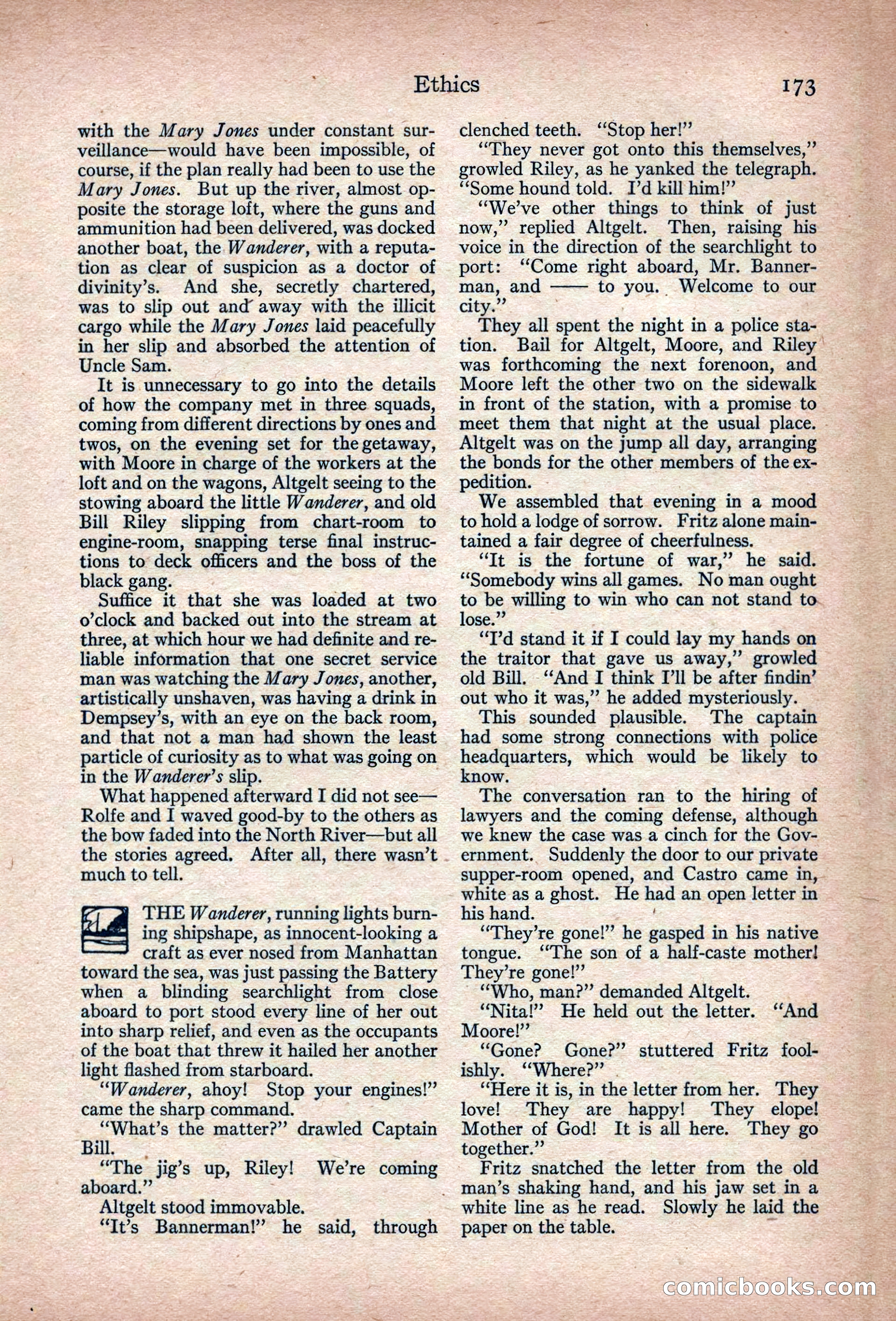
A restored page from Pulp Fiction, 1916. Page through the whole issue in the reader above.
📄 Transcribed text from this page (OCR, searchable)
Machine-transcribed from the original scan — historical spelling and the odd misread are preserved.
Ethics with the Mary Jones under constant sur- veillance—would have been impossible, of course, if the plan really had been to use the Mary Jones. But up the river, almost op- posite the storage loft, where the guns and ammunition had been delivered, was docked another boat, the Wanderer, with a reputa- tion as clear of suspicion as a doctor of divinity’s. And she, secretly chartered, was to slip out and away with the illicit cargo while the Mary Jones laid peacefully in her slip and absorbed the attention of Uncle Sam. It is unnecessary to go into the details of how the company met in three squads, coming from different directions by ones and twos, on the evening set for the getaway, with Moore in charge of the workers at the loft and on the wagons, Altgelt seeing to the stowing aboard the little Wanderer, and old Bill Riley slipping from chart-room to engine-room, snapping terse final instruc- tions to deck officers and the boss of the black gang. Suffice it that she was loaded at two o'clock and backed out into the stream at three, at which hour we had definite and re- liable information that one secret service man was watching the Mary Jones, another, artistically unshaven, was having a drink in Dempsey’s, with an eye on the back room, and that not a man had shown the least particle of curiosity as to what was going on in the Wanderer’s slip. What happened afterward I did not see— Rolfe and I waved good-by to the others as the bow faded into the North River—but all the stories agreed. After all, there wasn’t much to tell. THE Wanderer, running lights burn- ing shipshape, as innocent-looking a craft as ever nosed from Manhattan toward the sea, was just passing the Battery when a blinding searchlight from close aboard to port stood every line of her out into sharp relief, and even as the occupants of the boat that threw it hailed her another light flashed from starboard. “Wanderer, ahoy! Stop your engines!” came the sharp command. Bi the matter?” drawled Captain “The jig’s up, Riley! aboard.” Altgelt stood immovable. “It’s Bannerman!” he said, through a <7 We're coming 173 clenched teeth. ‘Stop her!’ “They never got onto this themselves,” growled Riley, as he yanked the telegraph. ‘Some hound told. I’d kill him!’ “We’ve other things to think of just now,” replied Altgelt. Then, raising his voice in the direction of the searchlight to port: “Come right aboard, Mr. Banner- man, and to you. Welcome to our city.” They all spent the night in a police sta- tion. was forthcoming the next forenoon, and Moore left the other two on the sidewalk in front of the station, with a promise to Bail for Altgelt, Moore, and Riley meet them that night at the usual place. . Altgelt was on the jump all day, arranging the bonds for the other members of the ex- pedition. - We assembled that evening in a mood to hold a lodge of sorrow. Fritz alone main- tained a fair degree of cheerfulness. “Tt is the fortune of war,” he said. *“‘Somebody wins all games. No man ought to be willing to win who can not stand to. lose.” “T’d stand it if I could lay my hands on the traitor that gave us away,” growled old Bill. ‘And I think T’ll be after findin’ out who it was,” he added mysteriously. This sounded plausible. The captain had some strong connections with police headquarters, which would be likely to know. The conversation ran to the hiring of lawyers and the coming defense, although we knew the case was a cinch for the Gov- ernment. Suddenly the door to our private supper-room opened, and Castro came in, white as a ghost. He had an open letter in his hand. “They’re gone!” he iad in his native tongue. ‘The son of a half-caste mother! They’re gone!” “Who, man?” demanded Altgelt. ‘“‘Nita!”? He held out the letter. ‘‘And Moore!”’ “Gone? Gone?” stuttered Fritz fool- ishly. “Where?” . “Here it is, in the letter from her. They love! They are happy! They elope! Mother of God! It is all here. They go together.”’ F ritz snatched the letter from the old . man’s shaking hand, and his jaw set in a white line as he read. Slowly he laid the paper on the table. (EO) 100k (o) ba YE i. pe aaa PK. 1 Alt wh OG Dit Al eat ve | } eri te uy