
Pulp Fiction, 1917 · page 103 of 228
Adventure, February 1917 — page 103: what you’re looking at
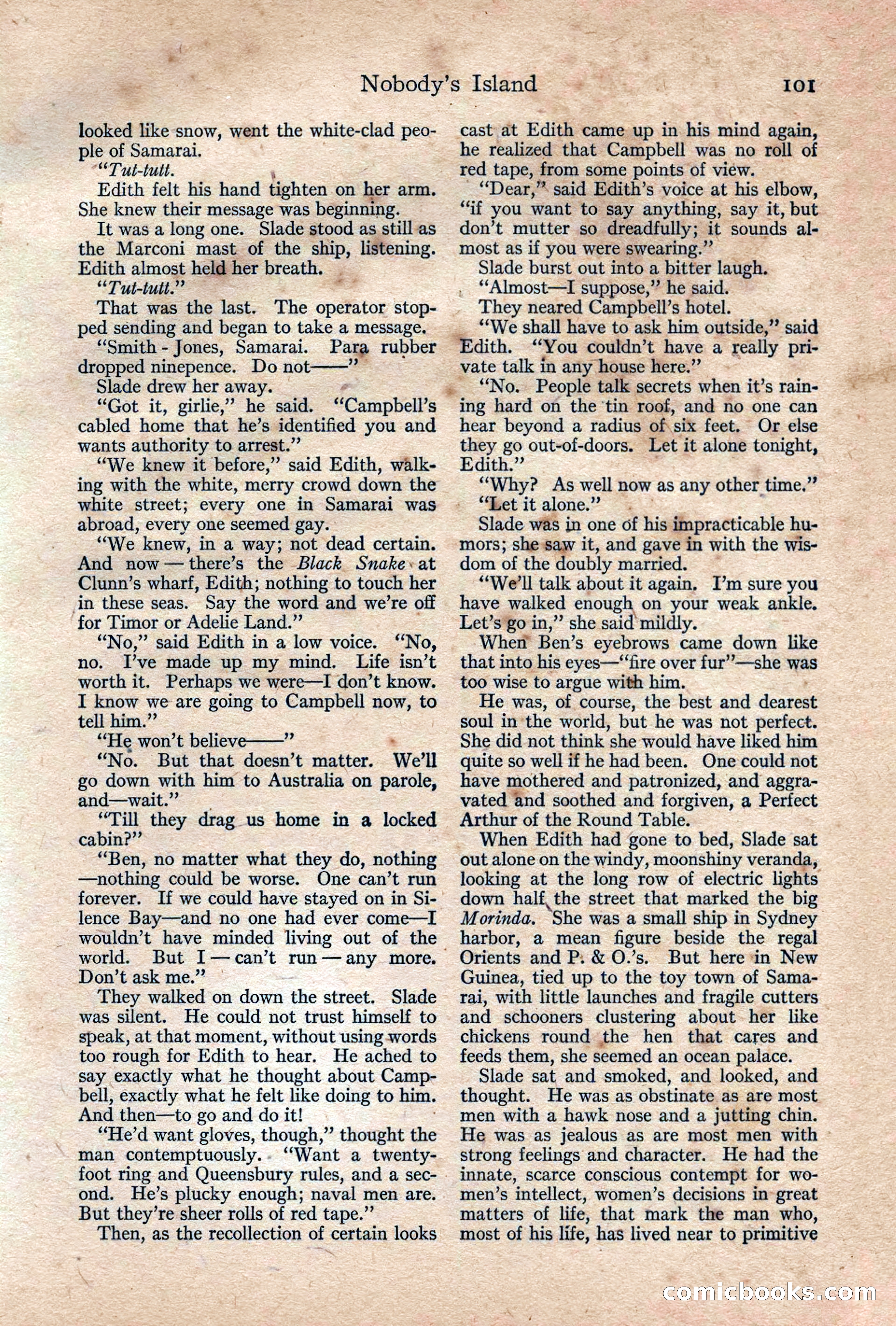
A restored page from Pulp Fiction, 1917. Page through the whole issue in the reader above.
📄 Transcribed text from this page (OCR, searchable)
Machine-transcribed from the original scan — historical spelling and the odd misread are preserved.
oo _ Nobody’ Island looked like snow, went the white-clad peo- ple of Samarai. “Tut-tutt. Edith felt his hand tighten on her arm. She knew their message was beginning. It was a long one. Slade stood as still as the Marconi mast of the ship, listening. Edith almost held her breath. “Tut-tutt.” : That was the last. The operator stop- ped sending and began to take a message. “Smith - Jones, Samarai. Para rubber dropped ninepence. Do not——" Slade drew her away. — “Got it, girlie,” he said. “Campbell's cabled home that he’s identified you and wants authority to arrest.” “We knew it before,” said Edith, walk- ing with the white, merry crowd down the white street; every one in Samarai was abroad, every one seemed gay. “We knew, in a way; not dead certain. And now—there’s the Black Snake. at Clunn’s wharf, Edith; nothing to touch her in these seas. Say the word and we’re off for Timor or Adelie Land.” “No,” said Edith in a low voice. “No, no. I’ve made up my mind. Life isn’t worth it. Perhaps we were—I don’t know. I know we are going to Campbell now, to tell him.” “He won’t believe——” . “No. But that doesn’t matter. We'll go down with him to Australia on parole, and—wait.” ‘Till they drag us home in a locked cabin?” “Ben, no matter what they do, nothing —nothing could be worse. One can’t run forever. If we could have stayed on in Si- lence Bay—and no one had ever come—I _ wouldn’t have minded living out of the world. But I—can’t run—any more. Don’t ask me.” © They walked on down the street. Slade was silent. He could not trust himself to speak, at that moment, without using words too rough for Edith to hear. He ached to say exactly what he thought about Camp- bell, exactly what he felt like doing to him. And then—to go and do it! ““He’d want gloves, though,” thought the man contemptuously.. “Want a twenty- foot ring and Queensbury rules, and a sec- . ond. He’s plucky enough; naval men are. But they’re sheer rolls of red tape.”’ Then, as the recollection of certain looks ‘Edith. vate talk in any house here.” cast at Edith came up in his mind again, he realized that. Campbell was no roll of red tape, from some points of view. “Dear,” said Edith’s voice at his elbow, ‘Sf you want to say anything, say it, but don’t mutter so dreadfully; it sounds al- most as if you were swearing.” Slade burst out into a bitter laugh. “‘Almost—I suppose,” he said. They neared Campbell’s hotel. “We shall have to ask him outside,” said “You couldn’t have a really pri- “No. People talk secrets when it’s rain- ing hard on the ‘tin roof, and no one can hear beyond a radius oft; six feet. Or else they go out-of-doors. Let it alone tonight, Edith.” “Why? As well now as any other time.” “Let it alone.” Slade was in one of his impracticable hu- mors; she saw it, and gave in with the wis- dom of the doubly married. “We'll talk about it again, I’m sure you have walked enough on your weak ankle. Let’s go in,” she said mildly. When’ Ben’s eyebrows came down like that into his eyes—“‘fire over fur’”’—she was too wise to argue with him. He was, of course, the best and deasnee soul in the world, but he was not perfect. She did not think ‘she would have liked him quite so well if he had been. One could not have mothered and patronized, and aggra- vated and soothed and forgiven, a Perfect Arthur of the Round Table. When Edith had gone to bed, Slade sat out alone on the windy, moonshiny veranda, looking at the long row of electric lights down half the street that marked the big Morinda. She was a small ship in Sydney harbor, a mean figure beside the regal Orients and P: & O.’s. But here in New Guinea, tied up to the toy town of Sama- Iol rai, with little launches and fragile cutters and schooners clustering about her like chickens round the hen that cares and feeds them, she seemed an ocean palace. Slade sat and smoked, and looked, and thought. He was as obstinate as are most men with a hawk nose and a jutting chin. He was as jealous as are most men with » strong feelings and character. He had the innate, scarce conscious contempt for wo- men’s intellect, women’s decisions in great matters of life, that mark the man who, most of his life, has lived near to primitive Ss 100 (CONAMIICE (Eo)