
Pulp Fiction, 1917 · page 104 of 228
Adventure, February 1917 — page 104: what you’re looking at
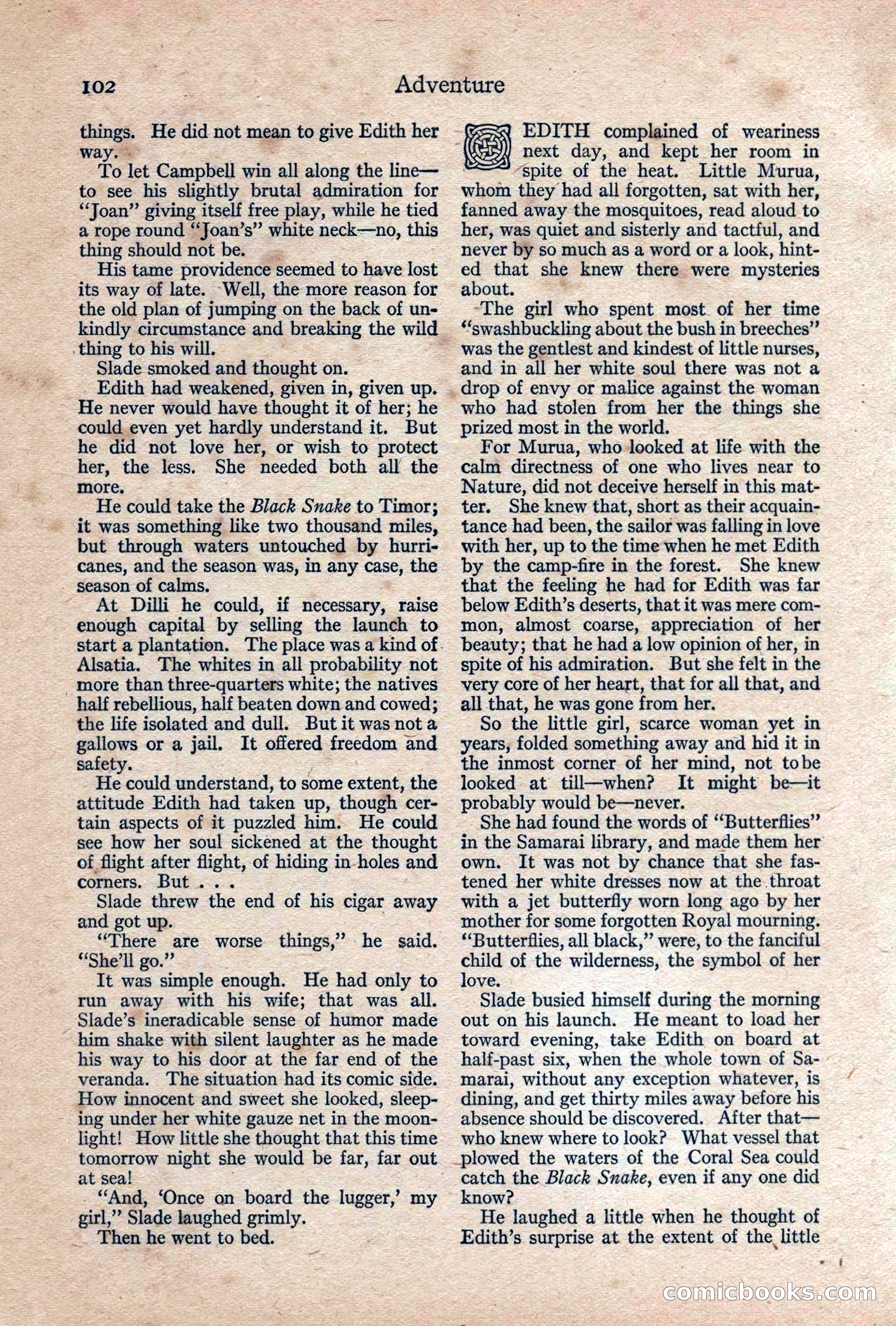
A restored page from Pulp Fiction, 1917. Page through the whole issue in the reader above.
📄 Transcribed text from this page (OCR, searchable)
Machine-transcribed from the original scan — historical spelling and the odd misread are preserved.
102 things. He did not mean to give Edith her — way. - To let Campbell win all along the line— to see his slightly brutal admiration for “Joan” giving itself free play, while he tied a rope round “Joan’s” white neck—no, this thing should not be. His tame providence seemed to have lost its way of late. Well, the more reason for the old plan of jumping on the back of un- kindly circumstance and breaking the wild -thing to his will. | Slade smoked and thought on. -_. Edith had weakened, given in, given up. ~ He never would have thought it of her; he could even yet hardly understand it. But he did not love her, or wish to protect her, the less. She needed both all the more. 7 He could take the Black Snake to Timor; it was something like two thousand miles, but through waters untouched by hurri- canes, and the season was, in any = the - season of calms. At Dilli he could, if necessary, raise enough capital by selling the launch to start a plantation. The place was a kind of. Alsatia. The whites in all probability not - more than three-quarters white; the natives half rebellious, half beaten down and cowed; the life isolated and dull. But it was not a gallows or a jail. It offered freedom and safety. He could understand, to some extent, the attitude Edith had taken up, though cer- tain aspects of it puzzled him. He could see how her soul sickened at the thought of flight after flight, of hiding in holes and corners. But... Slade threw the end of his cigar away and got up. “There are worse things,” he said. “She'll go.” It was simple enough. He had only to run away with his wife; that was all. ~Slade’s ineradicable sense of humor made ~ him shake with silent laughter as he made his way to his door at the far end of the veranda. The situation had its comic side. How innocent and sweet she looked, sleep- - ing under her white gauze net in the moon- light! How little she thought that this time tomorrow night she would be far, far out at sea! - “And, ‘Once on board the lugger,’ my ba = Slade laughed grimly. _ Then he went to bed. Adventure Fann EDITH complained of weariness @ next day, and kept her room in ‘Spite of the heat. Little Murua, whom they had all forgotten, sat with her, fanned away the mosquitoes, read aloud to her, was quiet and sisterly and tactful, and never by so much as a word or a look, hint- ed that she knew there were mysteries about. ~The girl who spent most of her time ‘‘swashbuckling about the bush in breeches” was the gentlest and kindest of little nurses, and in all her white soul there was not a _ drop of envy or malice against the woman who had stolen from her the things she prized most in the world. For Murua, who looked at life with the calm directness of one who lives near to Nature, did not deceive herself in this mat- ter. She knew that, short as their acquain- tance had been, the sailor was falling in love with her, up to the time when he met Edith by the camp-fire in the forest. She knew that the feeling he had for Edith was far below Edith’s deserts, that it was mere com- mon, almost coarse, appreciation of her beauty; that he had a low opinion of her, in spite of his admiration. But she felt in the very core of her heart, that for all that, and all that, he was gone from her. So the little girl, scarce woman yet in years, folded something away and hid it in the inmost corner of her mind, not tobe looked at till—when? It might be—it probably would be—never. She had found the words of “‘Butterflies”’ in the Samarai library, and made them her own. It was not by chance that she fas- tened her white dresses now at the throat with a jet butterfly worn long ago by her mother for some forgotten Royal mourning. “Butterflies, all black,” were, to the fanciful child of the wilderness, the symbol of her love. Slade busied himself during the morning out on his launch. He meant to load her toward evening, take Edith on board at half-past six, when the whole town of Sa- marai, without any exception whatever, is dining, and get thirty miles away before his absence should be discovered. After that— who knew where to look? What vessel that _plowed the waters of the Coral Sea could catch the Black Snake, even if any one did know? He laughed a little when he thought of Edith’s surprise at the extent of the little MMIC NOOKS (C (C©) (EC)