
Pulp Fiction, 1917 · page 15 of 228
Adventure, February 1917 — page 15: what you’re looking at
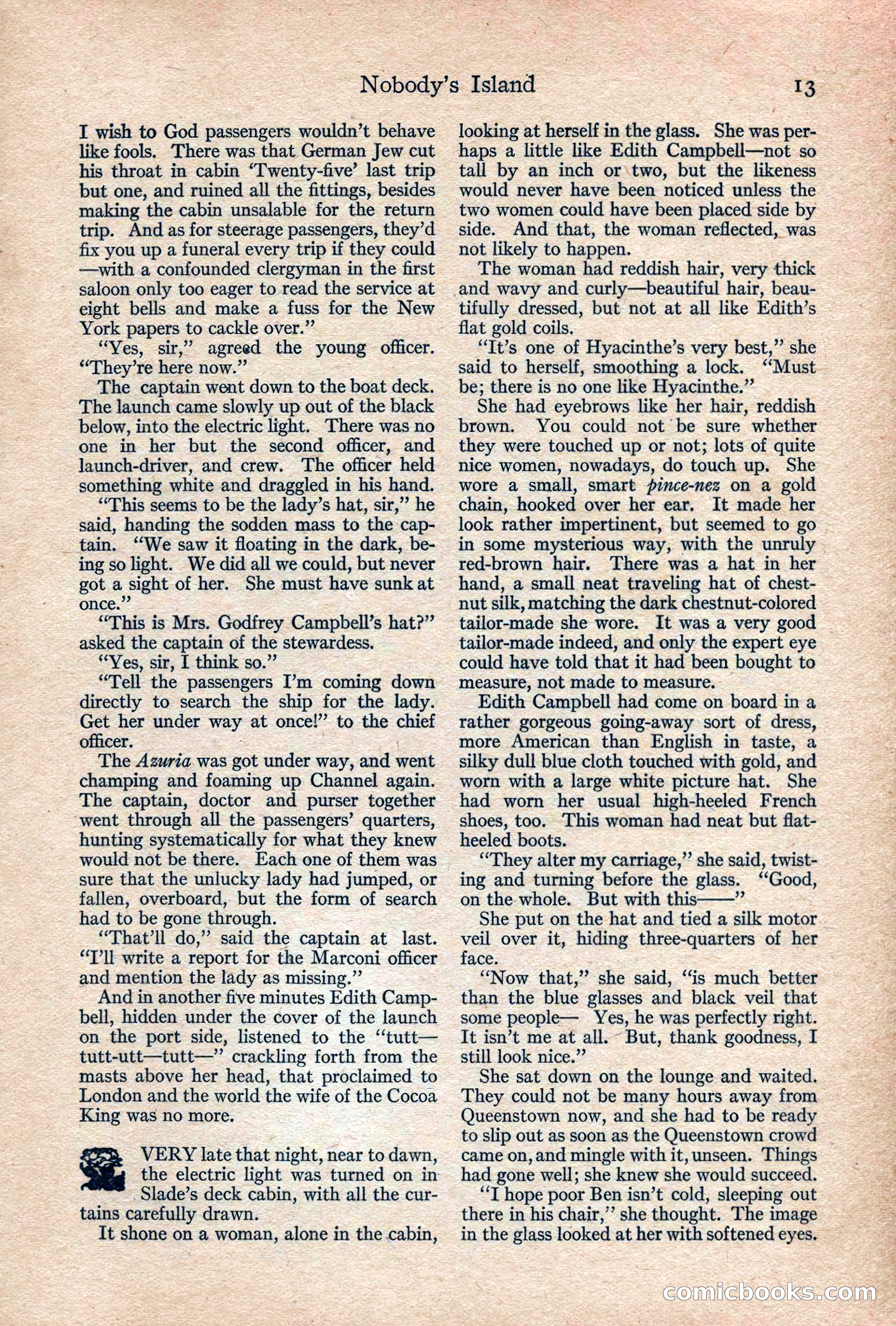
A restored page from Pulp Fiction, 1917. Page through the whole issue in the reader above.
📄 Transcribed text from this page (OCR, searchable)
Machine-transcribed from the original scan — historical spelling and the odd misread are preserved.
Nobody’s Island I wish to God passengers wouldn’t behave like fools. There was that German Jew cut his throat in cabin “Twenty-five’ last trip but one, and ruined all the fittings, besides making the cabin unsalable for the return trip. And as for steerage passengers, they’d fix you up a funeral every trip if they could —with a confounded clergyman in the first ~ saloon only too eager to read the service at eight bells and make a fuss for the New York papers to cackle over.” “Ves, sir,” agreed the young officer. “‘They’re here now.” The captain went down to the boat deck. The launch came slowly up out of the black below, into the electric light. There was no one in her but the second officer, and Jaunch-driver, and crew. The officer held something white and draggled in his hand. “‘This seems to be the lady’s hat, sir,”’ he said, handing the sodden mass to the cap- _ tain. “We saw it floating in the dark, be- ing so light. We did all we could, but never got a sight of her. She must have sunk at once.” “This is Mrs. Godfrey Campbell’s hat?” asked the captain of the stewardess. “Ves, sir, I think so.” “Tell the passengers I’m coming down directly to search the ship for the lady. Get her under way at once!” to the chief officer. , : The Azuria. was got under way, and went champing and foaming up Channel again. The captain, doctor and purser together ‘went through all the passengers’ quarters, hunting systematically for what they knew would not be there. Each one of them was sure that the unlucky lady had jumped, or fallen, overboard, but the form of search had to be gone through. “That'll do,” said the captain at last. “T’ll write a report for the Marconi officer and mention the lady as missing.” And in another five minutes Edith Camp- bell, hidden under the cover of the launch on the port side, listened to the ‘‘tutt— tutt-utt—tutt—”’ crackling forth from the masts above her head, that proclaimed to London and the world the wife of the Cocoa King was no more. St Slade’s deck cabin, with all the cur- tains carefully drawn. It shone on a woman, alone in the cabin, VERY late that night, near to dawn, the electric light was turned on in 13 looking at herself in the glass. She was per- haps a little like Edith Campbell—not so tall by an inch or two, but the likeness would never have been noticed unless the two women could have been placed side by side. And that, the woman reflected, was not likely to happen. The woman had reddish hair, very thick and wavy and curly—beautiful hair, beau- tifully dressed, but not at all like Edith’s flat gold coils. “Tt’s one of Hyacinthe’s very best,” she said to herself, smoothing a lock. “Must be; there is no one like Hyacinthe.”’ She had eyebrows like her hair, reddish brown. You could not be sure whether they were touched up or not; lots of quite nice women, nowadays, do touch up. She wore a small, smart pince-nez on a gold chain, hooked over her ear. It made her look rather impertinent, but seemed to go in some mysterious way, with the unruly - red-brown hair. There was a hat in her hand, a small neat traveling hat of chest- nut silk, matching the dark chestnut-colored tailor-made she wore. It was a very good tailor-made indeed, and only the expert eye could have told that it had been bought to measure, not made to measure. Edith Campbell had come on board in a rather gorgeous going-away sort of dress, more American than English in taste, a silky dull blue cloth touched with gold, and worn with a large white picture hat. She had worn her usual high-heeled French shoes, too. This woman had neat but flat- heeled boots. “They alter my carriage,’’ she said, twist- ing and turning before the glass. ‘Good, on the whole. But with this——’”’ She put on the hat and tied a silk motor. veil over it, hiding three-quarters of her face. “Now that,” she said, “is much better than the blue glasses and black veil that some people— Yes, he was perfectly right. It isn’t me at all. But, thank goodness, I still look nice.” She sat down on the lounge and waited. They could not be many hours away from Queenstown now, and she had to be ready to slip out as soon as the Queenstown crowd — came on, and mingle with it, unseen. Things had gone well; she knew she would succeed. “‘T hope poor Ben isn’t cold, sleeping out there in his chair,’”’ she thought. The image in the glass looked at her with softened eyes. (©) 0)(0 6) ANIC S (C@)